Limitations of inverse clearance for exposure
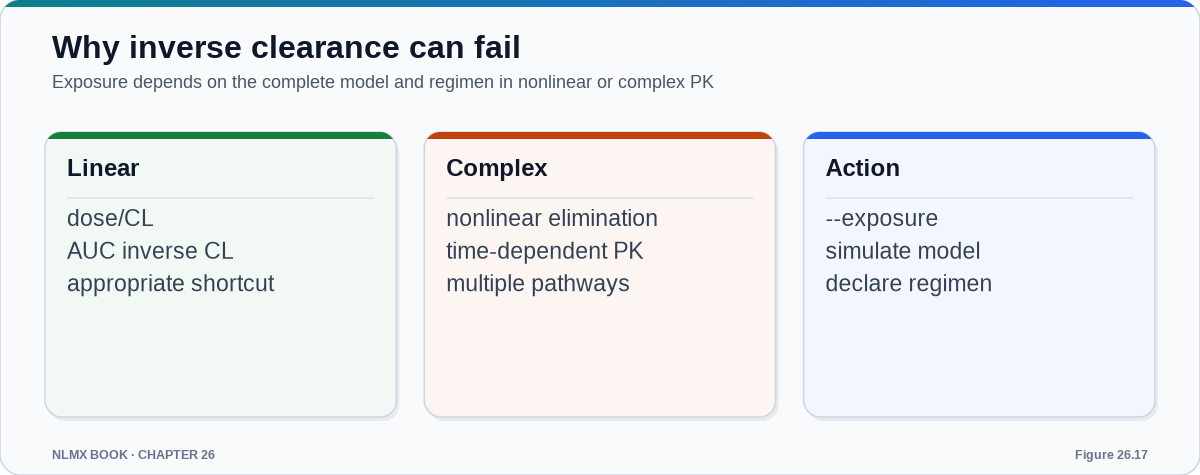
The identity AUC = dose/CL assumes linear systemic clearance under a defined bioavailability and dosing framework. Nonlinear elimination, saturable absorption, time-varying clearance, active metabolites, target-mediated disposition, or multiple routes can make a single inverse parameter inadequate.
Cmax and Ctrough depend on distribution, absorption, dosing interval, infusion, and accumulation even in linear models. An inverse-CL row cannot answer them. The fitted model may also name an apparent clearance whose exposure relationship is context dependent.
When in doubt, simulate steady state with --exposure, perform regimen sensitivity, and compare simulated AUC with inverse CL as a validation check. State the assumptions whenever an inverse section is labeled as exposure.
Common mistakes
- Treating a forest ratio or reference-band class as covariate-selection evidence, causality, or an automatic dosing recommendation.
- Omitting the reference subject, uncertainty source, regimen, subgroup denominator, data support, or fitted-model diagnostics.
- Confusing parameter-uncertainty intervals, BSV ranges, and subject-bootstrap intervals because they share one graphic.
Page checklist
- The numerator, denominator, fitted model, covariate settings, and units are explicit.
- The interval source and clinical meaning are distinguished from BSV and selection uncertainty.
- Tables, resolved settings, commands, diagnostics, limitations, and confirmation evidence are retained.