Worked preflight: inspect, validate, and posterior stage
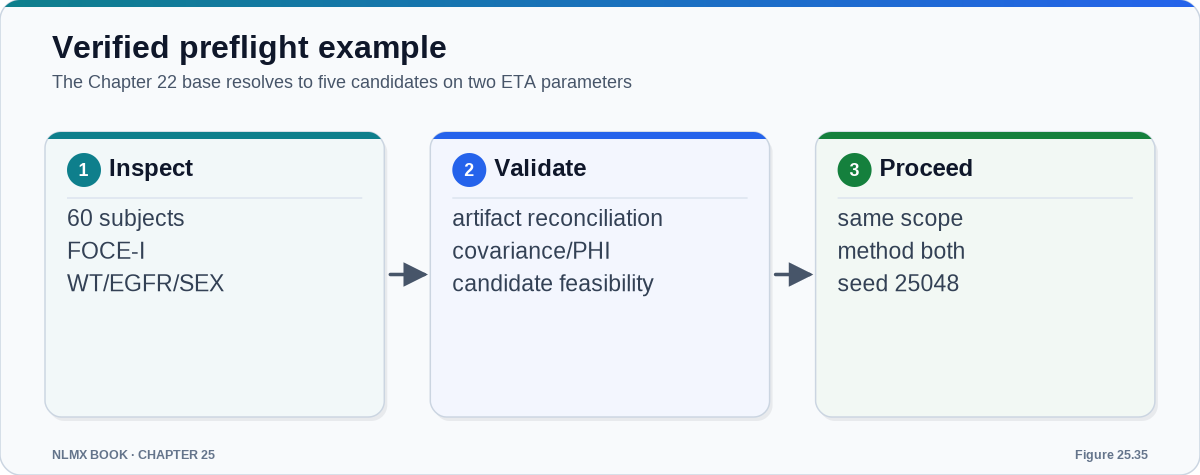
The preserved 4.14.3 example uses the Chapter 22 60-subject, 480-observation FOCE-I base and scope CL=WT,EGFR,SEX;V=WT,SEX. Inspection resolves WT and EGFR as continuous power relationships, SEX as binary proportional, CL to ETA1, V to ETA2, and five candidate relationships.
Validation reconciles the control stream, .ext, .cov, .cor, data, and .phi, confirms the base model and covariance/PHI structure, and checks both-engine prerequisites. The standalone posterior command then reads 60 PHI means with ETC covariance, evaluates posterior moment identity and shrinkage, writes posterior-stage diagnostics, and stops before stability selection.
Commands and captured console outputs are stored under documents/ch25. This sequence demonstrates the operational boundary: understand inputs first, challenge numerical readiness second, diagnose posterior construction third, then execute selection.
Common mistakes
- Changing the scientific question after seeing the result while presenting it as the original run.
- Reading one engine's summary without checking its prerequisites, failures, normalized settings, and fitted endpoint.
- Treating a generated draft, comparison label, or completed checkpoint as a substitute for model diagnostics and reference-software confirmation.
Page checklist
- The exact command, version, inputs, resolved settings, and output directory are identifiable.
- Engine-specific evidence is interpreted on its own scale before cross-method comparison.
- Recovery state, final refit, diagnostics, and remaining confirmation work are explicit.