23.29 Parametric bootstrap and Westfall–Young adjustment
Parametric-bootstrap calibration simulates datasets from the base model and rescores every candidate. It can represent outcome and random-effect behavior under the fitted null, including features that simple covariate permutation may not reproduce. It is slower and its validity depends on the base model being an adequate generator.
Westfall–Young uses the joint permutation distribution—commonly the minimum p-value or maximum statistic across candidates—to control family-wise error while preserving dependence. Request it with --adjust westfall-young; when calibration is otherwise none, the engine uses score permutations. The number of --calibration-replicates controls both resolution and Monte Carlo stability.
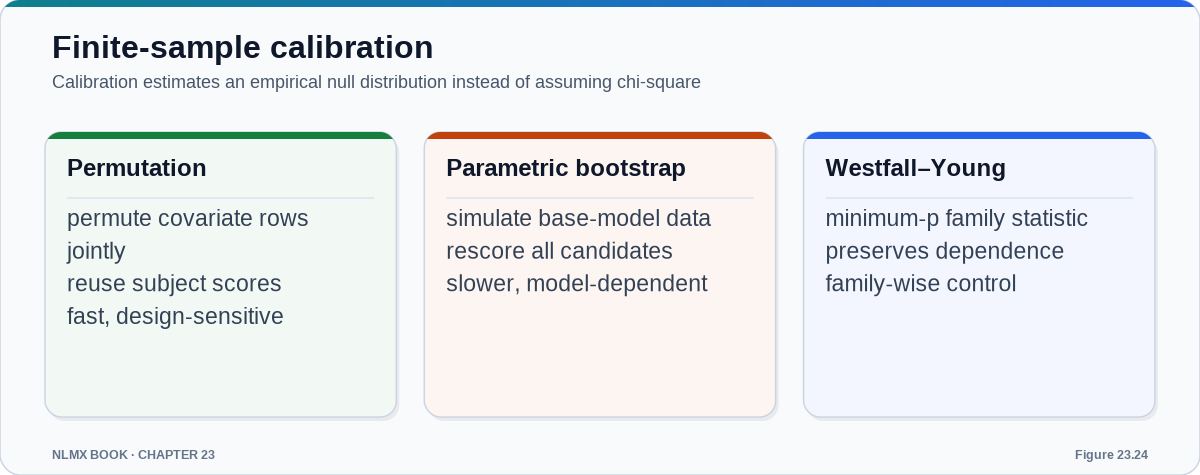
Choose permutation when exchangeability is credible and cached scores represent the intended null. Choose parametric bootstrap when design/outcome structure requires model-based simulation and the base generator is trusted. Use Westfall–Young when family-wise inference under correlated candidates is the target. None of these methods repairs poor candidate coding or a misspecified base.
Monitor failed simulated datasets or scores. A high failure fraction changes the effective null sample and can bias empirical p-values. Repeat tail results with more replicates and a second seed when decisions are material.
Planning replicate count
Replicate count should follow the smallest decision-relevant p-value and desired Monte Carlo precision. If the decision boundary is 0.05, a few hundred replicates may be adequate for coarse screening, but stable family-wise tail evidence often requires thousands. Near a boundary, calculate a binomial Monte Carlo interval for the empirical exceedance proportion. Continue with additional independently seeded replicates when that interval crosses the decision threshold, provided the extension rule was planned. Save replicate counts, failures, and seeds so a continuation cannot be confused with a selective rerun.
Common mistakes
- Calling parametric bootstrap model-free.
- Using Westfall–Young without defining the candidate family.
- Ignoring failed replicates.
- Comparing empirical p-values computed with very different replicate counts.
- Assuming calibration estimates effect-size uncertainty.
Checklist
- Match calibration method to exchangeability and model assumptions.
- Define family and statistic.
- Select adequate replicate count and seeds.
- Report failures and p-value resolution.
- Repeat material borderline empirical results.
Further reading
See multiplicity, permutation, and the command index.