Exposure bins and reference denominators
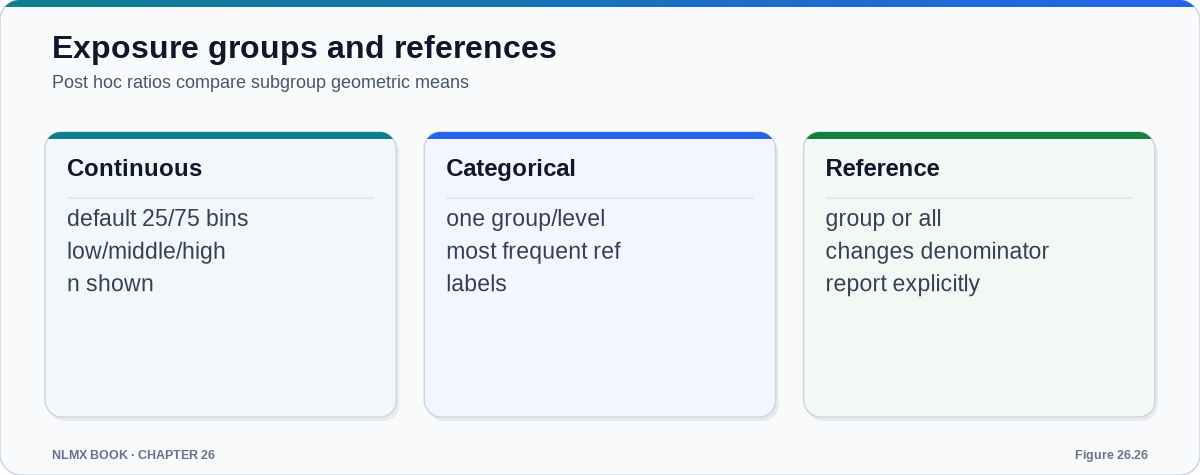
For post hoc continuous covariates, --exposure-bins 25,75 creates low, middle, and high groups. Displayed rows normally compare the low and high subgroup geometric means against the middle/reference group containing the median. Categorical levels compare against the most frequent reference level.
--exposure-reference all uses the geometric mean across all subjects as denominator instead. This changes every ratio and its interpretation; it is not a display-only choice. Group sizes and ranges must be reported because small bins yield unstable bootstrap intervals.
Predefine cut points where possible. Quantile bins balance counts but may not map to clinical categories; clinical cut points can create sparse groups. Review both support and meaning rather than choosing the visually clearest contrast.
Common mistakes
- Treating a forest ratio or reference-band class as covariate-selection evidence, causality, or an automatic dosing recommendation.
- Omitting the reference subject, uncertainty source, regimen, subgroup denominator, data support, or fitted-model diagnostics.
- Confusing parameter-uncertainty intervals, BSV ranges, and subject-bootstrap intervals because they share one graphic.
Page checklist
- The numerator, denominator, fitted model, covariate settings, and units are explicit.
- The interval source and clinical meaning are distinguished from BSV and selection uncertainty.
- Tables, resolved settings, commands, diagnostics, limitations, and confirmation evidence are retained.