27.11 Numerical predictive check
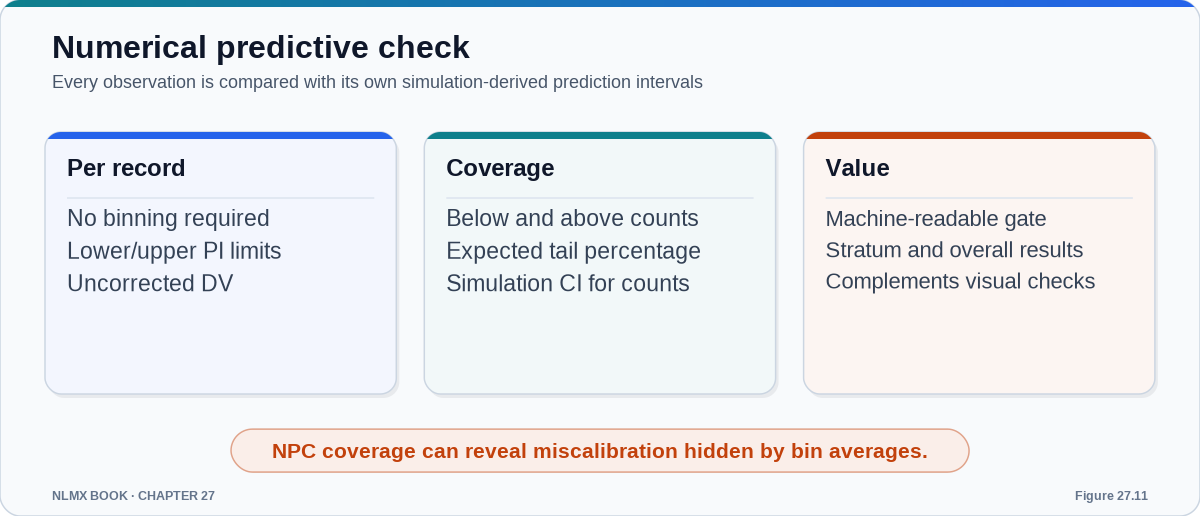
NPC compares each observed record with prediction intervals formed from that record’s simulated values, so it does not require bins. For each requested PI it counts observations below and above the limits and compares those percentages with the expected tail probability using replicate-derived confidence intervals.
Novice translation
This topic changes three practical decisions in a predictive-check review. First, for a 90% PI, each expected tail contains 5%; PI 0 compares observations with their simulated median. Second, nPC is computed with every VPC and for each stratum plus all observations; --vpc-type npc produces only NPC artifacts. Third, it uses uncorrected DV and excludes censored observations, making its scope different from pcVPC bands. Keep those decisions separate: one defines what is simulated or summarised, another controls how evidence is displayed, and the last controls what conclusion the evidence can support. A reviewer should be able to reproduce each decision from the resolved settings and numerical tables, not infer it from the appearance of the figure.
What to understand
- For a 90% PI, each expected tail contains 5%; PI 0 compares observations with their simulated median.
- NPC is computed with every VPC and for each stratum plus all observations;
--vpc-type npcproduces only NPC artifacts. - It uses uncorrected DV and excludes censored observations, making its scope different from pcVPC bands.
Practical interpretation
Use NPC for automated coverage monitoring and to corroborate directional tail findings, but inspect where failures occur through VPC bins, strata, and other diagnostics.
Evidence to retain
For numerical predictive check, retain the issued command, vpc_settings.vpc, the source model/data/result identifiers, seed and replicate count, the relevant CSV/JSON fields, warnings and notes, and the exact figure used for interpretation. Record any sensitivity run that changed the conclusion. If an option was selected after seeing the data, label that analysis exploratory. This evidence separates a reproducible diagnostic decision from a visual impression and lets another pharmacometrician check counts, transformations, exclusions, and uncertainty assumptions.
Common mistakes
- Calling NPC bin-specific
- Adding lower and upper tails together without direction
- Ignoring excluded BLQ records
Page checklist
- Prespecify PI levels
- Read both tails
- Review stratum and overall
- Link flags to visual location
Further reading
See previous page, next page, complete VPC command and settings index.