24.25 Boosting and conditional permutation importance
Boosting fits shallow gradient-boosted trees, default 150 trees, depth 2, learning rate 0.1, and minimum leaf 10. Selection uses held-out conditional permutation importance with a minimum importance share of 0.02.
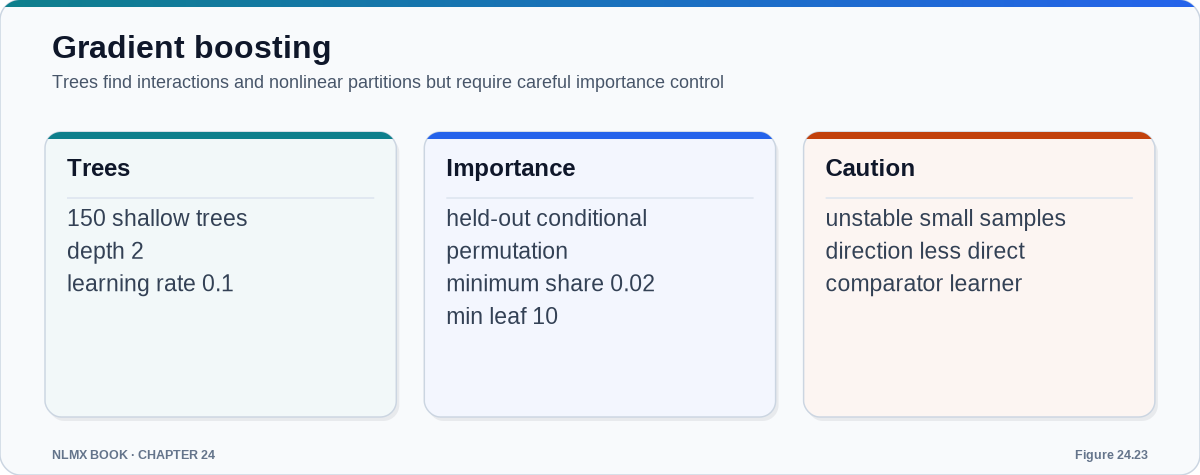
Trees can detect thresholds, interactions, and nonlinear partitions, but small resamples can make importance unstable. Conditional permutation attempts to respect correlated features, yet proxy clusters can still share or exchange importance. Direction and coefficient scale are less direct than in linear learners.
Use boosting to flag nonlinearity or interaction deserving explicit model development, not as automatic control-stream code.
Common mistakes
- Reading importance as an effect coefficient.
- Using deep trees on small half-samples.
- Ignoring min-leaf violations and failures.
- Claiming causal interaction from tree splits.
- Treating zero importance as proof of no smooth effect.
Checklist
- Record trees, depth, rate, leaf, and importance threshold.
- Review held-out performance and failures.
- Inspect proxy sensitivity.
- Translate discovered structure into explicit hypotheses.
- Confirm with a fitted pharmacometric model.
Further reading
Continue to multivariate learning and validation.