20.34 Validation, performance qualification, and known limits
A fit is ready for pharmacometric use only after several independent questions are answered. Did the correct records enter? Did the implementation evaluate the intended model? Did optimization and covariance behave acceptably? Do predictions and residuals support the model? Can another analyst reproduce the result? Each question needs evidence.
Build a qualification suite with three levels. Unit cases cover analytic PK solutions, event transitions, transformations and likelihood contributions. Reference cases compare nlmx against trusted software for representative ADVAN, $DES, $PRED, diagonal/block OMEGA, residual models and estimation methods. Workflow cases exercise CLI precedence, output schemas, plots, checksums, restarts, failure statuses and audit artifacts. Include negative tests: malformed data, impossible compartments, non-positive-definite matrices and deliberate nonconvergence.
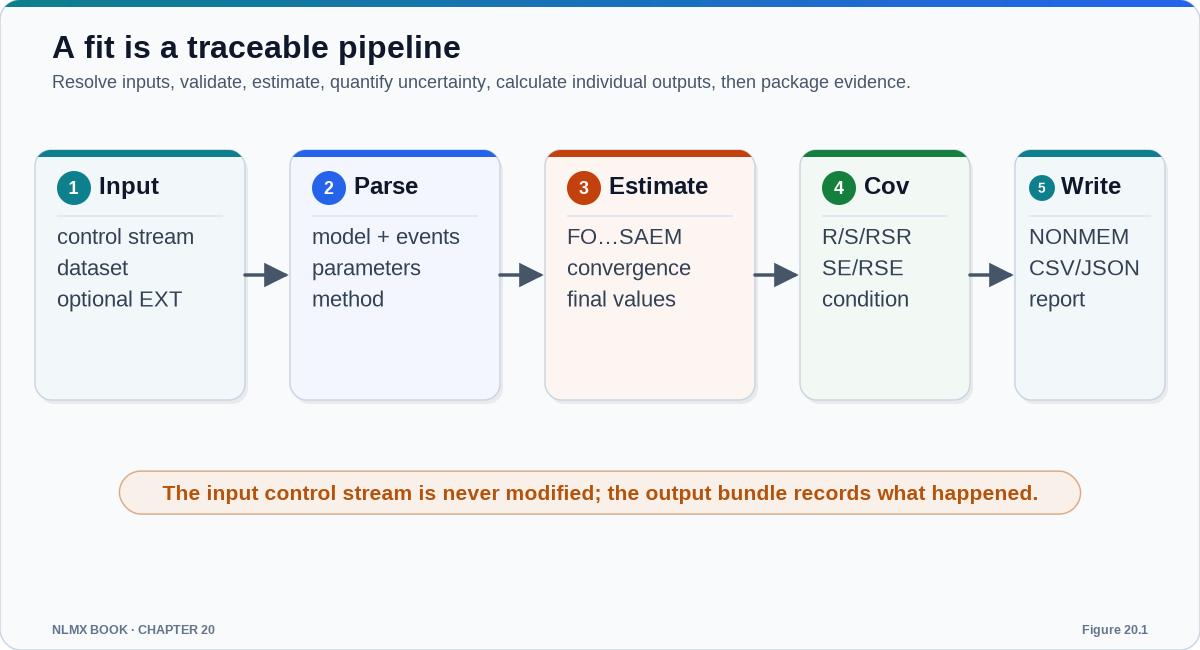
For performance, define the workload and acceptance criterion before timing. Record hardware, operating system, nlmx build/version, thread settings, model, data dimensions, method, iterations/evaluations, covariance and plotting choices. Run warm-ups and repetitions; report median and dispersion, not the best observation. Separate total elapsed time from computation stages. If two programs take different optimizer paths or terminate at different tolerances, raw elapsed time is not an apples-to-apples comparison.
Known limitations are not automatically defects, but they must be visible. Review the current version’s supported ADVAN/TRANS combinations, event semantics, $DES/$PRED language coverage, likelihood forms, SAEM behavior, covariance choices, output compatibility and platform-specific behavior before committing a production analysis. Unsupported syntax should fail clearly; never assume an unrecognized record was harmlessly ignored. Pin the nlmx version and rerun qualification cases after upgrades.
Establish change control: preserve baseline outputs, machine-readable tolerances and reviewer-approved expected differences. A checksum change signals byte-level change, not scientific failure; a scientifically meaningful difference can also occur without an obvious visual change. Review both.
Release-readiness evidence
The minimum package includes source control/data identity, resolved command and configuration, logs, checksums, termination and covariance status, parameters, predictions, diagnostics, cross-software comparison, performance protocol, deviations and reviewer conclusions. Preserve enough information to rerun without relying on memory or a mutable working directory.
Common mistakes
- Equating successful execution with validation.
- Benchmarking unequal methods or output workloads.
- Treating checksums as proof of scientific correctness.
- Omitting negative and boundary cases.
- Upgrading software without regression qualification.
Checklist
- Qualify calculations, reference agreement and workflow behavior.
- State tolerances and known limits explicitly.
- Benchmark equivalent, repeated workloads.
- Pin versions and preserve complete evidence.
- Requalify after material code, compiler or platform changes.
Further reading
Return to the Chapter 20 overview, use the complete option index, and continue with Chapter 21 diagnostics and goodness of fit.