Investigating engine disagreement
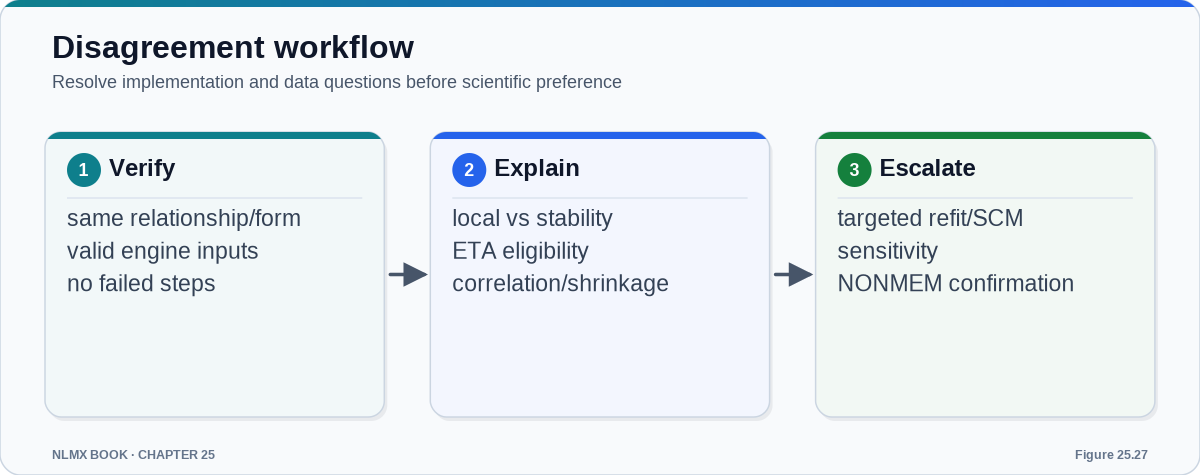
First verify comparability: same relationship, reference, form, missing policy, subject set, base run, and valid engine-specific prerequisites. Inspect failures, base stationarity, information conditioning, posterior source/curvature, shrinkage, learner agreement, correlated clusters, and final-refit convergence.
Then explain the statistical mechanism. Frozen can see a fixed-effect candidate without an ETA; posterior cannot. A strong local score may be unstable under resampling or correlated-feature switching. Posterior may retain a reproducible ETA association whose frozen class is uncertain because the joint/refit check or base-parameter uncertainty disagrees. Small replicate counts create wide probability intervals.
Escalate proportionately: increase a prespecified posterior schedule, inspect cluster-level evidence, run exhaustive SCM, likelihood-refit the disputed relationship, compare forms, and confirm in NONMEM. Preserve disagreement in the report even when a final scientific decision selects one model.
Common mistakes
- Changing the scientific question after seeing the result while presenting it as the original run.
- Reading one engine's summary without checking its prerequisites, failures, normalized settings, and fitted endpoint.
- Treating a generated draft, comparison label, or completed checkpoint as a substitute for model diagnostics and reference-software confirmation.
Page checklist
- The exact command, version, inputs, resolved settings, and output directory are identifiable.
- Engine-specific evidence is interpreted on its own scale before cross-method comparison.
- Recovery state, final refit, diagnostics, and remaining confirmation work are explicit.