40.23 A cross-software validation framework
What you will learn
- Design fixtures from unit to end-to-end levels
- Set method-specific tolerances and invariants
- Turn differences into traceable dispositions
Prerequisites: Chapter 39 troubleshooting, Chapter 36 command reference, and Chapter 38 output reference.
This page is scoped to nlmx 4.16.2 and an external-documentation snapshot of 2026-11-10. Product names describe different system boundaries; a blank or “outside role” is not a quality ranking. Treat every migration as a new implementation until model semantics, analysis population, objective definition, numerical behavior, outputs, and decisions have been independently reconciled.
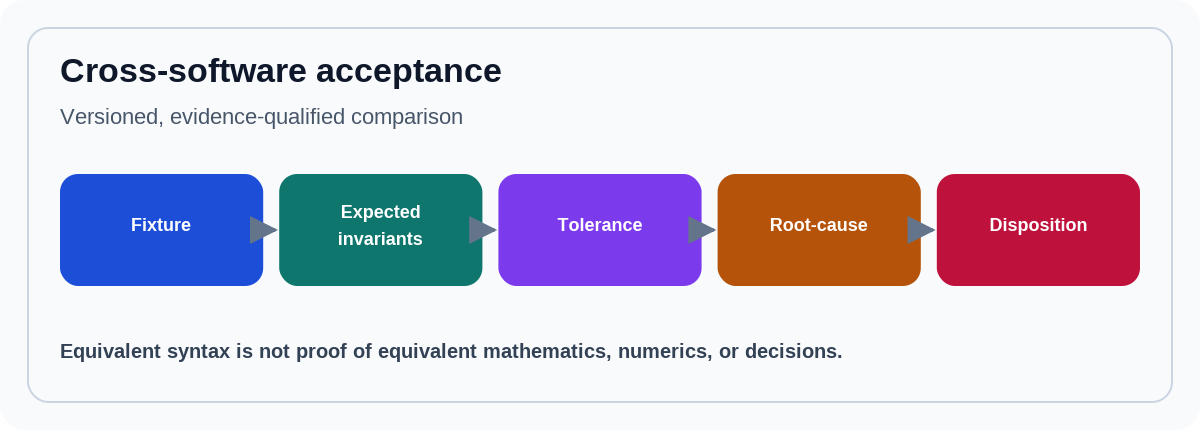
Use a validation pyramid. Level 1 tests parsing, parameter transforms, events, analytic PK, residual contributions, and matrix operations. Level 2 tests fixed-parameter predictions, individual modes, per-subject objective, simulation moments, and FIM pieces. Level 3 compares optimized estimates/covariance/diagnostics. Level 4 reproduces workflow decisions (SCM path, VPC bins, power threshold). Level 5 uses representative end-to-end cases.
Each fixture needs purpose, immutable inputs/hashes, reference engine/version/settings, expected outputs, exact invariants, numerical/statistical tolerances, random-seed protocol, acceptance rule, and reviewer. Include normal, boundary, missing/BLQ, infusion/SS/reset, ODE stiff/non-stiff, correlated OMEGA, failed-covariance, and unsupported-feature cases.
Use three tolerance types: exact structural invariants; deterministic absolute+relative numerical tolerances; stochastic confidence/Monte Carlo tolerances. Add decision margins around LRT/power/selection thresholds. Investigate failures by layer; never widen a global tolerance to make a suite green.
Classify disposition: implementation defect, translation defect, expected algorithmic difference, insufficient precision, unsupported scope, reference issue, or scientifically material unresolved difference. Chapter 42 will turn this framework into release/validation evidence.
Acceptance-matrix columns
Use fixture ID, feature, reference product/version, nlmx version, exact invariant, numeric/statistical metric, tolerance and rationale, observed result, pass/fail, difference class, issue link, reviewer, and date. Give every tolerance an origin: analytical truth, reference repeatability, floating-point study, Monte Carlo precision, or clinical decision margin. A tolerance copied from another metric has no evidentiary basis.
Review checklist
- Are the exact product versions, task boundaries, inputs, methods, and settings named?
- Were semantics and frozen-parameter results aligned before optimized outputs?
- Is the comparison using a method-appropriate deterministic or stochastic tolerance?
- Are unsupported or analogous features described without implying equivalence?
- Can every claim be reproduced from retained primary evidence?
Navigation
See the previous page, next page, and complete comparison reference.