32.12 Binary diagnostics, sparse data, and separation
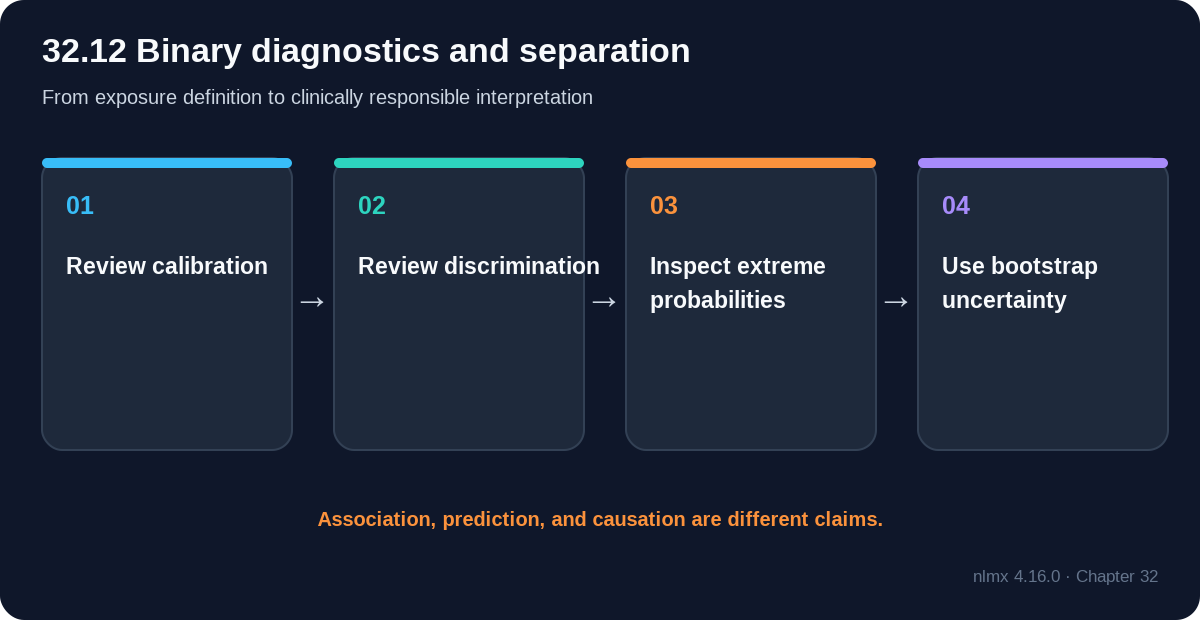
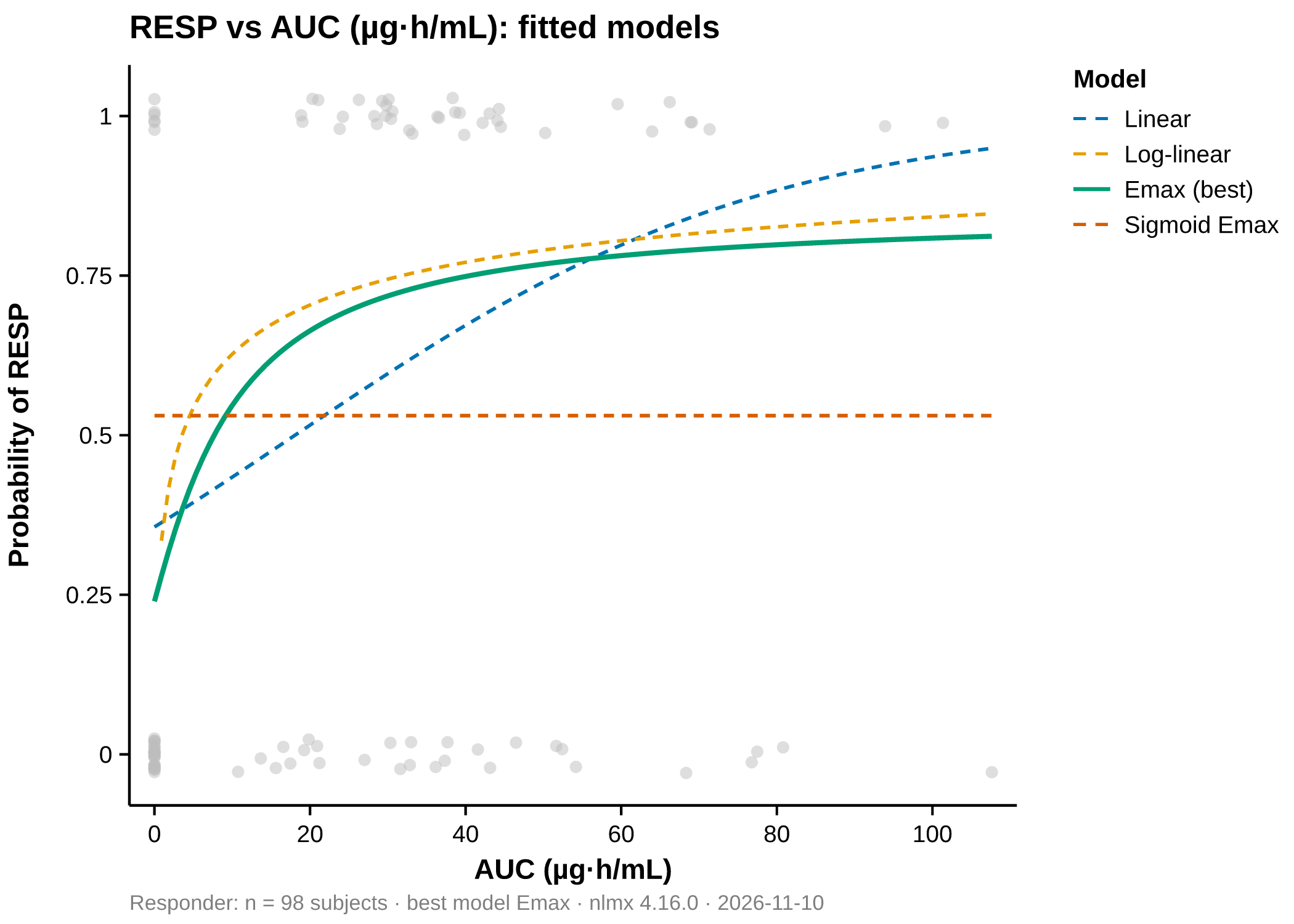
Binary E–R can fit an exposure trend while individual parameters remain weakly identified. Separation occurs when predictors nearly determine outcome, pushing coefficients or probabilities to extremes. Sparse categories and many covariates worsen this.
Core concepts
- The c statistic measures ranking, not calibration. Brier score measures probability error; Hosmer–Lemeshow is a coarse grouped calibration check.
- Extreme predicted probabilities, huge SEs, nonconvergence, or bootstrap failures flag instability.
- Bootstrap distributions can be skewed and reveal boundary or EC50 problems missed by Wald intervals.
Keep five layers separate: the dose assignment, the individual exposure, the endpoint definition, the statistical estimand, and the clinical decision. A fitted curve connects exposure and endpoint within the analysed data; it does not automatically identify the effect of changing dose or exposure in another population.
Worked interpretation
In the 50-replicate smoke bootstrap, 49/50 Emax refits succeeded and the EC50 percentile interval extended from near zero to 26.67; the Wald interval was still wider, 0.965–138.9.
Recognising instability before it becomes a result
Complete separation occurs when some predictor combination perfectly splits outcomes; quasi-separation nearly does so. Symptoms include enormous coefficients or SEs, estimates at bounds, probabilities indistinguishable from 0 or 1, repeated optimiser warnings, and bootstrap fits that diverge. Emax and sigmoid models can be unstable even without classical linear-predictor separation because EC50 or Hill can escape the observed range.
Construct outcome-by-arm and outcome-by-category tables before modelling. A common event-per-parameter heuristic is only a warning signal; effective information also depends on imbalance, overlap, collinearity, and nonlinear parameters. Hosmer–Lemeshow results vary with grouping and should not be the sole calibration decision.
Document requested, attempted, converged, and eligible bootstrap replicates separately. Inspect percentile distributions rather than only endpoints. If instability is material, simplify the shape or adjustment set, reconsider sparse categories, and use validated penalised or Bayesian methods outside the current command when appropriate. Never silently discard failed replicates or present a finite-looking Wald interval as reassurance.
For a novice, translate every coefficient back to the endpoint scale. Name the starting exposure, ending exposure, predicted outcome at both, contrast, interval, and observed support. For categorical or survival endpoints, also show absolute probabilities or survival estimates because odds and hazard ratios can be hard to interpret clinically.
Quality control and scientific review
Count successful bootstrap fits per model, inspect parameter histograms, and reduce complexity or use penalised/external methods when separation is material.
Review sample size alone only after checking events, category cells, visit counts, placebo support, exposure overlap, exclusions, and missingness. A statistically precise curve can still be clinically irrelevant, confounded, extrapolated, or based on an endpoint definition that does not match the intended estimand.
Common mistakes
- Treating AUC=0.77 as calibration
- Reporting only successful bootstrap estimates
- Treating a significant exposure term as proof that the selected shape or causal story is correct
Evidence to retain
- exposure definition, window, units, derivation, estimation uncertainty, and distribution by arm;
- endpoint derivation, time origin/visit, analysis population, missing/censoring rules, and exclusions;
- candidate models, covariate rationale, contrasts, selection criterion, diagnostics, failed/unstable fits;
- effect estimates with intervals, observed range, sensitivity analyses, software version, settings, and checksums.
Navigation
See the previous page, next page, and model and estimand catalogue.