Cmax, Cmin, and Ctrough
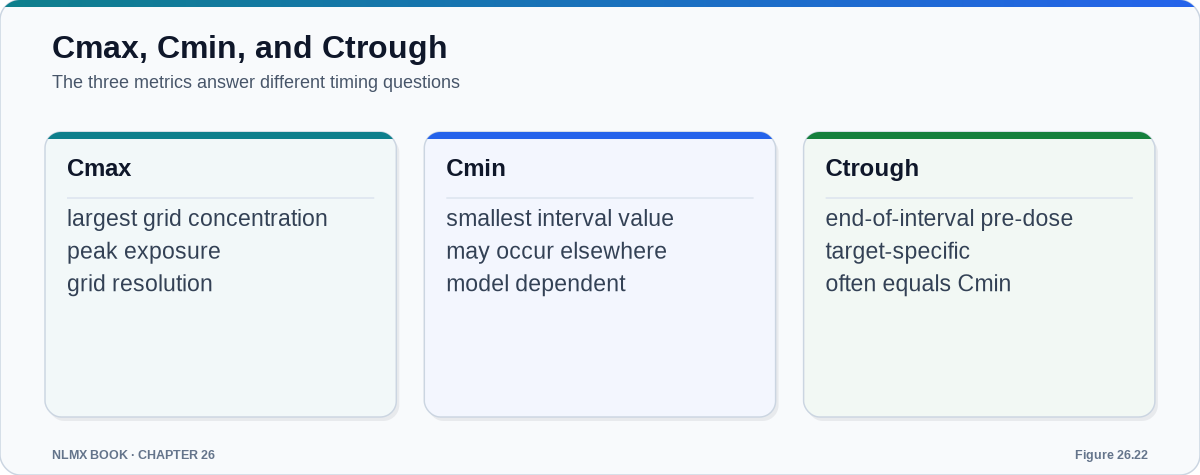
Cmax is the largest predicted concentration on the steady-state grid and is sensitive to absorption, distribution, infusion, and grid resolution. Cmin is the smallest concentration anywhere in the interval. Ctrough is the concentration at the interval end immediately before the next dose.
Cmin and Ctrough often coincide in monotonic terminal decline, as in the Chapter 26 example, but they need not coincide with delayed absorption, multiple peaks, infusions, oscillatory PD-linked kinetics, or unusual dosing. Report which metric a therapeutic target actually uses.
Check numerical grid convergence for sharp peaks and ensure the interval end is represented consistently. Do not relabel Cmin as Ctrough merely because their printed values match in one run.
Common mistakes
- Treating a forest ratio or reference-band class as covariate-selection evidence, causality, or an automatic dosing recommendation.
- Omitting the reference subject, uncertainty source, regimen, subgroup denominator, data support, or fitted-model diagnostics.
- Confusing parameter-uncertainty intervals, BSV ranges, and subject-bootstrap intervals because they share one graphic.
Page checklist
- The numerator, denominator, fitted model, covariate settings, and units are explicit.
- The interval source and clinical meaning are distinguished from BSV and selection uncertainty.
- Tables, resolved settings, commands, diagnostics, limitations, and confirmation evidence are retained.