15.27 Worked example: single-dose oral NCA
The first evidence set contains six subjects given 100 mg orally, with ten postdose samples through 48 hours. Concentrations follow deterministic one-compartment oral curves with modest subject scale differences.
Files:
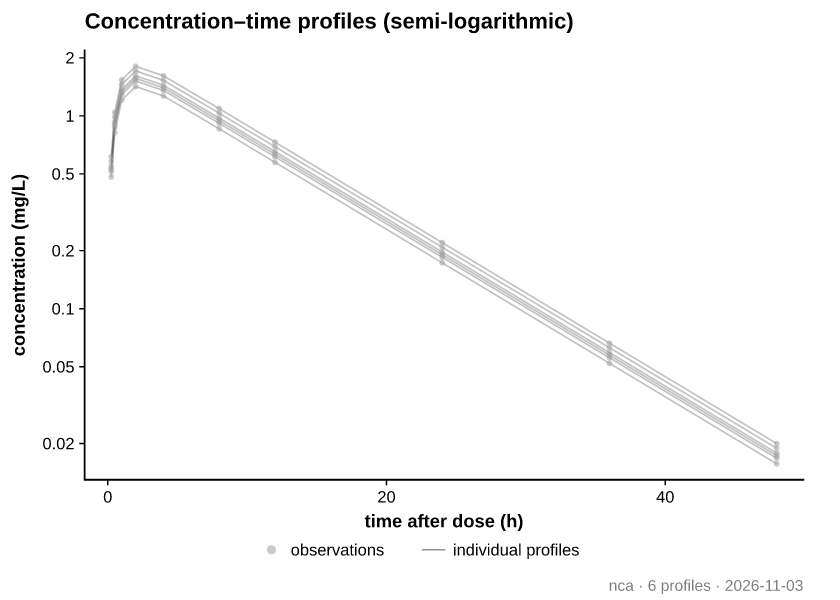
The settings use automatic route inference, linear-up/log-down integration, default positional BLQ handling, best-fit lambda-z, and partial areas 0–4 and 0–12 hours. Figures are written as PNG and SVG with terminal points ringed and observations joined.
Run and read
Equivalent invocation:
nlmx nca -c documents/ch15/input/oral_single.nca `
  -o documents/ch15/results/oral_single
Start with nca_parameters.csv. Confirm six analysed extravascular profiles, oral apparent fields (CL_F_*, VZ_F_*), and both configured partial-area columns. Compare each subject's terminal window in nca_lambda_z.csv and rings on the individual page.
The semilog figure shows an early rise followed by approximately straight terminal decline. That visual supports but does not replace candidate-table review. Compare AUC_0_4 + AUC_4_12 only if both adjacent windows were configured; this fixture configures 0–4 and 0–12, illustrating that output columns follow the requested list exactly.
Exercises
Rerun into separate directories with --auc-method linear and with --lz-method none. Linear integration should alter exposure while leaving observed Cmax/Tmax unchanged. Disabling lambda-z should retain AUClast and partial areas but blank infinite-time, half-life, clearance, and terminal volume fields.
Next change --partial-auc 0-4,4-12,0-12 and verify additivity. Record all CLI overrides because they supersede the file.
Common mistakes
- Looking for IV clearance columns in an oral result.
- Assuming every possible partial window is written automatically.
- Interpreting semilog straightness without checking selected points.
- Overwriting the primary evidence with sensitivity output.
Checklist
- Confirm six extravascular profiles.
- Inspect partial-area headers and values.
- Review lambda-z candidates and panel rings.
- Trace CL/F to dose and AUCinf.
- Put each sensitivity run in a new directory.
Further reading
Review AUC/partial controls, parameter columns, and oral NCA theory.