Output files and the SCM audit bundle
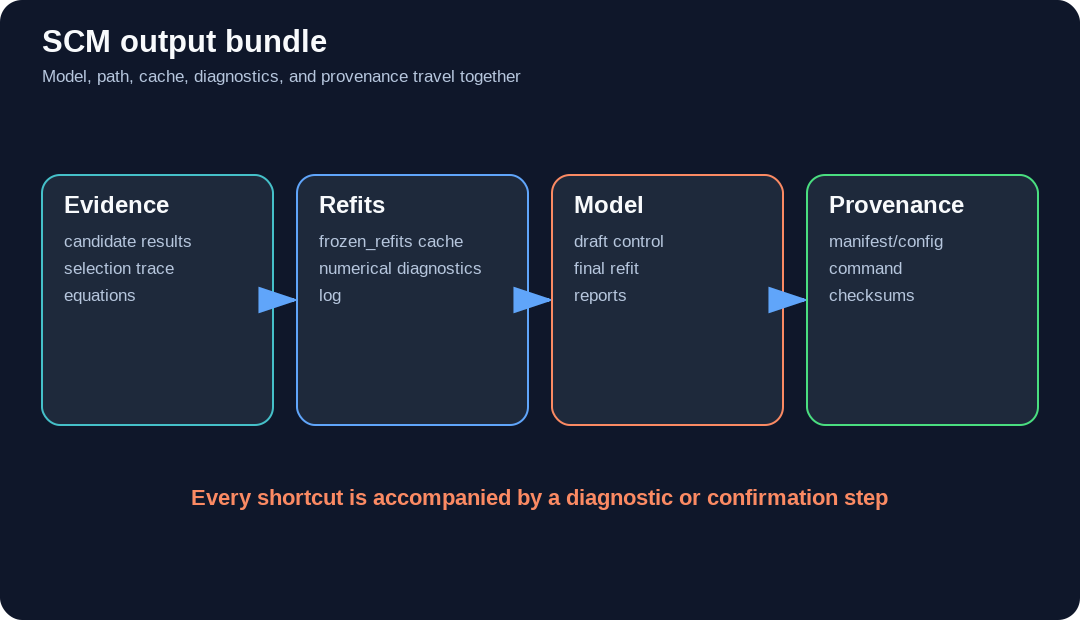
A complete SCM result is a bundle, not one CSV. Core evidence includes candidate_results.csv and candidate_results.json, selection_trace.csv, equations.csv, covariate_summary.csv, frozen_refits.json (every refit that was run, the final joint refit among them), numerical_diagnostics.json, the draft model (draft_model.ctl, draft_covariate_block.txt), and the reports (report.md, report.html). Provenance includes input_manifest.json, normalized_config.covar, the log (log_<number>.txt), and checksums.sha256; the command line is recorded in frozen_refits.json (argv).
Some names contain “frozen” because SCM shares the covariate engine's infrastructure; the search decisions are still refit-based. Optional matrices, subject scores, uncertainty summaries, and plots depend on command choices. Absence must be interpreted using the manifest/config rather than assumed to mean failure.
Archive the entire immutable output directory plus the exact executable/version and command. Verify checksums after transfer. A publication table should be regenerable from machine-readable files, and every reported relationship should trace back to an equation definition, model comparison, and final fitted coefficient.
Common mistakes
- Treating a stepwise p-value as clinical importance or causal proof.
- Reading a candidate comparison without its active model, convergence state, degrees of freedom, and exact threshold.
- Reporting only the terminal relationship list while discarding failed models, path decisions, configuration, and provenance.
Page checklist
- The scientific question, model identities, and comparison direction are explicit.
- Numerical validity is reviewed before interpreting statistical evidence.
- The result is linked to the complete trace and final joint-model diagnostics.