40.5 Optimizers, convergence, and solution basins
What you will learn
- Separate objective agreement from optimizer agreement
- Compare convergence evidence and boundaries
- Detect multimodality rather than selecting a convenient run
Prerequisites: Chapter 39 troubleshooting, Chapter 36 command reference, and Chapter 38 output reference.
This page is scoped to nlmx 4.16.2 and an external-documentation snapshot of 2026-11-10. Product names describe different system boundaries; a blank or “outside role” is not a quality ranking. Treat every migration as a new implementation until model semantics, analysis population, objective definition, numerical behavior, outputs, and decisions have been independently reconciled.
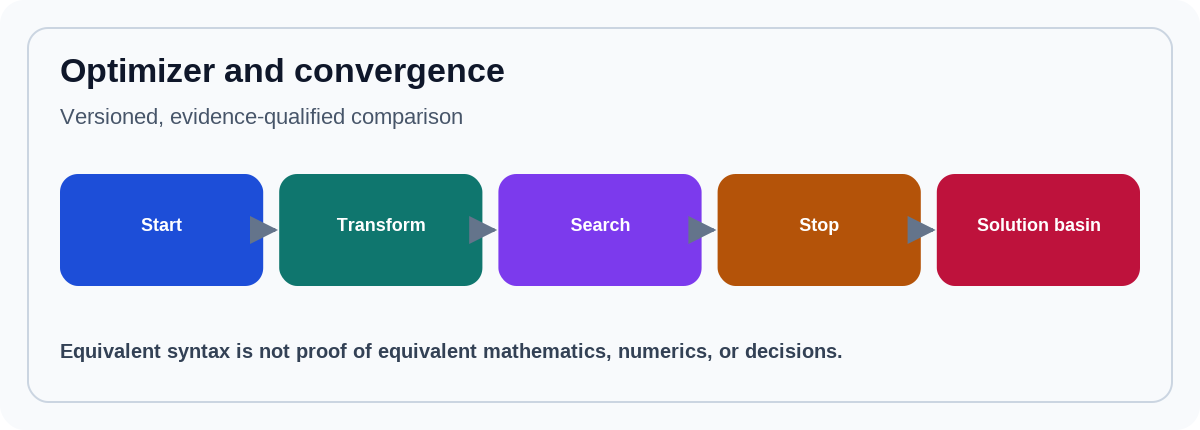
nlmx classical fitting uses its own transformed-parameter BFGS implementation; NONMEM uses its implementation and controls; Monolix estimates population parameters with SAEM in the cited workflow. Even on the same objective, iteration paths, function counts, and termination messages will differ.
Align initial parameter values, fixed elements, bounds, covariance parameterization, method, maximum work, and stopping tolerances. First prove both tools evaluate the start similarly. Then compare final objective, estimates, gradients, boundary/collapse flags, covariance condition, and predictions. “Minimization successful” strings are not interchangeable contracts.
Parameter transformations matter. nlmx maps bounded THETAs to unconstrained coordinates and OMEGA/SIGMA blocks through Cholesky factors. Another engine may step differently near bounds, handle zero variances differently, or use distinct scaling/preconditioning. The same reported parameter can therefore take a different numerical route.
Use multiple controlled starts when multimodality is plausible. If tools reach different basins, evaluate each solution in both engines at frozen values. Do not choose the one with the desired estimate. Record basin, objective, scientific plausibility, diagnostics, and sensitivity. Retry is evidence generation, not a substitute for diagnosis.
Minimum convergence comparison
Keep a table with start and final objective, final estimates on natural and transformed scales, maximum gradient or available stationarity measure, iterations/evaluations, termination reason, boundary flags, covariance status, and condition number. Add prediction differences at clinically relevant covariates. If one engine stops and another continues to a meaningfully lower objective, evaluate both parameter vectors in both engines; this separates an optimizer issue from an objective mismatch.
Review checklist
- Are the exact product versions, task boundaries, inputs, methods, and settings named?
- Were semantics and frozen-parameter results aligned before optimized outputs?
- Is the comparison using a method-appropriate deterministic or stochastic tolerance?
- Are unsupported or analogous features described without implying equivalence?
- Can every claim be reproduced from retained primary evidence?
Navigation
See the previous page, next page, and complete comparison reference.