13A.30 Output bundle, schemas, and provenance
The default destination is <input-directory>/<input-stem>_custom. A non-empty directory is refused unless overwrite is explicit. The bundle contains only formats requested and item types generated.
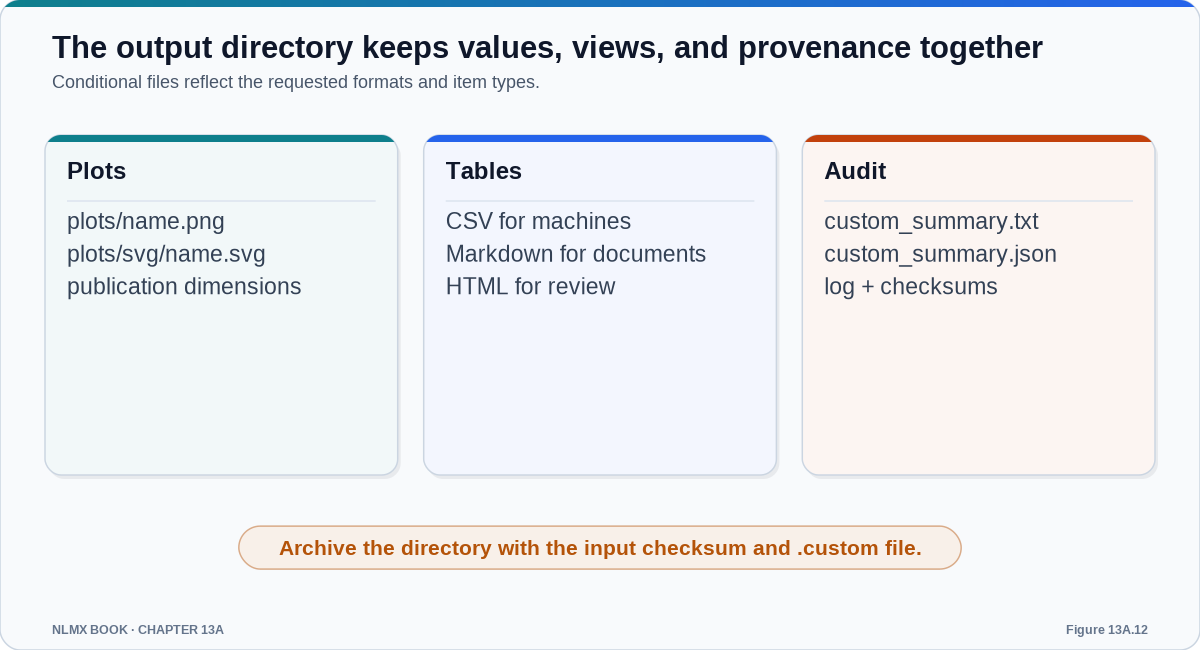
Plots and tables
PNG files are written to plots/<name>.png; SVG files are written to plots/svg/<name>.svg when requested. Tables are written to tables/<name>.csv, .md, and .html unless a format is disabled. CSV is the validation source, Markdown is convenient for authored documentation, and HTML is a standalone human-review view.
Summary and audit files
custom_summary.txt lists the dataset, command, rows and columns, shared data steps, plots with geoms/files, tables with row counts/files, and notes. custom_summary.json contains the same concepts for programs: dataset, command, columns, NONMEM table count, data steps, plot objects, table objects, notes, and elapsed seconds where supported. checksums.sha256 binds generated artifacts; the log preserves execution details.
Conditional absence is expected: --no-tables produces no tables directory, PNG-only produces no SVG files, and [output] json=false suppresses JSON. Automation should compare the requested inventory rather than demand every possible file.
The bundle does not automatically copy the input or .custom file. Archive their checksums and version alongside the result.
After transfer, recalculate checksums from the destination rather than trusting copied metadata. A checksum mismatch is an integrity failure; a matching checksum only confirms identical bytes. Scientific review must still verify row scope, mappings, statistics, and interpretation.
Common mistakes
- Validating rounded HTML instead of CSV.
- Treating a conditional missing file as run failure.
- Keeping images while deleting the commands and summaries.
- Assuming checksums prove scientific validity.
Checklist
- Compare inventory with requested formats.
- Use CSV for numeric validation.
- Parse JSON rather than scraping text.
- Verify checksums after transfer.
- Archive executable version, input hash, settings, and command.
Further reading
See first run, settings, worked evidence, and Chapter 9's reproducibility contract.