Running both engines
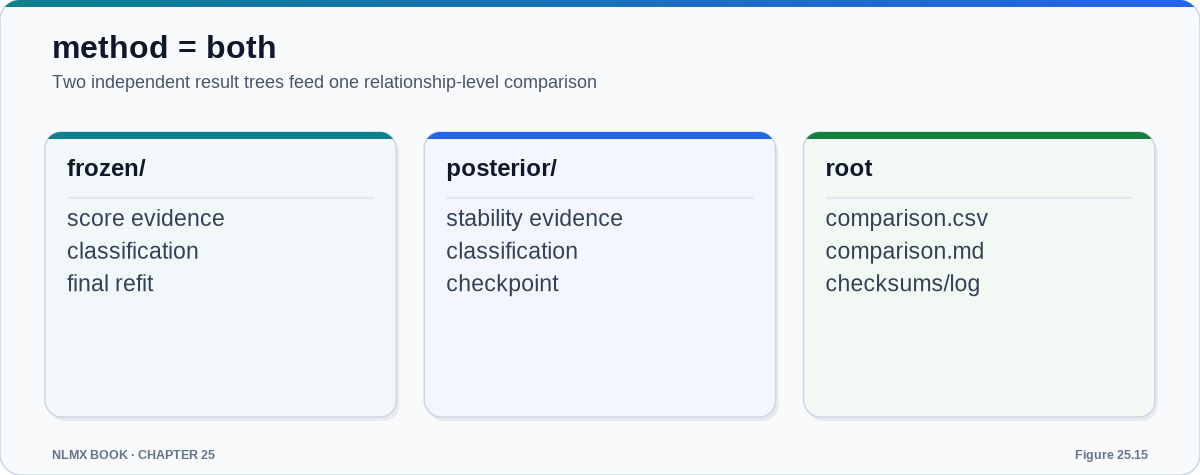
--method both runs frozen first in frozen/, posterior second in posterior/, then writes comparison.csv and comparison.md at the parent. Each child is a full method-owned bundle with its own reports, normalized configuration, manifests, caches/checkpoint, draft model, diagnostics, and checksums.
The top-level comparison reduces each parameter–covariate pair to the frozen chosen equation and posterior strongest equation. It reports each engine's class and evidence plus an agreement label. It does not combine a p-value and a selection probability into one statistic, and it does not run SCM. If an SCM reference is needed, run it separately using the same scope and coding.
Plan disk and runtime as approximately the sum of both engines plus comparison/reporting. A posterior interruption leaves the frozen child complete; resume targets the posterior/ child. After recovery, confirm that the parent comparison represents the completed posterior evidence rather than an earlier partial state.
Common mistakes
- Changing the scientific question after seeing the result while presenting it as the original run.
- Reading one engine's summary without checking its prerequisites, failures, normalized settings, and fitted endpoint.
- Treating a generated draft, comparison label, or completed checkpoint as a substitute for model diagnostics and reference-software confirmation.
Page checklist
- The exact command, version, inputs, resolved settings, and output directory are identifiable.
- Engine-specific evidence is interpreted on its own scale before cross-method comparison.
- Recovery state, final refit, diagnostics, and remaining confirmation work are explicit.