20.43 --print-options and resolved fit settings
--print-options parses the control stream, resolves its estimation settings, prints them as explicit CLI options, and stops before reading the dataset or estimating the model. It is a compact way to expose defaults and control-stream intent that would otherwise remain implicit. It is particularly valuable before a retry experiment because every attempt must use the same resolved numerical policy.
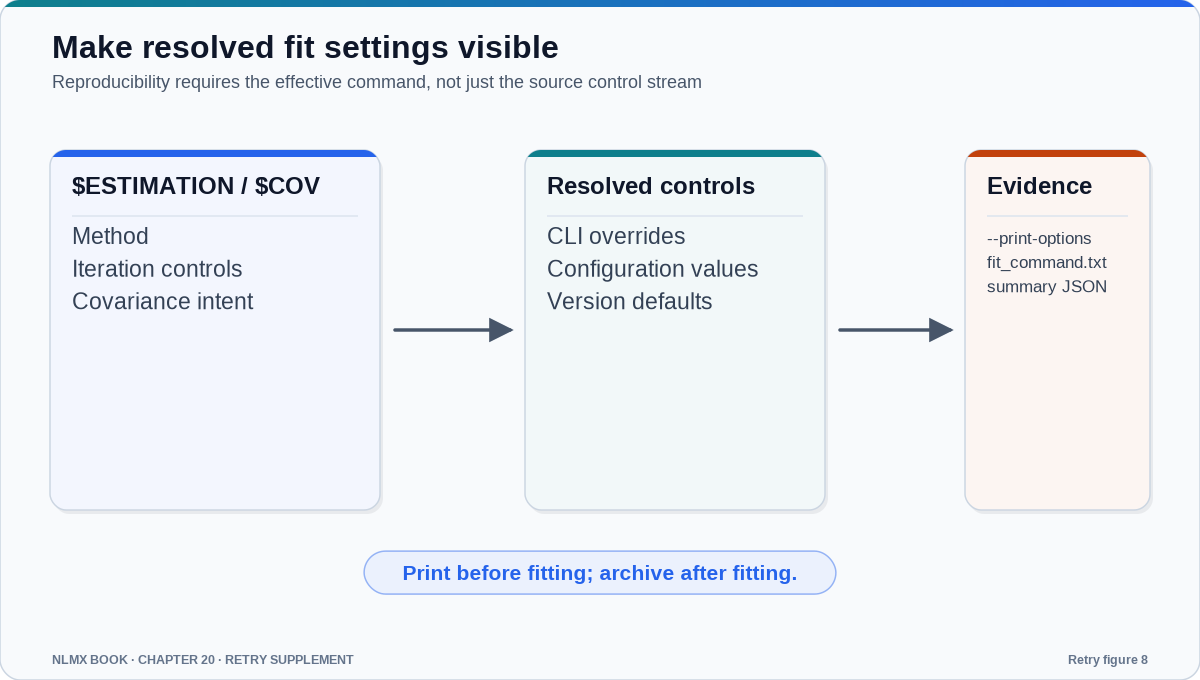
For the Chapter 20 reference stream, nlmx 4.14.3 prints:
nlmx fit documents/ch20/input/run20.ctl --print-options

--approximation foce-i --max-iterations 300 `
  --gradient-tolerance 0.001 --cov-step --cov-matrix rsr
The result shows that METHOD=1 INTERACTION resolves to FOCE-I, the effective iteration maximum is 300, the classical gradient tolerance is 0.001, covariance is enabled, and the sandwich RSR matrix is selected. The printed line is not a complete replay command: add the control stream, dataset override, output path, retry count, seed, tables, plots, logging, and other operational choices as applicable.
An actual fit writes the effective estimation options to fit_command.txt inside each attempt’s result bundle. In a retry tree, inspect the parent and winning retry copies. They should agree on the estimation policy while their control streams differ in starting values. Also archive the user-issued command because it records --retry, --seed, and output choices that are not necessarily represented by the resolved estimation fragment.
Use this sequence when preparing a reproducible run:
- Run
--print-optionsand preserve its output. - Decide whether any override is scientifically justified.
- Execute the fit with an explicit output directory and seed.
- Archive the submitted command and generated
fit_command.txt. - If retry occurs, compare the effective options across attempt folders.
- Record nlmx version because defaults and implementation details are versioned.
--print-options does not validate the full dataset, execute model predictions, or prove that the settings are appropriate. It is an audit aid, not a preflight substitute. Use ordinary data/control validation and, when needed, a deliberate evaluate-only or short diagnostic run.
Common mistakes
- Treating the printed fragment as a complete executable command.
- Assuming it validates data and model evaluation.
- Archiving only the source
$ESTIMATIONrecord after CLI overrides. - Failing to compare settings across retry attempts.
Checklist
- Preserve print-options output with version metadata.
- Add operational and input options to the run record.
- Archive
fit_command.txtfrom the winner. - Confirm identical estimation policy across attempts.
Further reading
See settings precedence, logging and reproducibility, and the preserved documents/ch20/results/retry-print-options.txt.