D.16 Packaging and handover: the archive and the report
What you will learn
- Make the release archive: what goes in, what stays out, and why an earlier archive is never overwritten.
- Write the commit subject and the closing report that ends every release.
- Run the whole sequence as a checklist, from the request to the handover.
Prerequisites: D.13, D.14 and D.15.
The archive
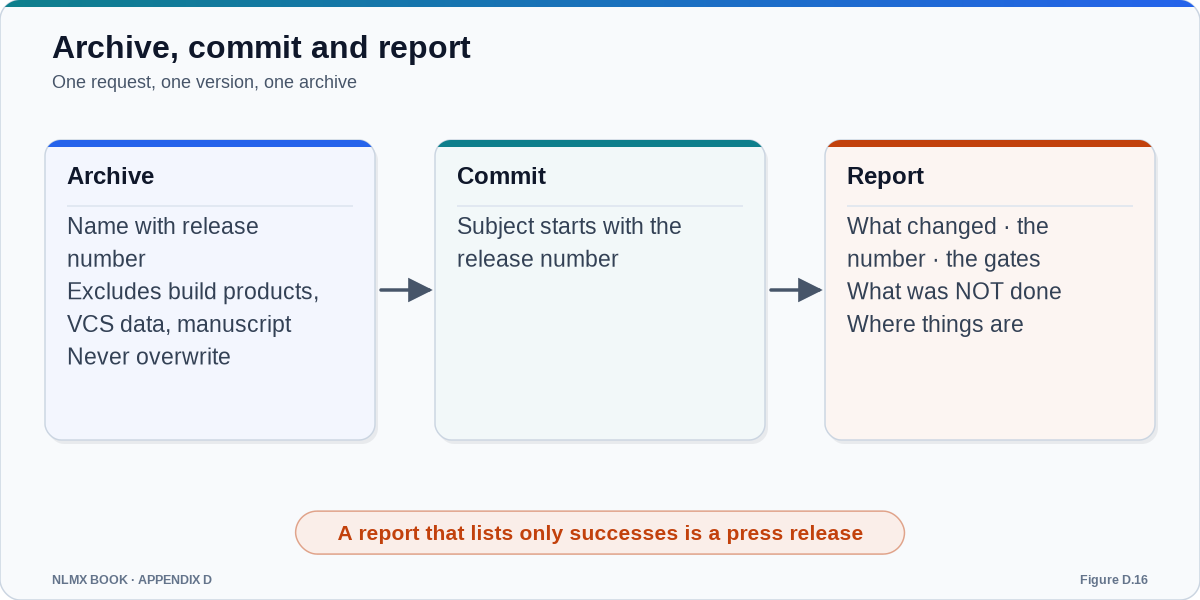
After the gates, the release is frozen as an archive next to the project, named with the program's name and the release number. The rules are short.
| Rule | Reason |
|---|---|
| Include the sources, the tests, the documentation and the change log | the archive must be enough to rebuild and to audit |
| Exclude build products | they are derived, large and machine-specific |
| Exclude version-control metadata | the archive is a snapshot, not a history |
| Exclude the manuscript folder | the book describes the program; it is not part of it |
| Never overwrite an earlier archive | an archive that can be replaced is not a record; if a name already exists, the number was wrong |
| One archive per release | one request, one version, one archive |
The last two rules are linked to the rule of page D.13: if you want to overwrite an archive, you are trying to change a release that already exists. Make a new release instead.
The commit
The subject line starts with the release number, then says what changed in the user's words (the first bold name of the change-log entry is a good source). The body, when needed, says why. A history in which every subject starts with a number is a history one can search by release.
The closing report
Every release ends with a report to the person who asked. It is short, and it has five parts.
| Part | Content |
|---|---|
| What changed, in two or three sentences | in the user's words, as in the change log |
| The number and the kind of increase | with the reason (the upgrade test of page D.13) |
| The gates | green, with the test count; any variant built |
| What was not done | a limitation left, a case not tested, a decision deferred |
| Where things are | the archive, the changed documentation |
The fourth row is the one that matters. A report that lists only successes is a press release. The book has taken the same stance throughout: the section "what this case does not show" of every Chapter 41 page is the same habit applied to analyses.
The sequence, end to end
| Step | Action | Page |
|---|---|---|
| 1 | Read the request; decide whether it is one release or more | D.13 |
| 2 | Find the place of the change in the layers | D.1, D.2 |
| 3 | Implement; choose the exit code and the message of each new failure | D.3 |
| 4 | Settings: template, reader, echo, precedence | D.4 |
| 5 | Outputs: the output set, the checksum written last, the random stream | D.5 |
| 6 | Tests: happy path, error, determinism | D.11, D.12 |
| 7 | Documentation checklist and the grep | D.14 |
| 8 | The change-log entry, the number, the banner date | D.13 |
| 9 | The five gates | D.15 |
| 10 | The archive, the commit, the report | this page |
Handover to a colleague
When the work passes to another maintainer, the report is the handover. A new maintainer needs to find, in order: the change log (what happened), this appendix (how the work is done), the code map (D.1) and the reference page (developer reference). If a maintainer cannot work out why a decision was taken from those four, the decision was not written down, and writing it down is part of the work.
Review checklist
- Does the archive exclude build products, version-control metadata and the manuscript, and is its name new?
- Does the commit subject start with the release number?
- Does the report say what was not done?
- Could a new maintainer reconstruct the reasoning from the change log and the documentation?
Navigation
See the previous page, the overview and the developer reference.