Chapter 31 — power: the command
nlmx power sizes and evaluates pharmacometric trial designs with stochastic simulation and estimation (SSE), an expected Fisher information matrix (FIM), or both. This chapter is the complete novice-first operating guide for nlmx 4.16.0. Chapter 30 explains the statistical theory; Chapter 31 explains every input, option, settings key, scenario mechanism, output, and review decision needed to run the command safely.
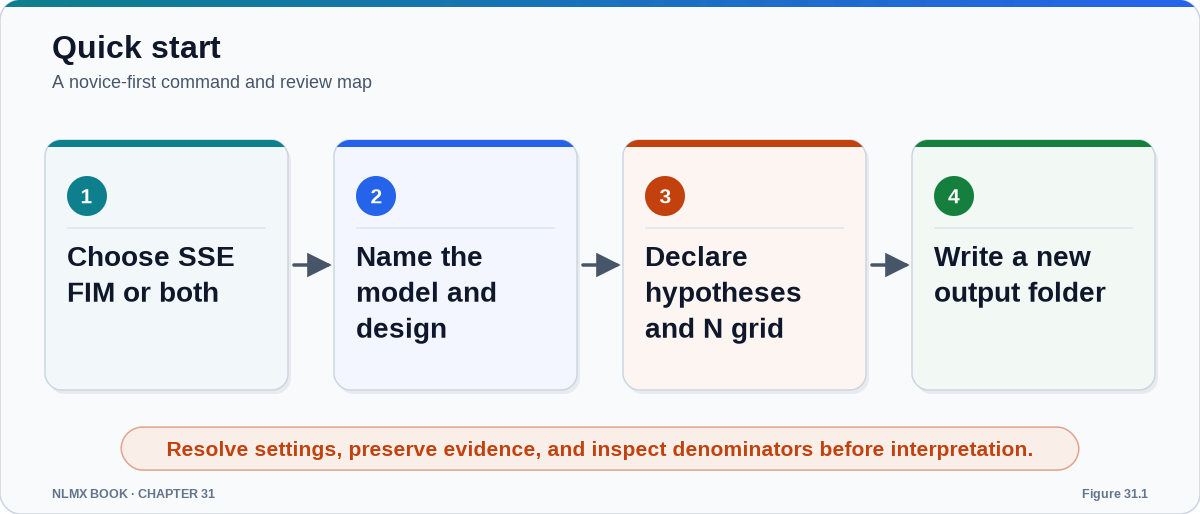
What this chapter covers
- every power-specific and shared CLI option, including places where shared help text is misleading;
- every key in the generated
.powertemplate, path resolution, defaults, and CLI precedence; - control streams, design templates, EXT/COV selection, hypotheses, scenario grids, and allocations;
- SSE fitting, Type I trials, parameter uncertainty, empirical parameter sets, failures, deterministic resume, and saved datasets;
- FIM approximation, matrix kind, draws, finite differences, precision, correlations, and target-N scaling;
- every CSV/JSONL/JSON/text/plot/report artifact and the dynamic replicate columns;
- six worked workflow patterns and a final trust checklist.
Executed nlmx 4.16.0 evidence
The release executable was rebuilt from the current 4.16.0 source before these examples were run. Evidence is preserved under documents/ch31/results:
| Workflow | Scale | Teaching result |
|---|---|---|
| reduced-FIM scenario grid | 24 scenarios, two hypotheses | 48 power rows and 16 target-N curves |
| combined screen/confirmation | N=30,45,60; 12 SSE replicates each | FIM N=44; noisy SSE interpolation N=55 |
| nonzero-null THETA | N=40,80; eight replicates each | THETA(3)=1.4 tested against 1.1 |
| uncertainty and Type I smoke | six alternative + four null trials | assurance 0.833; Type I 0.000 with very inadequate n=4 |
| completed resume | ten checkpoint rows | zero new trials scheduled |
| settings precedence | file values overridden by CLI | N=30,60 and target 0.9 used |
| precision-only FIM | two sizes, no hypothesis | no power/sample-size files, as designed |
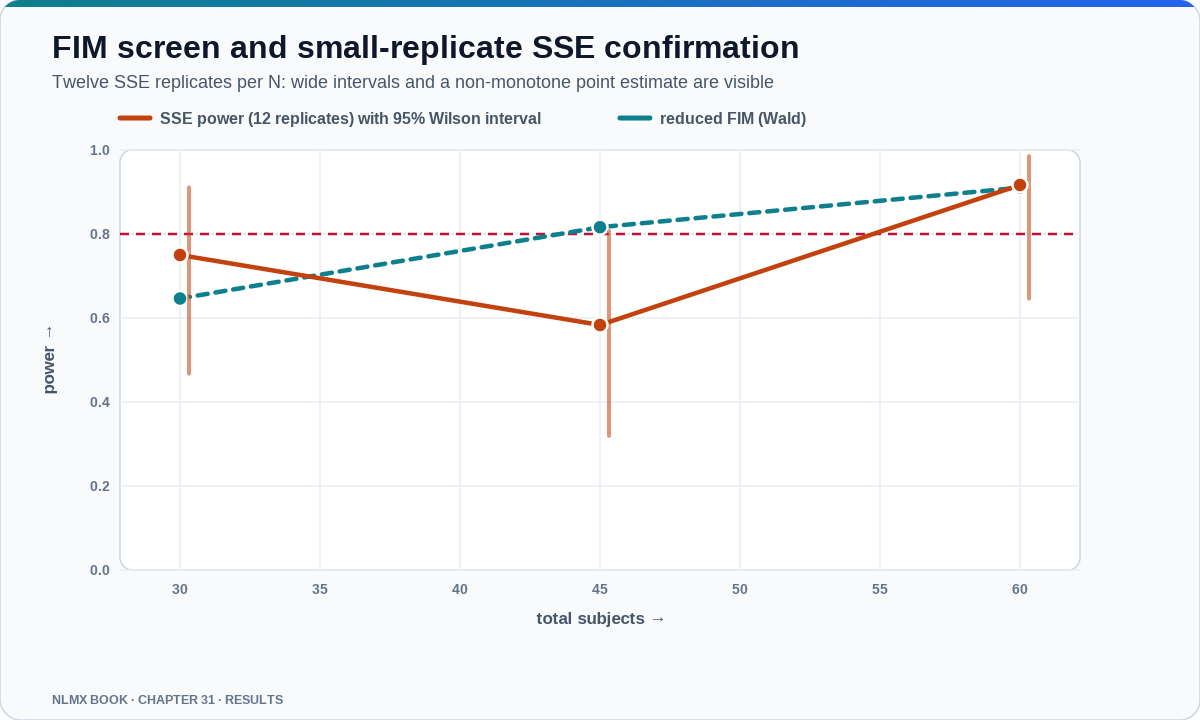
The small SSE run is deliberately not qualification evidence. Its power estimate decreased from 0.750 at N=30 to 0.583 at N=45 before rising to 0.917 at N=60. The reduced FIM curve increased monotonically. This visible discrepancy is Monte Carlo noise from twelve replicates and demonstrates why a final sample size must not be selected from a smoke run.
Accuracy corrections and boundaries
- In
power,--methodmeanssse|fim|both; the shared 4.16.0 help description incorrectly lists covariate-selection engines. - Power estimation accepts FOCE-I, FOCE, or Laplace, defaults to 100 maximum iterations, and rejects zero; shared fit help describes broader choices and another default.
--ci,--lloq,--param-file, and--no-plotsapply to power even where their shared help descriptions mention other commands.- Compliance thins explicit AMT-positive dose records only; ADDL doses are not independently thinned.
- FIM does not apply compliance or LLOQ/BLQ. When both engines run, they may describe different designs and nlmx writes a warning.
- Primary SSE power is test-evaluable power, not necessarily converged-only power; the conservative and converged-only rates are separate columns.
power_settings_used.powerdoes not capture a positional control-stream argument. Supply it again, use--ctl, or add[input] control_streambefore reproduction.
Use the complete command and settings index for lookup, or begin with 31.1 Quick start. The next planned chapter is Chapter 32, exposure-response concepts and models.