Chapter 19 — SAEM and the importance-sampling objective
SAEM estimates nonlinear mixed-effects models by repeatedly sampling each subject’s latent random effects and updating population parameters from stochastic sufficient statistics. It is valuable when linearization is fragile, but it introduces new responsibilities: Markov-chain mixing, burn-in, stationarity, stochastic averaging, seeds, and Monte Carlo error.
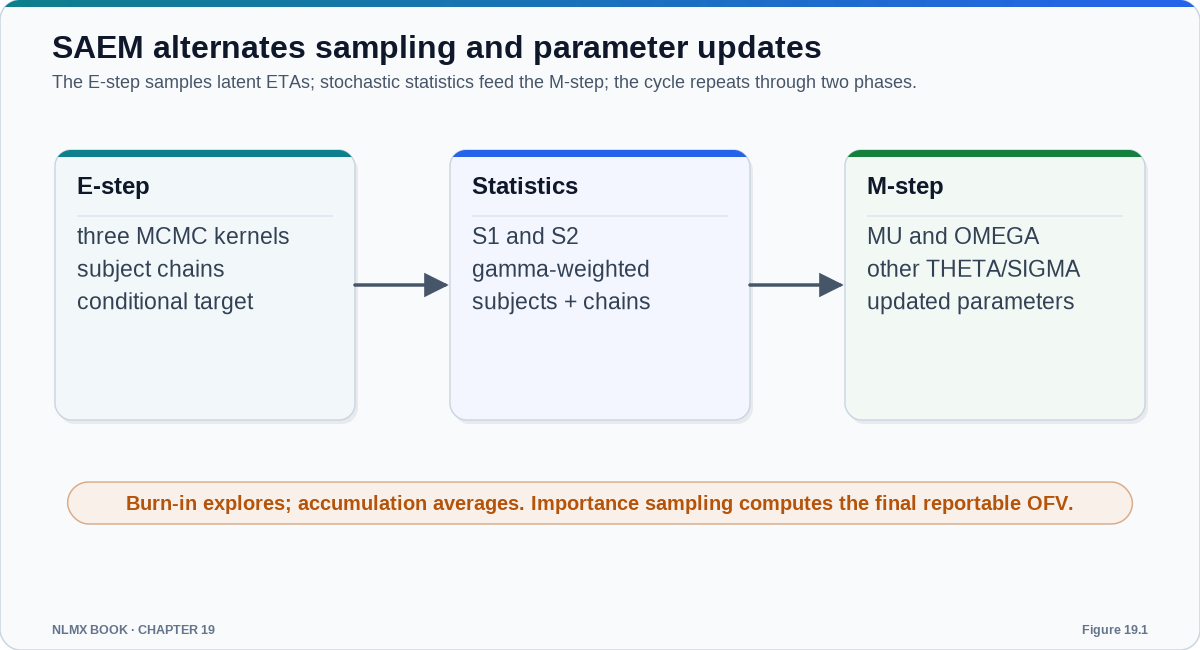
This chapter explains the algorithm implemented in nlmx 4.6.0. It separates three quantities that are often confused: the conditional target sampled by the E-step, the SAEM trace objective used to judge stability, and the importance-sampling OFV used for reporting and model comparison. The last is computed after SAEM with heavy-tailed, mode-centred proposals and an effective-sample-size diagnostic.
The chapter is novice-first but implementation-specific. It covers all SAEM and importance-sampling settings before deriving the three MCMC kernels, adaptive scales, sufficient statistics, MU-linked updates, OMEGA safeguards, stochastic quasi-Newton updates, stationarity test, accumulation, antithetic importance draws, log weights, ESS, covariance, performance, and method choice.
Evidence and scope
A deterministic one-dimensional teaching analogue generates MCMC traces, acceptance adaptation and stochastic-statistic paths. A second calculation applies the nlmx importance-sampling design to Chapter 18’s nonlinear toy likelihood and compares it with numerical quadrature. These graphics explain mechanisms; they are not substitutes for validation on full population-PK models.
SAEM command usage appears here only where required to explain the algorithm. Chapter 20 will provide the complete fit command and option reference.
Learning outcomes
You should be able to explain each kernel and phase, distinguish stationarity from convergence proof, interpret acceptance and ESS, choose chain/draw settings, reproduce a seeded run, and state why the SAEM objective must never be inserted into AIC, BIC or LRT.
Start with the settings and symbol index, then follow the numbered pages in order.