Chapter 34 — Maxson: concepts, guardrails, and the audit trail
Maxson is the conversational interface behind nlmx ask. It turns a plain-language request into structured proposals, but deterministic nlmx code decides what may be read, written, confirmed, and executed. This separation makes Maxson useful without treating language-model output as an execution authority or scientific conclusion.
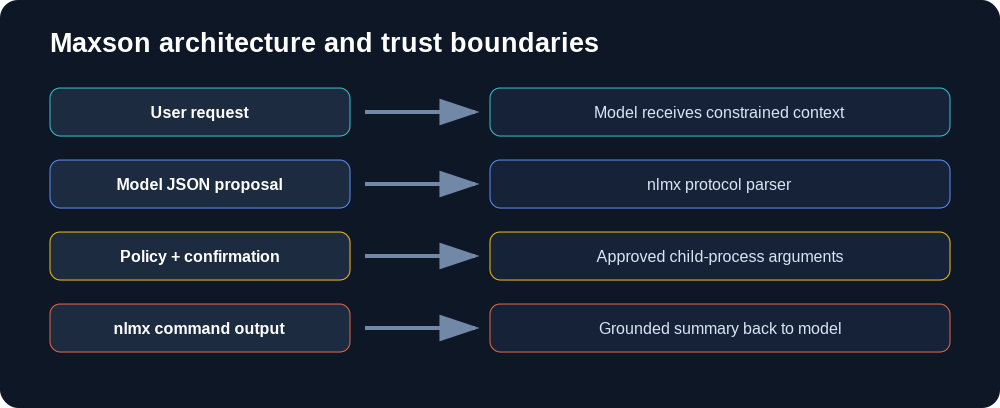
What this chapter establishes
- the architecture and trust boundaries from request to child process;
- the JSON reply protocol and live command/manual/template context;
- command, option, numeric, path, network, confirmation, and resource guardrails;
- why instructions are not security boundaries;
- how settings lineage, transcripts, event logs, and step folders support reproducibility;
- how failures and corrections remain checked and reviewable;
- what Maxson cannot establish and how compliance reviewers should gate conclusions.
Chapter 35 will cover day-to-day use, backend setup, complete .ask settings, guided mode, troubleshooting, and prompt patterns. Chapter 34 concentrates on the conceptual safety and evidence model.
Executed 4.16.1 evidence
Three mock-backend sessions were executed without reading or using a model file:
| Session | Proposal | Observed outcome |
|---|---|---|
| allowed | qc-data data/er/er_data.csv |
approved, default .qcd saved, child ran, NOT READY result captured |
| plan-only | continuous er command |
checked and recorded; settings written; zero analysis commands ran |
| refusal | start another ask |
refused before execution because the assistant may not start itself |
The mock backend scripts only replace language-model replies. Policy, settings generation, child execution, session output, and audit logging are the real 4.16.1 implementation.
Reading order
Start with the guardrail, policy, and audit index, then continue through 34.1 The Maxson trust model. The chapter contains 18 numbered pages plus this overview and the index; every page includes a visual.