28.1 Purpose, scope, and accuracy boundary
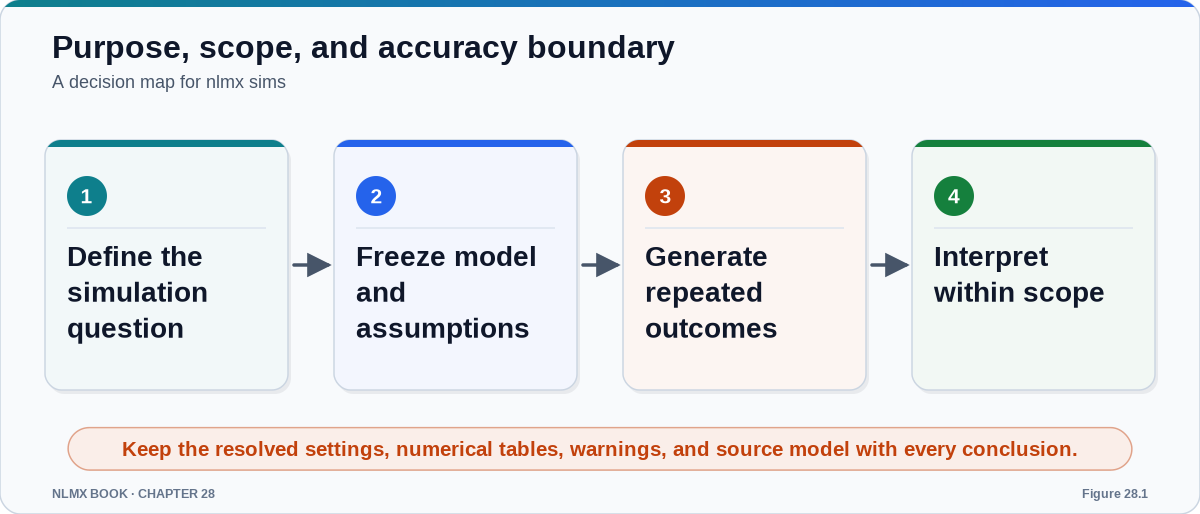
nlmx sims asks a forward-looking question: what exposure outcomes would this model generate if a specified population received a specified regimen under a specified sampling design? It does not estimate parameters, select covariates, prove efficacy, or establish that the source model is true. Its results are conditional on the structural model, statistical model, parameter state, covariate generator, event design, and random-variable policy supplied to the run.
Why this matters
This decision changes what population, random quantity, time interval, or numerical summary the command represents. For a novice, the safest habit is to write the question in one sentence before choosing an option, then verify that the resolved settings and output columns express that same question. For a reviewer, the important distinction is between what was assumed, what was randomly generated, what was calculated, and what can legitimately be concluded.
Detailed behavior
- Define the estimand before the command: distribution of exposure, target attainment, dose comparison, or design sensitivity.
- Treat every scenario as an extrapolation boundary. A pediatric simulation from an adult-only model is computationally possible but is not pediatric qualification.
- Separate variability among simulated subjects from uncertainty among repeated trials and from uncertainty in population parameters.
- Use tables as analytical evidence and figures as views of those tables.
The subject-level table is the bridge between the design and the exposure result. Use it to check IDs, arms, population labels, age, sex, weight, dose, interval start, tau, ETA values, and added covariates. Use the metric table to check one row per subject and simulation, the requested metric columns, and COVERED. Use pooled and replicate summaries for different purposes: pooled rows describe all simulated subject outcomes, while replicate intervals describe how a finite simulated study result varies from study to study.
Example command or settings fragment
nlmx sims run.ctl --ext run.ext --estimates final --subjects 200 --subproblems 500 --seed 28001 -o sims_primary
Start with a small smoke run and inspect the transcript before scaling. For command-line work, quote expressions containing comparison signs, brackets, or commas as required by the shell. For a permanent analysis, prefer a settings file: it exposes settings-only controls, resolves paths relative to itself, rejects unknown keys, and is echoed in fully resolved form with the output.
Interpretation and quality control
A defensible conclusion names the model version, population, regimen, exposure metric, target, uncertainty sources, and the exact simulated range. Replace statements such as ‘the dose is safe’ with scoped statements such as ‘under this qualified model and scenario, the simulated CMAX target was met by X% of subjects.’
At minimum, reconcile the console summary with the CSV/JSON result, inspect warnings and notes, confirm subject and observation counts, verify requested groups and targets, and review the source model's applicability. A chart can reveal shape and subgroup patterns, but every reported number should come from the tables. If a result changes a decision, run a prespecified sensitivity for Monte Carlo stability, parameter uncertainty, population assumptions, and the metric-profile source.
Common mistakes
- Calling simulation validation
- Generalising beyond generated covariate and dose ranges
- Reporting a plot without numerical uncertainty
Also avoid overwriting a completed evidence folder merely to change styling. Create a new scenario directory or preserve the prior checksums so analytical changes remain distinguishable from presentation changes.
What to retain and report
- the nlmx version, complete issued command, submitted settings, and resolved
_settings.sims; - CTL, selected EXT, optional COV or parameter table, and supplied dataset or population-generation assumptions;
- seed, subproblems, thread count, ETA/EPS and parameter-uncertainty policy;
- metric interval, tau, profile source, grid, integration rule, group definitions, and target limits;
- numerical tables, JSON, HTML, figures, transcript, checksums, warnings, sensitivities, and scoped interpretation.
Navigation
See the previous page, next page, and complete sims command and settings index.