The role of SCM and the question it answers
Stepwise covariate modelling (SCM) asks a conditional model-building question: after re-estimating the current population model, does adding or removing this covariate relationship improve the likelihood enough to cross a prespecified threshold? That is different from asking whether a univariate plot looks persuasive, whether a coefficient has a convenient sign, or whether a fast local score is small.
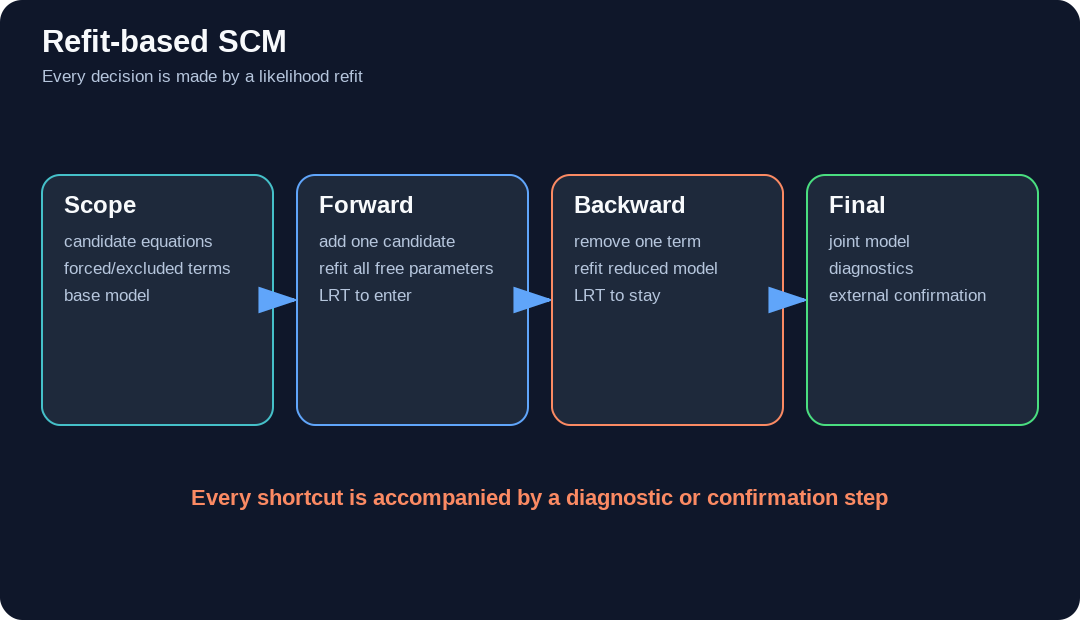
With --method scm, nlmx performs likelihood refits during the path. The current active effects, structural parameters, variance components, residual error parameters, and individual modes are allowed to adjust. Each decision therefore belongs to a particular active model, dataset, likelihood approximation, equation coding, and search direction. SCM is a reference method relative to nlmx's frozen local approximation; it is not an infallible truth procedure.
The defensible use is confirmatory model development within a prospectively defined scientific scope. Specify plausible parameter–covariate pairs, equation forms, reference values, forced/excluded relationships, forward and backward thresholds, and the candidate cap before reading the result. After selection, refit and diagnose the joint model, assess clinical relevance, and—when NONMEM/PsN equivalence matters—confirm it in that target workflow.
Common mistakes
- Treating a stepwise p-value as clinical importance or causal proof.
- Reading a candidate comparison without its active model, convergence state, degrees of freedom, and exact threshold.
- Reporting only the terminal relationship list while discarding failed models, path decisions, configuration, and provenance.
Page checklist
- The scientific question, model identities, and comparison direction are explicit.
- Numerical validity is reviewed before interpreting statistical evidence.
- The result is linked to the complete trace and final joint-model diagnostics.