40.8 Covariance matrices, standard errors, and parameter scales
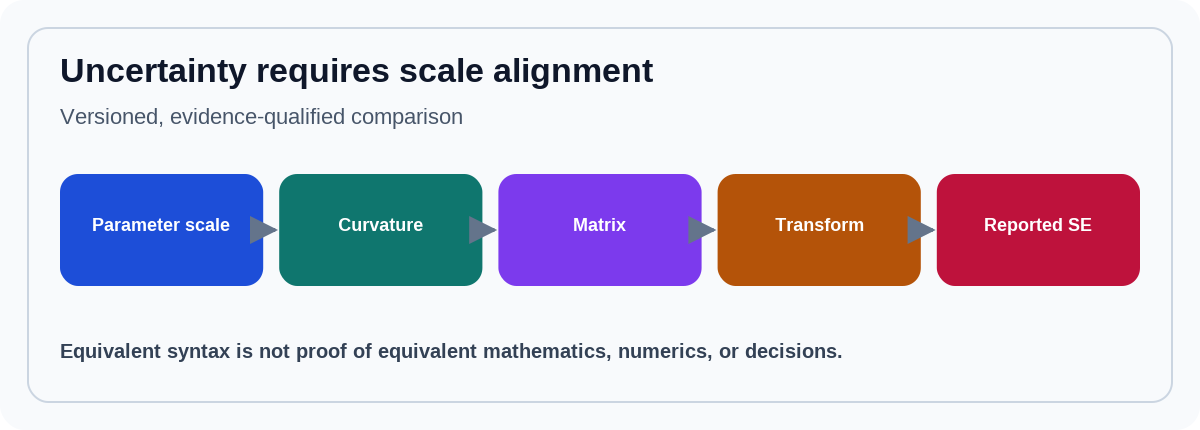
What you will learn
- Align the parameter scale and matrix definition
- Distinguish observed, sandwich, expected, and stochastic FIMs
- Transform covariance before comparing SEs
Prerequisites: Chapter 39 troubleshooting, Chapter 36 command reference, and Chapter 38 output reference.
This page is scoped to nlmx 4.16.2 and an external-documentation snapshot of 2026-11-10. Product names describe different system boundaries; a blank or “outside role” is not a quality ranking. Treat every migration as a new implementation until model semantics, analysis population, objective definition, numerical behavior, outputs, and decisions have been independently reconciled.
nlmx provides R-inverse, S-inverse, and sandwich R^-1 S R^-1 covariance choices from finite differences of total/per-subject objective contributions. NONMEM provides its covariance-step definitions. Monolix documents linearization and stochastic-approximation FIM methods and notes the transformed normally distributed parameter scale. PopED computes expected design FIM variants—including full and reduced forms—so its predicted RSE is not a post-fit covariance estimate.
Create a parameter dictionary: reported symbol, natural scale, estimation/transformed scale, variance versus standard deviation, fixed/free status, and Jacobian. Align OMEGA/SIGMA element order and whether correlations are represented directly or through covariance/Cholesky terms. Transform matrices with the Jacobian before comparing.
Then align matrix definition, likelihood approximation, boundary handling, finite-difference/Monte Carlo precision, and inclusion of fixed/nuisance parameters. Compare eigenvalues/condition numbers and correlations, not only diagonal SEs. Near-singular matrices can yield superficially similar SEs while unstable directions differ.
Set parameter-specific tolerances and require the same qualitative inference/precision classification. Never substitute a PopED expected FIM for empirical post-fit uncertainty without stating the design-model assumptions.
Variance-versus-SD trap
An OMEGA entry of 0.09 is a variance with SD 0.3. If a translated design model expects SD and receives 0.09, the assumed variability is threefold smaller in SD and the FIM can change dramatically. Write the convention beside every input. When converting covariance between log and natural parameter scales, retain the Jacobian and compare the complete matrix; comparing displayed RSE percentages alone can conceal a scale mismatch.
Primary source note: See the official Monolix standard-errors documentation and htmlPopED FIM reference for their respective matrix definitions and scales.
Review checklist
- Are the exact product versions, task boundaries, inputs, methods, and settings named?
- Were semantics and frozen-parameter results aligned before optimized outputs?
- Is the comparison using a method-appropriate deterministic or stochastic tolerance?
- Are unsupported or analogous features described without implying equivalence?
- Can every claim be reproduced from retained primary evidence?
Navigation
See the previous page, next page, and complete comparison reference.