31.17 Proportional categorical effects
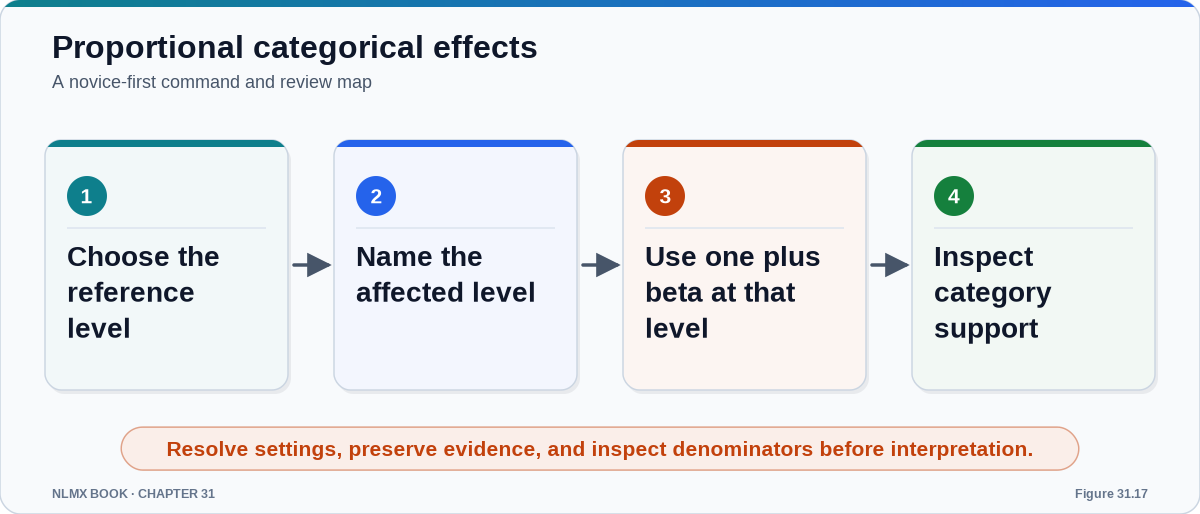
proportional applies factor 1+beta when the covariate equals level, otherwise one. The reference defaults to the median. If exactly one non-reference level exists, nlmx can infer the affected level; otherwise it requires level.
What the controls mean
- A beta of −0.3 means a 30% reduction for the named level.
- Sparse levels reduce information even when total N is large.
- Current power syntax tests one coefficient and one level at a time.
The issued command is only the beginning of the audit trail. Always distinguish the reference model, the design template, the resolved scenario, the replicate-specific truth, the fitted result, and the test decision. A value can be correct at one layer and misinterpreted at another.
Command or settings pattern
--test "CL~SEX=-0.3;form=proportional;level=1;ref=0"
Command-line values override settings-file values. Use a fresh folder for an analytical run; preserve the command, resolved settings, log, checksums, and row-level data. Defaults are versioned behavior, so a production protocol should state important values explicitly.
Interpretation and quality control
Tabulate the affected level by arm and anticipated N; verify coding and reference explicitly.
For a novice review, first confirm counts and labels, then inspect numerical values, then ask whether the assumptions represent the proposed clinical study. For an expert review, additionally reconcile aggregates from row-level output, reproduce a subset of trials, and compare the implementation with an independent reference where the claim requires it.
Common mistakes
- Confusing a factor of 0.7 with exponent −0.3
- Omitting level for a multi-level covariate
- Reporting a point estimate without its denominator, interval, method, and version
Minimum evidence to retain
- nlmx version, command,
.powerfile, resolved settings, seed, threads, and output checksums; - control stream, design dataset, EXT/COV or parameter sets, and their provenance;
- scenario table, replicate rows and failures, method summaries, plots, report, and interpretation;
- prespecified criteria, Monte Carlo target, validation scope, deviations, and reviewer decisions.
Navigation
See the previous page, next page, and complete command and settings index.