14.19 Bioavailability and group-ratio methods
Absolute bioavailability compares dose-normalised systemic exposure after extravascular and intravenous administration:
F = (AUCev / Doseev) / (AUCiv / Doseiv)
The exposures should use compatible definitions and adequate coverage, and the treatments should be comparable in population, analyte, period, and sampling design. A result above 1 is possible through variability or bias and should trigger review; it is not automatically truncated to 1.
When the same subjects receive both routes, within-subject comparison controls some between-subject variability. Missing periods, sequence effects, or long study gaps still matter. A parallel comparison combines more assumptions because different subjects contribute to each route.
Geometric mean ratios
Positive PK endpoints are commonly analysed on the logarithmic scale. If L is the estimated difference in mean log endpoint between test and reference, the geometric mean ratio is exp(L). Confidence limits are also exponentiated from the log scale. nlmx selects a paired comparison when at least half of subjects overlap across groups; otherwise it uses a parallel, Welch-style comparison. That pragmatic rule must not be mistaken for a complete crossover model.
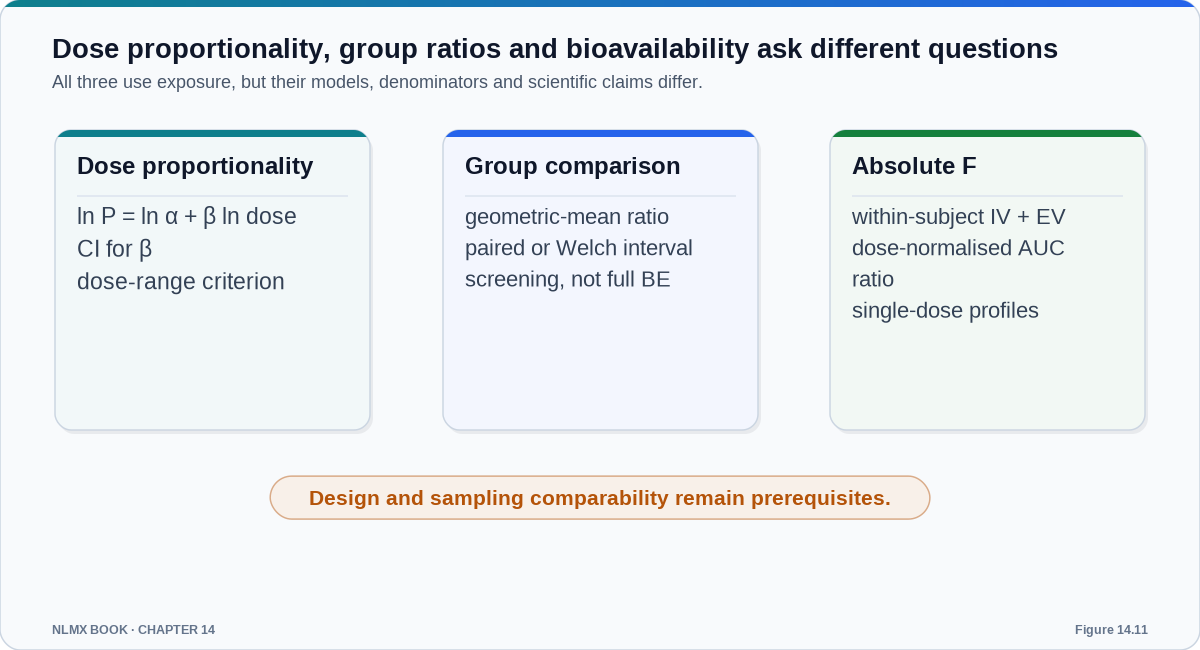
A paired calculation uses only matched subjects and accounts for within-subject differences. A parallel calculation treats group observations as independent and permits unequal variances. Neither method automatically adjusts for sequence, period, carryover, repeated formulations, replicate designs, or other fixed and random effects required by many regulatory bioequivalence analyses.
Scope boundary
These NCA comparisons are useful descriptive or exploratory summaries. They are not a full bioequivalence platform. A confirmatory analysis requires a prespecified model, validated data exclusions, protocol-defined endpoints, multiplicity handling where applicable, and regulatory conventions for the design. Agreement in a simple balanced example does not establish equivalence for complex designs.
Common mistakes
- Comparing unnormalised AUC when route doses differ.
- Mixing AUClast for one group with AUCinf for another.
- Calling an automatically paired result a crossover ANOVA.
- Treating a 90% interval inside 80–125% as universally sufficient regardless of design and endpoint.
Checklist
- Match exposure definition and dose units.
- Verify subject overlap and the selected comparison type.
- Review missing pairs and group imbalance.
- State whether the result is descriptive or confirmatory.
- Use a design-appropriate statistical model for regulatory claims.
Further reading
See dose proportionality, reference-software validation, and Chapter 15 for exact comparison outputs.