12.25 Reading before-and-after results
When corrections are enabled, each applicable checklist row can have an original status and an after-fix status. Read these as two assessments of two different files. A move from FAIL to PASS says the generated source no longer triggers that check; it does not prove semantic equivalence, successful estimation, or scientific validity.
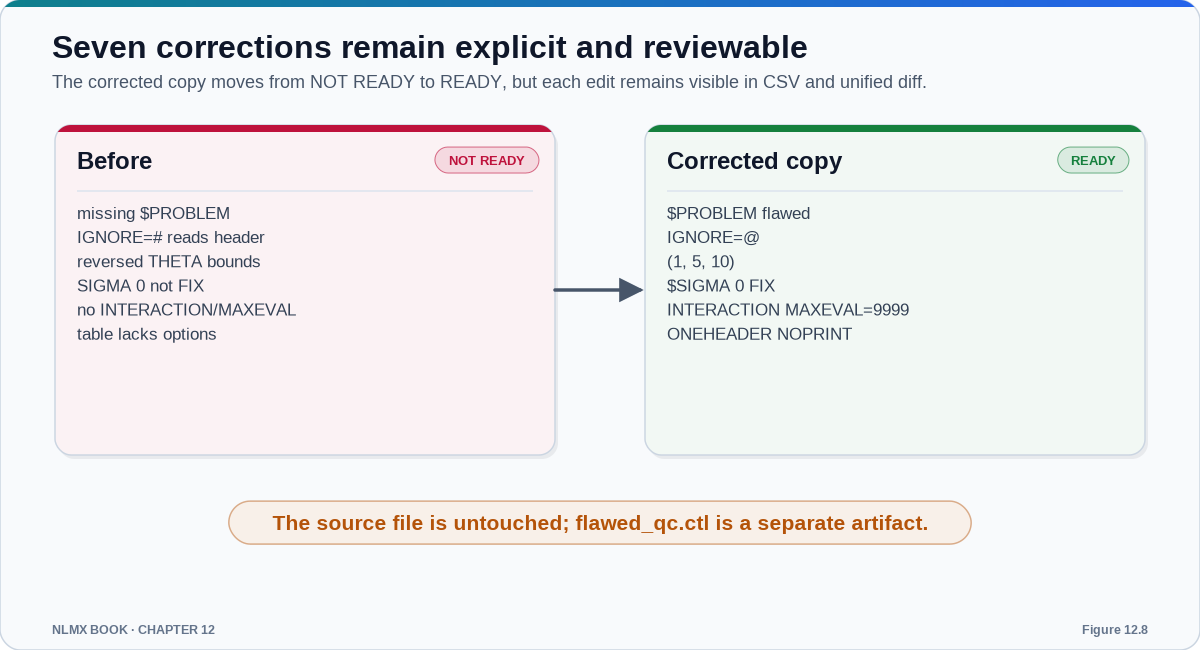
A disciplined reading order
Start with the original verdict and status counts. Then identify each FAIL and WARN, including line numbers and “To do” text. Next, read the changes table and diff. Only then examine the after-fix status and corrected source. This order prevents the green after-state from obscuring what was changed.
In the worked example, the original file is NOT READY: 64 PASS, 6 COMMENT, 1 WARN, 4 FAIL, and 6 N/A across 81 checks. Seven corrections create a candidate that is READY: 72 PASS, 4 COMMENT, no WARN, no FAIL, and 5 N/A. The counts change by more than seven statuses because one edit can affect multiple checks or applicability.
COMMENT is not failure. It records facts or review prompts, such as absence of a covariance step. N/A means the check does not apply to that model context, not that the feature was tested successfully. Always preserve both categories in summaries.
Triage by consequence
Review data-selection changes first, then parameter and estimator changes, then output-schema changes, and finally purely presentational changes. This consequence-based order is often more useful than file line order.
Common mistakes
- Reporting only the after-fix READY verdict.
- Assuming one correction corresponds to exactly one changed check.
- Converting COMMENT or N/A to PASS in dashboards.
- Ignoring a line because its final status is green.
Checklist
- Record original and after-fix verdicts separately.
- Trace every status transition to a diff hunk.
- Preserve COMMENT and N/A meanings.
- Prioritize changes that affect data, parameters, and estimation.
- Execute and numerically compare the reviewed candidate.
Further reading
See the txtworked summary, csvworked changes table, and worked example narrative.