18.4 Random effects and OMEGA
The ETA vector models subject-to-subject deviations. In nlmx’s classical likelihood, active ETAs follow \(\eta_i\sim N(0,\Omega)\). A diagonal OMEGA estimates one variance per ETA and fixes covariances to zero. BLOCK(n) estimates the lower triangle, allowing correlations.
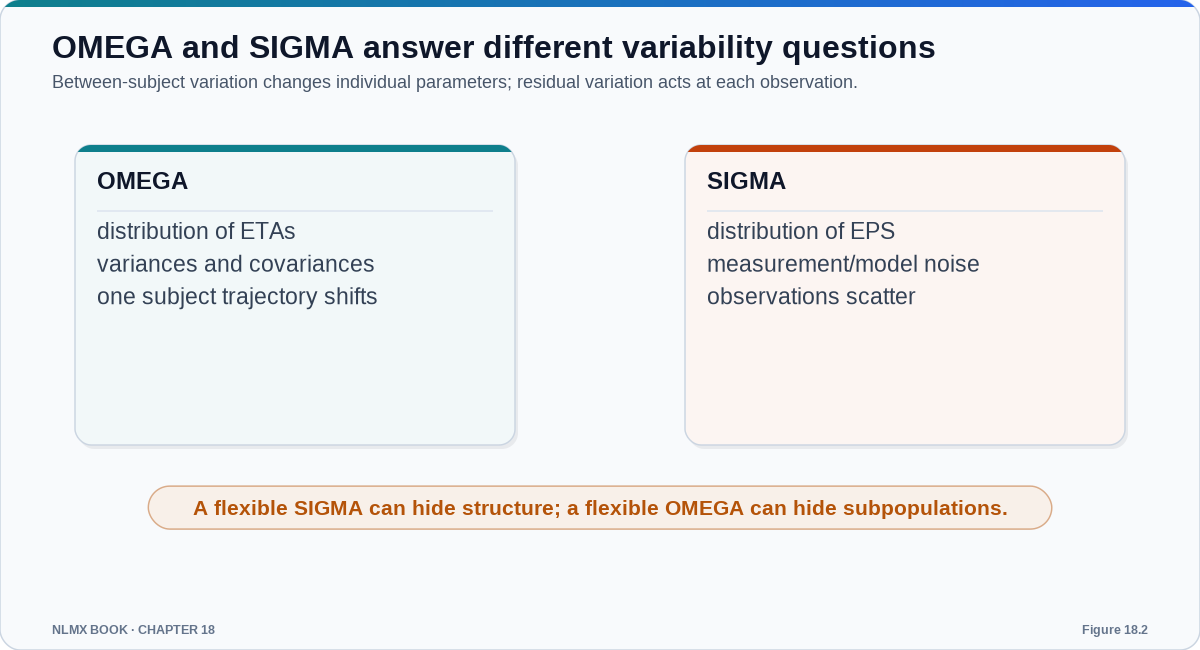
For an exponential parameter model, the ETA standard deviation is on the log scale. nlmx reports the derived coefficient of variation as \(100\sqrt{e^{\omega_{kk}}-1}\). For additive random effects, the square root of a diagonal OMEGA is an SD on that parameter’s scale.
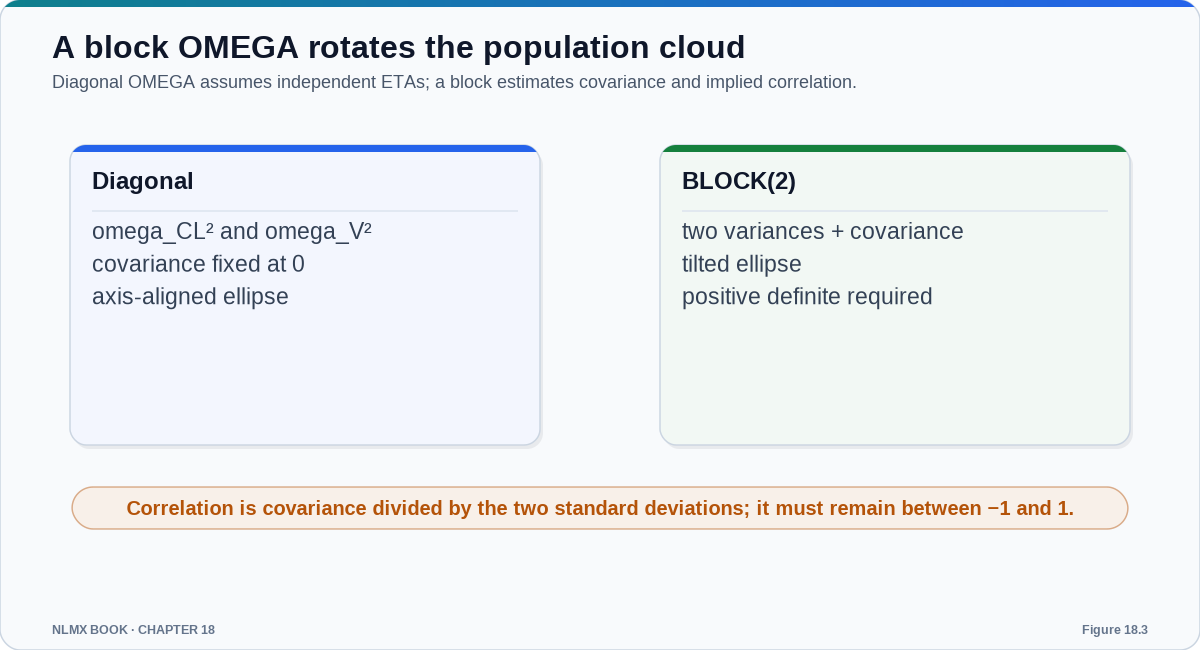
A covariance \(\omega_{kl}\) becomes correlation \(\omega_{kl}/\sqrt{\omega_{kk}\omega_{ll}}\). Strong correlation can be real, parameterization-driven, or a sign that the design cannot separate effects. OMEGA must remain positive definite. nlmx optimizes a Cholesky factor so invalid matrices are not proposed directly.
An initial zero diagonal is treated as fixed, following NONMEM behavior. FIX elements are not estimated; SAME blocks share another block’s elements. The active ETA set therefore depends on both model code and covariance records.
Practical interpretation
Sketch the ETA distribution for a two-parameter model. With diagonal OMEGA the ellipse is aligned to the axes; with positive covariance it tilts upward. Now imagine only trough samples: clearance and volume effects may be difficult to separate, producing a narrow direction in the likelihood. This picture connects OMEGA correlation, design information, EBE correlation and condition number without treating them as identical quantities.
Common mistakes
Do not read an OMEGA variance as a CV percentage, interpret zero covariance as demonstrated independence, or add a full block without enough subjects/design information. A variance near zero is a boundary problem, not automatically proof of no biological variability.
Checklist
- Identify active ETAs and their parameter transformations.
- Distinguish variance, SD, CV, covariance and correlation.
- Check block positive definiteness and boundary warnings.
- Examine EBE correlations alongside estimated OMEGA.
- Report fixed and tied elements explicitly.
Further reading
Continue to residual error, Cholesky parameterization, and shrinkage.