43.1 Why web apps for pharmacometrics
What you will learn
- The questions a clinical pharmacologist is asked, and why they form a chain.
- What goes wrong when each step lives in a different tool.
- Why a browser app on one engine changes the economics of an analysis.
A dose is a promise
A dose promises that a given amount, given a given way, puts enough drug in the body for long enough to work and not so much that it harms. Clinical pharmacology exists to keep that promise for every kind of patient, not only the average one. Three facts make it hard.
- Exposure is not dose. The same dose produces very different concentrations in different people. Clearance and volume change with body weight, age, kidney and liver function, sex, genetics, food, co-medication and disease.
- Response follows exposure. Efficacy and safety relate to concentration, whether peak, trough or area under the curve. Between dose and effect sits a chain: dose, concentration, target engagement, response, and each link varies between people and between occasions.
- The data are sparse, noisy and costly. A phase 2 or 3 study offers a few samples per patient, some below the limit of quantification, from people who miss doses and change co-medication. Only a population model, separating the typical from the explained from the random, can use such data.
The questions form a chain
A clinical pharmacologist is asked questions like these:
- What are a typical patient's clearance and volume, and how much do patients differ?
- Which characteristics change exposure enough to matter, and do they justify another dose?
- What dose gives children the same exposure as adults, and how many stay in the therapeutic window?
- Is the model good enough to trust for those decisions?
- How many patients are needed to detect a covariate effect or an exposure-response relationship with 80% power?
- Is the dataset itself correct, so none of the above rests on a coding error?
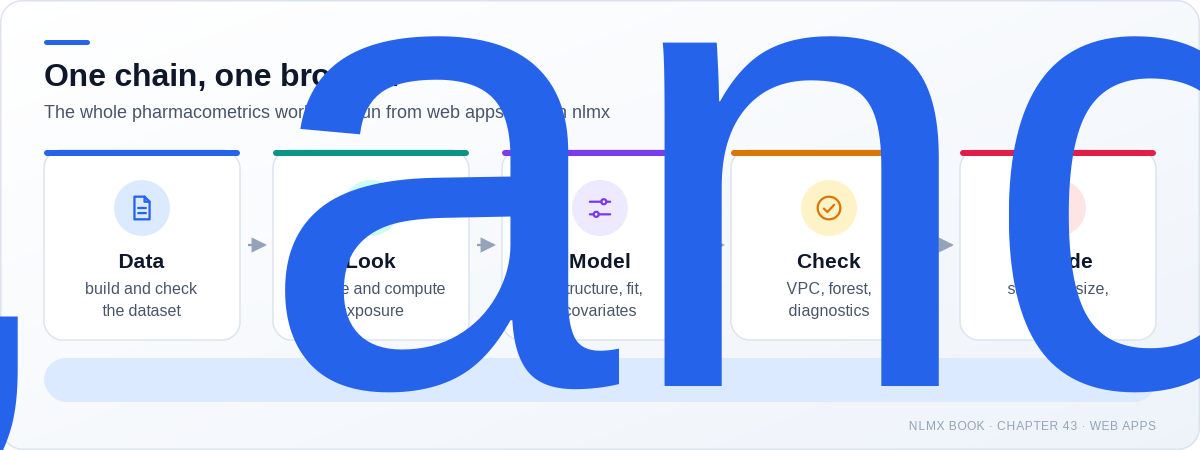
Answering them is a chain of tasks: check the data, explore it, build a structural model, estimate it, find covariates, evaluate the model, simulate other populations and doses, size the next study, relate exposure to response. When each task belongs to a different tool, every handover converts files by hand, hides a silent error, and makes the analysis hard to repeat and to audit.
What the web apps change
nlmx answers the chain in one program, and the apps put that program where analysts already work: the browser. Four properties follow from the design.
- One input format. The NONMEM dataset and control stream are read directly. The
.ext,.covand.phifiles of a fit are read by the covariate, predictive-check, forest, simulation and power steps. - One kind of settings file. A form in an app and a settings file are two views of the same thing, so work moves freely between the browser and scripted use.
- One output style. Tables as CSV, a self-contained report, publication figures, a text summary and, for the main commands, a manifest with the checksum of every input.
- One engine. A single native program does the work, with no compile step. A VPC, an exposure simulation or a power study starts immediately because nothing has to be built first.
On top of that the apps add what a command line does not give: a guided form with the checks a run needs, a live preview of the exact command, a live console with progress, and result views that turn the files into tables, plots and comparisons, in the same place and with the same look for every step.
Positioning
The standard for a pharmacometrics workflow today is not a single clever estimator. It is how much of the chain is covered, how quickly an answer appears, how little is lost between steps, and how well the work can be repeated and explained. On those measures the nlmx apps are built to be the reference point: complete coverage of the chain in one suite, an engine without a compile step, automation that carries each result into the next step, and two assistants that turn plain requests into real, auditable runs.
Practical consequences
- A new analyst can run a correct end-to-end analysis the first day, because each form shows what a run needs and refuses to start when something fails the checks.
- An experienced modeller saves the time that used to disappear into file conversion and waiting for builds.
- A reviewer can open any run folder and see precisely what was run, with which settings, on which files.
Navigation
See the previous page, next page, and the chapter overview.