21.8 IWRES: individually weighted residuals
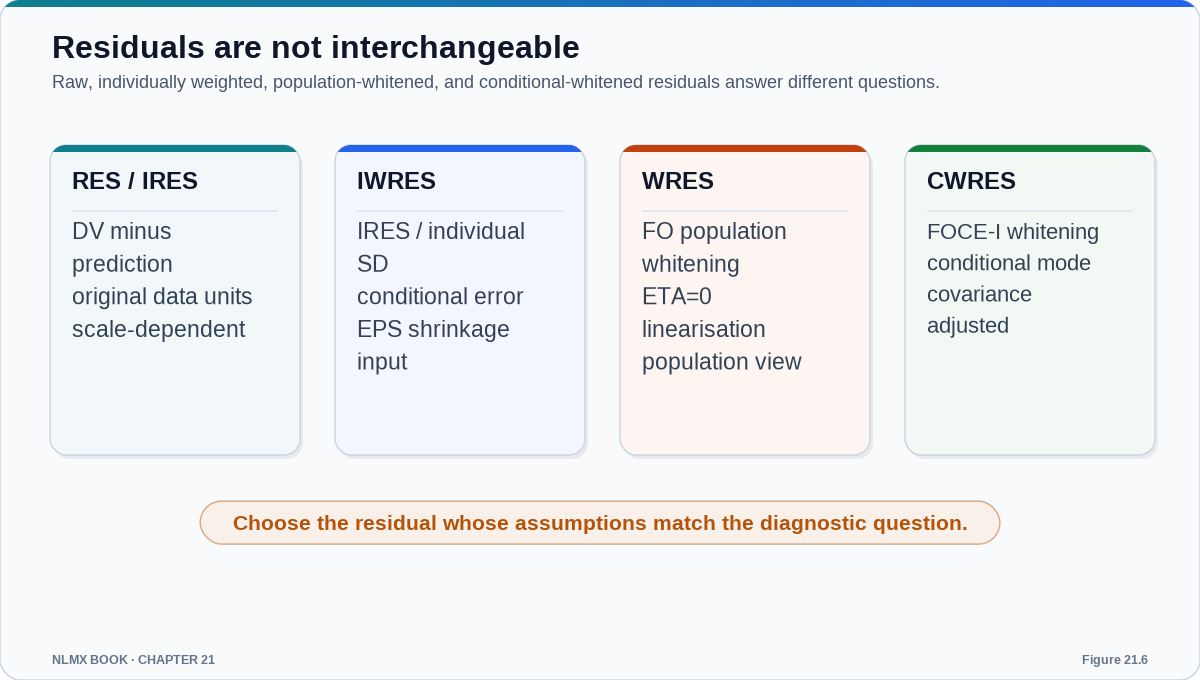
IWRES standardizes the conditional residual using the residual standard deviation evaluated at the individual prediction:
IWRES = (DV - IPRED) / sqrt(V at the conditional ETA)
For the Chapter 20 combined-error model, W = sqrt((theta_prop × IPRED)^2 + theta_add^2) and IWRES is IRES divided by W. If the conditional error model is appropriate, IWRES should be centered around zero with broadly stable spread across IPRED and time.
Because IWRES conditions on fitted EBEs, it is useful for assessing the residual-error model after individual differences are accounted for. It does not fully adjust for uncertainty in the EBE or the way random effects influence observations across a subject. CWRES provides a different linearized population/conditional diagnostic.
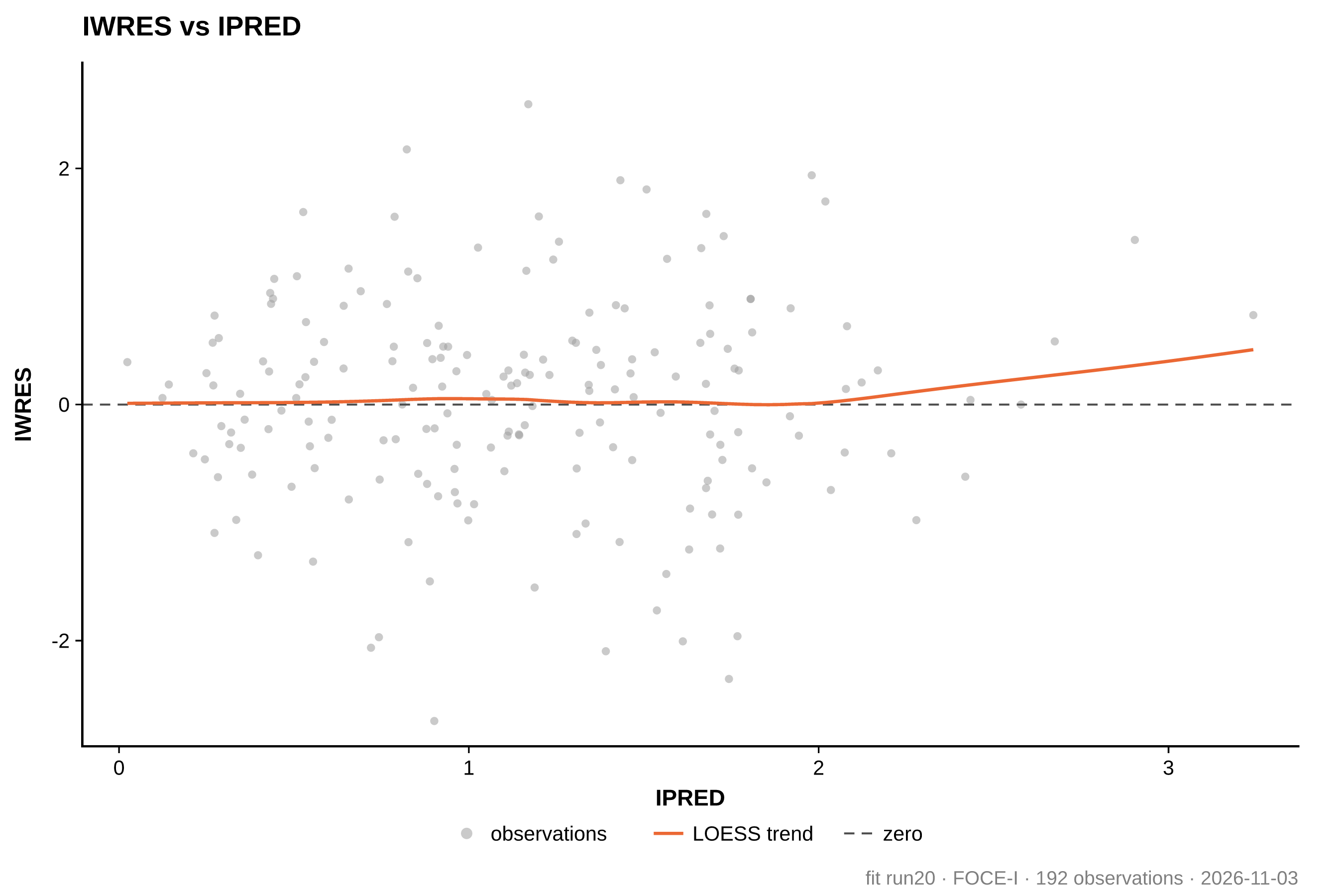
The nlmx standard panel plots IWRES against IPRED. A widening fan suggests that the declared error SD grows too slowly; narrowing suggests it grows too quickly. Curvature around zero suggests mean-model bias. Isolated extreme IWRES should be traced to assay, timing, dosing, transcription, or model causes before any exclusion decision.
EPS shrinkage is calculated as 1 - SD(IWRES) under the documented standard-deviation definition. The Chapter 20 example reports about 12.1%. This summary is model- and dataset-dependent and should not replace inspection of distribution shape or subgroups.
Common mistakes
- Assuming IWRES is independent within subject.
- Treating all values outside ±2 as errors to delete.
- Ignoring a fan pattern because the mean trend is flat.
- Comparing IWRES generated under different error parameterizations directly.
- Using EPS shrinkage without inspecting the IWRES distribution.
Checklist
- Verify the residual variance formula and scale.
- Review center, spread, curvature, tails, and clusters.
- Plot by IPRED, time, endpoint, and relevant strata.
- Trace extremes to complete subject/event histories.
- Report EPS shrinkage with its definition.
Further reading
See residual distributions and outliers, EPS shrinkage, and residual error parameterization.