24.22 Group elastic net and equation-level selection
Group elastic net penalizes all columns belonging to one equation together. Categorical contrasts and spline bases therefore enter or leave as a group instead of producing a partial relationship based on one favorable column.
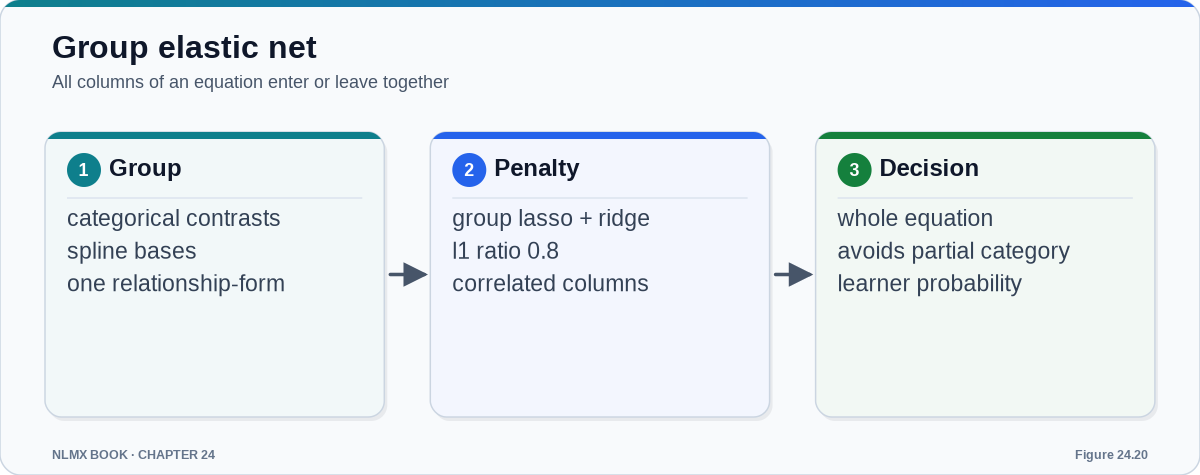
The default L1 ratio is 0.8 and lambda selection uses the minimum-CV rule. Group size affects penalty behavior, so feature scaling and group definitions matter. A selected group still requires coefficient/form interpretation after refitting; group selection only says the equation contributed predictive structure.
Agreement between adaptive and group elastic nets is valuable when candidates have multiple columns. Disagreement can reveal that only one contrast or basis direction carries signal.
Common mistakes
- Treating group selection as evidence for every contrast.
- Comparing groups of different size without understanding penalty behavior.
- Building groups that mix alternative equations.
- Ignoring CV-rule differences from the primary learner.
- Reporting penalized group coefficients clinically.
Checklist
- Verify one group per relationship-form.
- Review group sizes and scaling.
- Record L1 ratio, lambda grid, and selection rule.
- Inspect learner disagreement.
- Refit and interpret the whole relationship.
Further reading
See multi-df features and form stability.