Prerequisites and final-model readiness
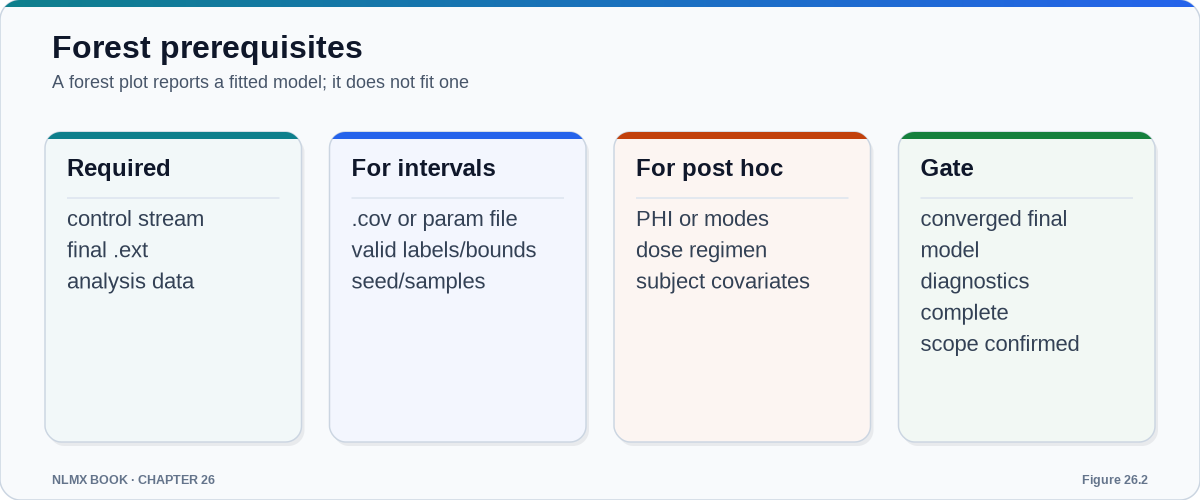
The required input is the fitted control stream plus final estimates and analysis data. Confidence intervals normally require a usable covariance matrix or a bootstrap/SIR parameter file. Post hoc exposure requires individual ETAs from PHI or successful conditional-mode estimation. The dose, interval, infusion, and compartment must define the intended steady-state regimen.
Before plotting, confirm minimization and covariance-step success, plausible parameter estimates, acceptable gradients and conditioning, stable covariate coefficients, residual and predictive diagnostics, and a model code version matching the estimates. A forest command reads and evaluates this fitted model; it does not rerun estimation.
The Chapter 26 example first fits the Chapter 23A three-effect SCM model under nlmx 4.14.3. It converges at OFV −1157.8135 and produces a covariance matrix with correlation-condition number 7.41 plus PHI records for all 60 subjects. These are the forest inputs—not the earlier unconfirmed draft.
Common mistakes
- Treating a forest ratio or reference-band class as covariate-selection evidence, causality, or an automatic dosing recommendation.
- Omitting the reference subject, uncertainty source, regimen, subgroup denominator, data support, or fitted-model diagnostics.
- Confusing parameter-uncertainty intervals, BSV ranges, and subject-bootstrap intervals because they share one graphic.
Page checklist
- The numerator, denominator, fitted model, covariate settings, and units are explicit.
- The interval source and clinical meaning are distinguished from BSV and selection uncertainty.
- Tables, resolved settings, commands, diagnostics, limitations, and confirmation evidence are retained.