36.32 Shared simulation, uncertainty, and compute options
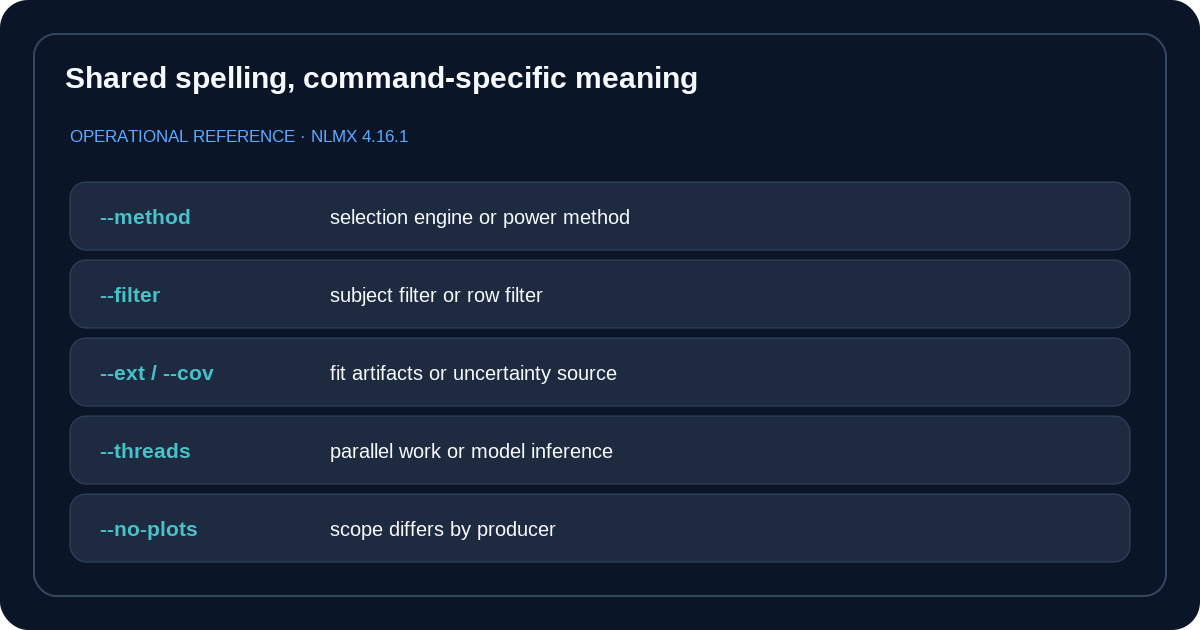
This chapter is a lookup reference for nlmx 4.16.1. Option tables are generated from the installed release executable. Read an option in the context of the command page: nlmx uses a global parser, but an accepted option can be irrelevant to a command unless its help text names that command or the command's method chapter defines the behavior.
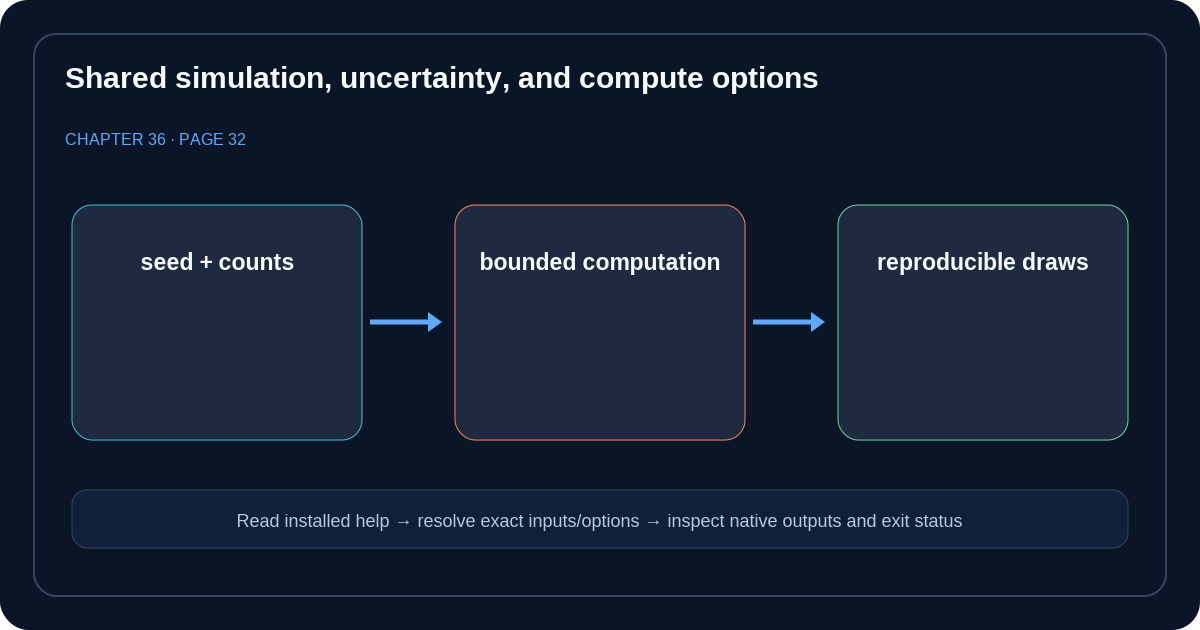
The safe sequence is: identify the installed version, open that command's help, freeze input/settings/output paths, run into a new or empty output directory, inspect both the process status and the command-native verdict, and retain the log/resolved settings/checksums. A command line is reproducible only when its referenced files and software version are also frozen.
Bound stochastic and expensive work deliberately
--seed is the master seed for supported uncertainty draws, resampling, posterior draws, VPC simulations, autoinit learning, and other stochastic stages. Replicate terms are not interchangeable: --samples generally describes VPC simulated datasets; --subproblems describes full study simulations; --replicates is used by resampling/analysis contexts; --study-replicates defines simulation-study trials.
--threads changes throughput but is intended not to change analytical results. Still validate determinism for the command/version and avoid oversubscribing CPUs when several jobs run concurrently. Parameter uncertainty can come from .cov draws or an explicit parameter file; record its ordering, positive-definiteness handling, and mapping to replicates.
Estimate storage and time before enabling per-observation simulation outputs, large bootstrap counts, retry grids, or many scenarios. Use checkpoints where supported, preserve partial evidence, and distinguish a timeout/interruption from a numerical failure.
Novice review checklist
- Can you identify the exact installed nlmx version and canonical command?
- Are positional inputs, named options, settings, and output paths unambiguous?
- Did you distinguish parser acceptance from command-specific meaning?
- Will the run preserve enough native evidence to determine semantic success?
- Is a qualified human decision required after the software completes?
Navigation
See the previous page, next page, and complete command index.