Choosing frozen, SCM, posterior, or both
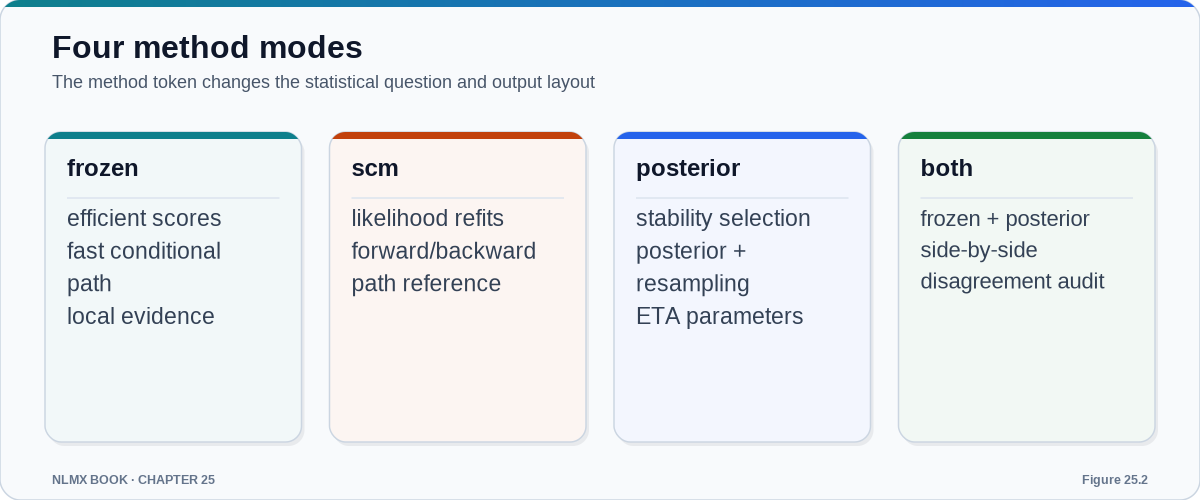
Choose the method from the question, not from the result you hope to see. frozen asks whether local efficient-score evidence remains after nuisance adjustment and is the fastest broad screen. scm repeatedly refits nested population models and applies likelihood-ratio thresholds, making it the most direct path-based reference within nlmx. posterior asks whether ETA–covariate features are selected repeatedly across posterior draws, subject resamples, and learners. both runs frozen and posterior and writes a relationship-level comparison.
Eligibility also matters. Posterior selection needs a parameter-linked ETA and usable subject posterior information; a fixed-effect parameter without an ETA may be testable only by frozen/SCM. SCM cost can be prohibitive for a wide ODE scope. Frozen local approximations need escalation when base stationarity, curvature, or candidate effects make the local boundary doubtful.
Define a primary engine and escalation rule prospectively. A practical hierarchy is frozen for broad screening, posterior as a robustness layer, and exhaustive SCM or targeted reference fits for consequential disagreements. both is not a voting rule: the engines answer different questions, and concordance is stronger evidence only after each individual engine is valid.
Common mistakes
- Changing the scientific question after seeing the result while presenting it as the original run.
- Reading one engine's summary without checking its prerequisites, failures, normalized settings, and fitted endpoint.
- Treating a generated draft, comparison label, or completed checkpoint as a substitute for model diagnostics and reference-software confirmation.
Page checklist
- The exact command, version, inputs, resolved settings, and output directory are identifiable.
- Engine-specific evidence is interpreted on its own scale before cross-method comparison.
- Recovery state, final refit, diagnostics, and remaining confirmation work are explicit.