37.36 Version migration and qualification playbook
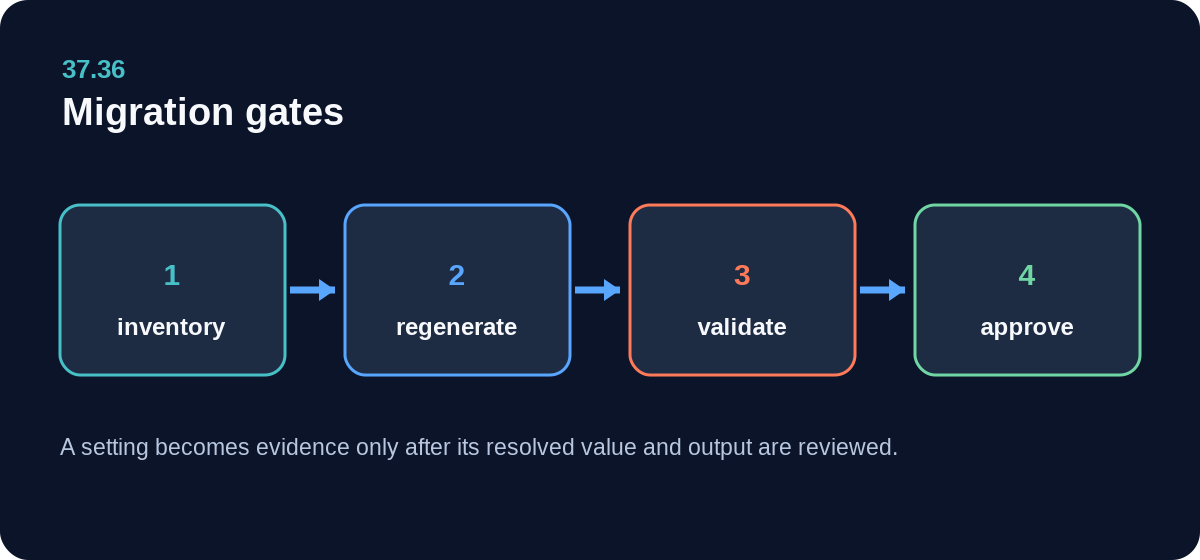
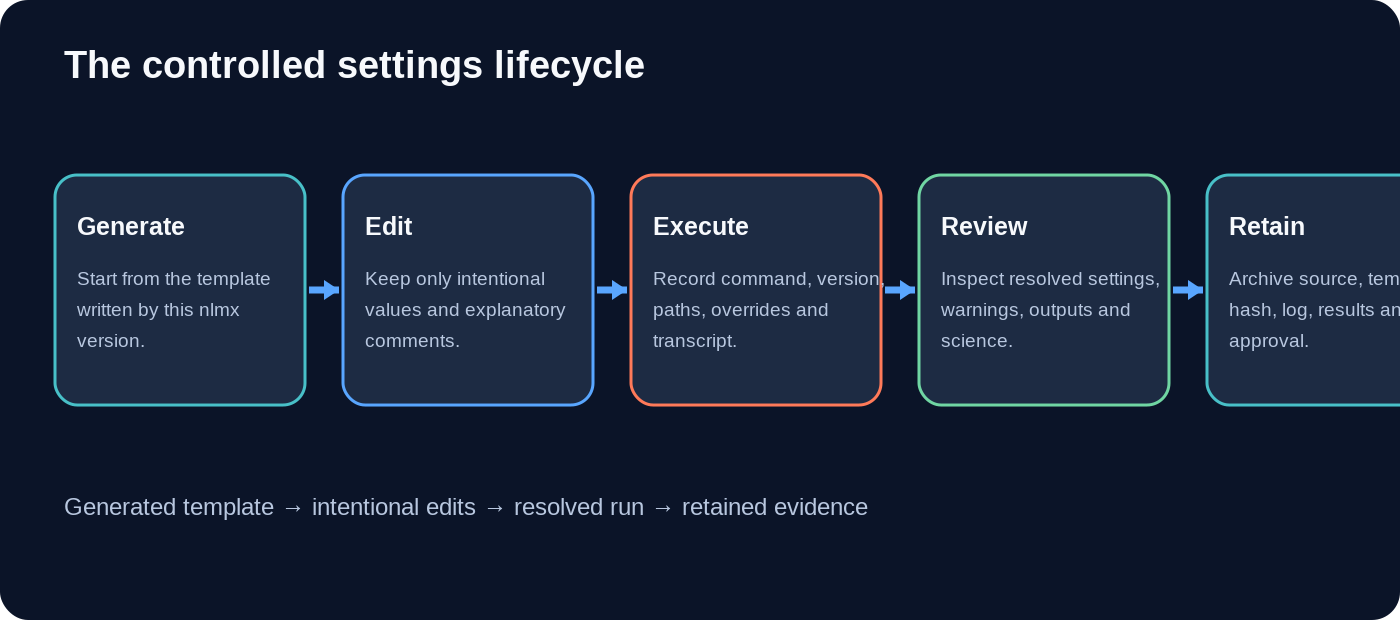
Use this playbook when upgrading nlmx, importing an older project, or standardising settings from another team. The objective is not merely a zero exit code; it is preservation—or deliberate, approved change—of the analysis intent.
1. Freeze the old evidence
Copy the old settings, exact executable version, command, transcript, key inputs, output inventory, checksums and known limitations into a read-only migration bundle. Record whether the old run was actually approved. Never overwrite the only working evidence while experimenting with a new release.
2. Inventory the interface
Identify the owning command and required extension. Generate the new release's annotated template. Compare sections, keys, types, allowed values, defaults stated in annotations, path rules and CLI options. Classify every difference as added, removed, renamed/aliased, type-changed, default-changed, range-changed, semantic-change or documentation-only.
3. Build a minimal migrated file
Start from the new template, not the old file. Transfer one intentional setting group at a time. Use canonical spellings. Reconstruct relative paths from the new file's location. Keep a migration decision table with old path/value, new path/value, reason, evidence and reviewer.
4. Exercise validation and failure behavior
Run in an empty disposable output. Use inspect, validate, command dry-run support, --list-checks, --list-plots or plan-only behavior as applicable. Intentionally test a misspelled key, wrong extension and impossible value in disposable copies so the team knows the guardrails are active. Review all warnings and the resolved command context.
5. Compare scientific outputs
Define acceptance criteria before looking at results. Compare included subjects/rows, artifact identities, estimates, objective functions, uncertainty, random-seed behavior, selected models/covariates, plots, tables and failure denominators. Numerical differences need method-appropriate absolute/relative tolerances and investigation; visual similarity is insufficient.
6. Approve and retire
Have a qualified reviewer approve the migrated intent and evidence. Update automation and training material, preserve the previous version for traceability, and mark the old settings as superseded rather than deleting them. If equivalence cannot be established, document the new run as a changed analysis rather than an invisible software upgrade.
Final release checklist
- Every settings file has the correct command-specific extension.
- Every active key exists in the fresh template or is verified as an accepted compatibility form.
- CLI overrides and environment-dependent paths are captured.
- Important defaults are either made explicit or tied to a versioned template.
- Disposable validation and expected-failure tests pass.
- Scientific and operational comparisons meet prespecified criteria.
- Inputs, settings, transcripts, outputs, hashes and review are retained.
Navigation
See the previous page, next page, and complete settings reference.