Troubleshooting, limitations, and validation
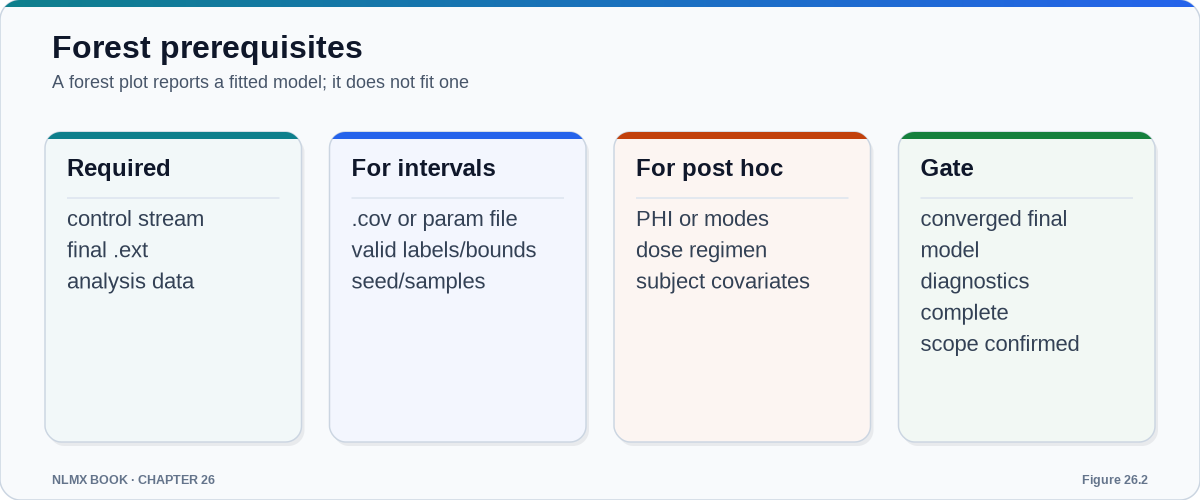
Common failures include missing/mismatched .ext or .cov, wrong result stem, absent data, unknown parameter/covariate, no changing model row, invalid reference/value, inadmissible parameter draws, missing PHI/mode failure, absent II, wrong dosing compartment, or unsupported regimen. Start from console paths and notes before changing options.
Validation should include analytic equation checks; covariance-draw reproducibility; bootstrap-file fixtures; category/reference cases; scenario composition; BSV calculations; inverse reciprocity; exposure grid convergence; AUC versus dose/CL in linear models; PHI versus reconstructed modes; common/own regimen cases; and thread/seed determinism. Compare selected outputs with an independent implementation or NONMEM simulation where accuracy claims matter.
Scientific limitations include model-selection uncertainty, extrapolation, correlated covariates, time-varying covariates summarized at baseline, shrinkage, empirical subgroup confounding, and a reference band that may not represent clinical relevance. Report them beside the figure.
Common mistakes
- Treating a forest ratio or reference-band class as covariate-selection evidence, causality, or an automatic dosing recommendation.
- Omitting the reference subject, uncertainty source, regimen, subgroup denominator, data support, or fitted-model diagnostics.
- Confusing parameter-uncertainty intervals, BSV ranges, and subject-bootstrap intervals because they share one graphic.
Page checklist
- The numerator, denominator, fitted model, covariate settings, and units are explicit.
- The interval source and clinical meaning are distinguished from BSV and selection uncertainty.
- Tables, resolved settings, commands, diagnostics, limitations, and confirmation evidence are retained.