37.6 Dataset-QC settings: complete generated key catalogue
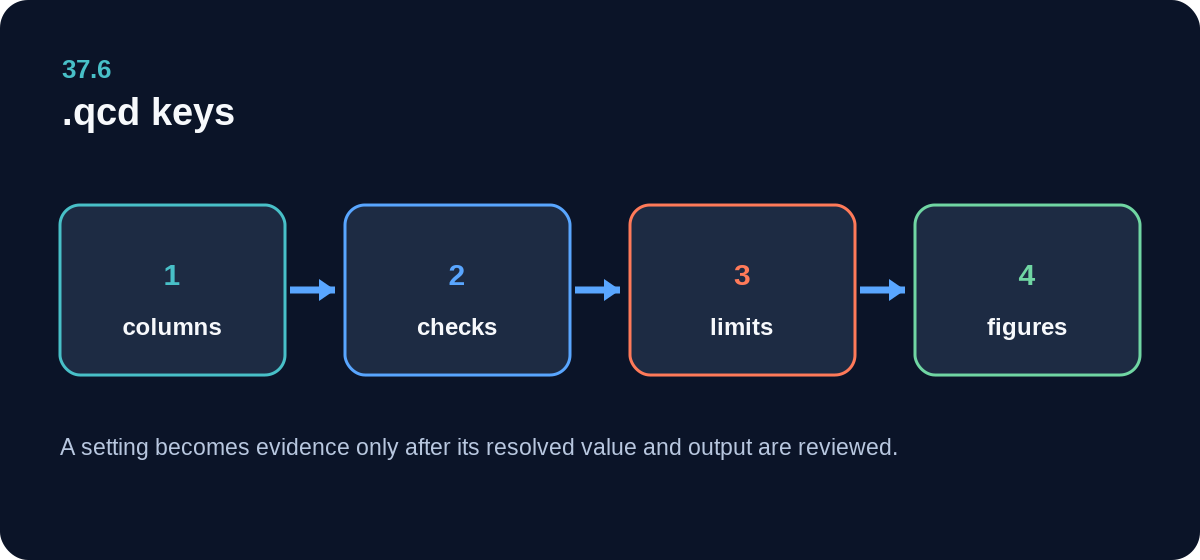
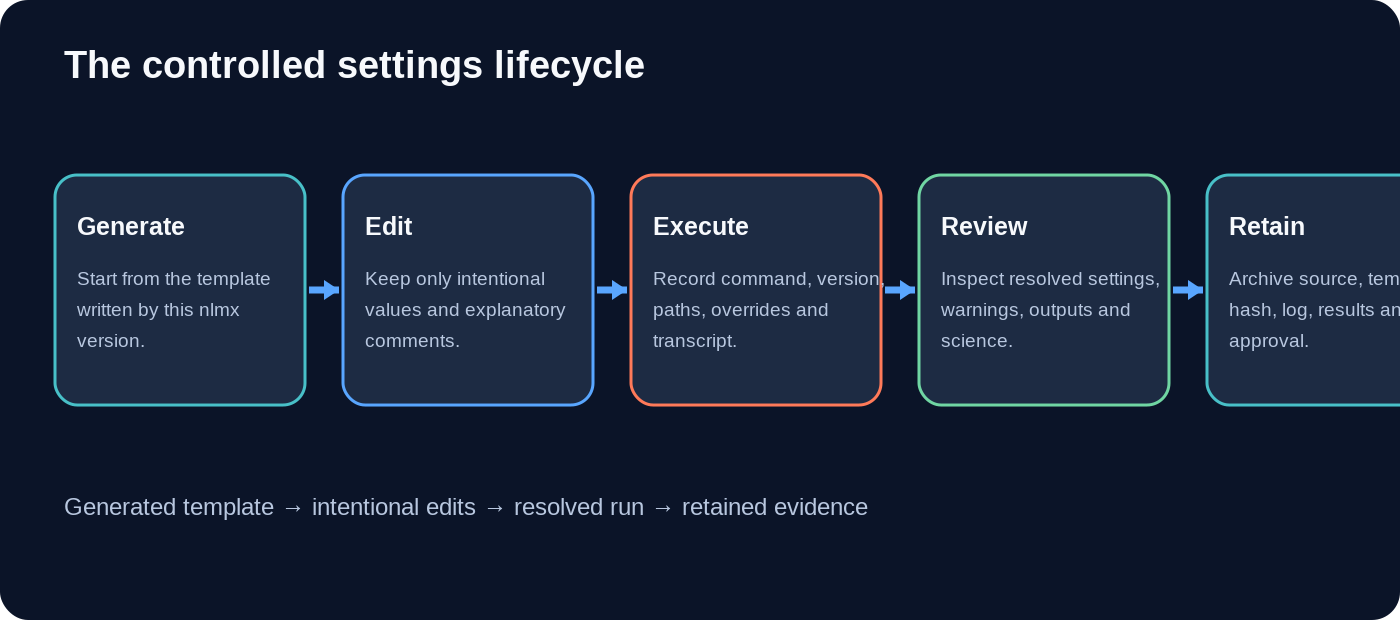
This is the exhaustive generated-template catalogue for nlmx.qcd in nlmx 4.16.2. It contains 233 unique dotted key paths. “Active” means the generated example assigns the key; “commented example” means the template exposes it without assigning it. The value column is a template value or example—not automatically the program default. Defaults and constraints are reported only when the nearby template annotation states them.
How to use the table
Search by the full table and key context. Preserve TOML type: do not quote numbers or Booleans, and do not replace an array with a comma-separated string unless the template explicitly uses a string grammar. When two settings interact, use the orientation page and command chapter to review the combination rather than interpreting rows independently.
data
| Key | Type | Template state | Generated value/example | Template annotation and constraints |
|---|---|---|---|---|
file |
string | commented example | "data/pk.csv" |
the dataset (or give it on the command line) |
id |
string | active | "ID" |
column names (any case) |
time |
string | active | "TIME" |
No default or constraint is stated on this template line; consult the command page and resolved run. |
dv |
string | active | "DV" |
No default or constraint is stated on this template line; consult the command page and resolved run. |
amt |
string | active | "AMT" |
No default or constraint is stated on this template line; consult the command page and resolved run. |
evid |
string | active | "EVID" |
No default or constraint is stated on this template line; consult the command page and resolved run. |
mdv |
string | active | "MDV" |
No default or constraint is stated on this template line; consult the command page and resolved run. |
cmt |
string | active | "CMT" |
No default or constraint is stated on this template line; consult the command page and resolved run. |
rate |
string | active | "RATE" |
No default or constraint is stated on this template line; consult the command page and resolved run. |
addl |
string | active | "ADDL" |
No default or constraint is stated on this template line; consult the command page and resolved run. |
ii |
string | active | "II" |
No default or constraint is stated on this template line; consult the command page and resolved run. |
ss |
string | active | "SS" |
No default or constraint is stated on this template line; consult the command page and resolved run. |
filter |
string | commented example | 'STUDY != 3' |
Row filter (R syntax), as NONMEM IGNORE/ACCEPT: rows that fail it are left out of the checks, doses and observations alike. Quoted text compares as text. |
obs_filter |
string | commented example | "DVID == 1" |
observation rows only (doses are always kept) |
groups |
array | active | [] |
Grouping columns (study, arm, formulation): constant within an individual unless listed in [subjects] time_varying_groups. e.g. ["STUDY", "ARM"] |
lloq |
number | commented example | 0.05 |
lower limit of quantification (enables the BLQ checks) |
blq |
string | commented example | "BLQ" |
a column flagging BLQ samples (non-zero) |
dv_log |
Boolean | active | false |
DV is ln(concentration) |
columns
| Key | Type | Template state | Generated value/example | Template annotation and constraints |
|---|---|---|---|---|
tad |
string | commented example | "TAD" |
Optional columns that switch on further checks (any case). time after the latest dose: compared with the dosing history |
nominal_time |
string | commented example | "NTIM" |
scheduled time: compared with TIME |
dvid |
string | commented example | "DVID" |
observation type (parent, metabolite, PD): listed per type |
lloq_column |
string | commented example | "LLOQ" |
the LLOQ of each record (when it differs by assay or study) |
file
| Key | Type | Template state | Generated value/example | Template annotation and constraints |
|---|---|---|---|---|
delimiter |
string | active | "auto" |
auto | comma | tab | space | semicolon |
ignore |
string | active | "@" |
the IGNORE option you plan to put in $DATA: |
max_line_length |
integer | active | 1000 |
# the NM-TRAN default: skip records with # in column 1 C (any character) skip records with it in column 1 none no IGNORE: every line is data characters; NM-TRAN stops reading long… |
header
| Key | Type | Template state | Generated value/example | Template annotation and constraints |
|---|---|---|---|---|
required |
array | active | ["ID", "TIME", "DV"] |
No default or constraint is stated on this template line; consult the command page and resolved run. |
recommended |
array | active | ["AMT", "EVID", "MDV", "CMT"] |
columns that must exist |
max_name_length |
integer | active | 20 |
columns whose absence is only noted NM-TRAN labels are at most 20 characters |
max_items |
integer | active | 50 |
data items NM-TRAN accepts (DROP columns do not count) |
extra_reserved |
array | active | [] |
more names that may not be used as column labels |
values
| Key | Type | Template state | Generated value/example | Template annotation and constraints |
|---|---|---|---|---|
text_columns |
array | active | [] |
columns that hold text on purpose (to be DROPped in $INPUT) |
missing_markers |
array | active | ["NA", "N/A", "#N/A", "NAN", "NULL", "NIL", "NONE", "MISSING", "-", "--", "?", "..",… |
No default or constraint is stated on this template line; consult the command page and resolved run. |
sentinels |
array | active | [-99, -999, -9999, -99999, 99999, 999999] |
text that stands for a missing value elsewhere but cannot be read by NM-TRAN |
max_abs |
number | active | 1e10 |
numbers used as missing codes (reported where a covariate or DV has one) values larger in magnitude are suspect |
max_field_length |
integer | active | 24 |
NM-TRAN data items are at most 24 characters |
max_id_digits |
integer | active | 15 |
IDs with more digits lose precision as numbers |
events
| Key | Type | Template state | Generated value/example | Template annotation and constraints |
|---|---|---|---|---|
evid_values |
array | active | [0, 1, 2, 3, 4] |
No default or constraint is stated on this template line; consult the command page and resolved run. |
ss_values |
array | active | [0, 1, 2, 3] |
EVID values NONMEM knows SS values NONMEM knows (3 from NONMEM 7.3) |
max_cmt |
integer | active | 99 |
largest compartment number (a negative CMT turns it off) |
min_infusion_duration |
number | commented example | 0.01 |
No default or constraint is stated on this template line; consult the command page and resolved run. |
max_infusion_duration |
integer | commented example | 24 |
AMT / RATE shorter than this is suspect |
time
| Key | Type | Template state | Generated value/example | Template annotation and constraints |
|---|---|---|---|---|
first_dose_at_zero |
Boolean | active | true |
the first dose of an individual is at time 0 |
zero_tolerance |
number | active | 1e-9 |
how close to 0 counts as 0 |
max_time |
integer | active | 100000 |
a larger TIME suggests dates, seconds or clock times |
max_gap |
integer | commented example | 720 |
report gaps between consecutive records longer than this |
tad_tolerance |
number | active | 0.01 |
allowed difference between TAD and the time since the dose |
nominal_tolerance |
number | active | 0.5 |
allowed difference between TIME and the nominal time ... |
nominal_relative |
number | active | 0.1 |
... or this fraction of the nominal time, whichever is larger |
dosing
| Key | Type | Template state | Generated value/example | Template annotation and constraints |
|---|---|---|---|---|
require_dose |
Boolean | active | true |
every individual with observations needs a dose (false: PD or baseline data) |
require_observation |
Boolean | active | true |
every dosed individual needs observations |
dose_ratio |
integer | active | 10 |
a dose this many times above or below the typical dose is suspect ... |
rare_dose_fraction |
number | active | 0.02 |
... when it is rarer than this fraction of the doses |
irregular_cv |
number | active | 0.25 |
coefficient of variation of the dosing intervals that counts as irregular |
min_interval |
integer | commented example | 1 |
shortest plausible interval between doses |
observations
| Key | Type | Template state | Generated value/example | Template annotation and constraints |
|---|---|---|---|---|
negative_ok |
Boolean | active | false |
DV may be negative (PD, change from baseline) |
zero_ok |
Boolean | active | false |
DV of 0 is genuine (not BLQ, not pre-dose) |
max_blq_fraction |
number | active | 0.2 |
fraction of BLQ observations above which to warn |
blq_tolerance |
number | active | 0.000001 |
relative tolerance when comparing DV with the LLOQ |
predose_tolerance |
number | active | 0.0 |
pre-dose concentrations up to this are accepted (endogenous compounds) |
min_per_individual |
integer | active | 2 |
fewest observations of an individual |
outlier_k |
number | active | 4.5 |
outliers: robust z-score beyond this (MAD scale) at similar times after the dose ... |
outlier_min_fold |
number | active | 3.0 |
... and at least this fold away from the typical value |
outlier_bins |
integer | active | 10 |
time bins (equal counts) for the comparison |
outlier_min_n |
integer | active | 8 |
fewest observations in a bin |
outlier_dose_normalise |
Boolean | active | true |
No default or constraint is stated on this template line; consult the command page and resolved run. |
rebound_fold |
number | active | 5.0 |
compare concentrations per unit dose when there are several dose levels spike: a value this many times above both neighbours |
sampling_bins |
integer | active | 0 |
bins of the sampling-design table and plot (0 = automatic) |
subjects
| Key | Type | Template state | Generated value/example | Template annotation and constraints |
|---|---|---|---|---|
min_records |
integer | active | 2 |
fewest records of an individual |
record_count_k |
number | active | 5.0 |
records per individual beyond this many robust SDs are reported (0 = off) |
time_varying_groups |
array | active | [] |
grouping columns allowed to change within an individual |
covariates
| Key | Type | Template state | Generated value/example | Template annotation and constraints |
|---|---|---|---|---|
columns |
array | active | [] |
the covariates to check (default: every column that is not a NONMEM |
exclude |
array | active | [] |
data item, a bookkeeping column or text) columns that are never covariates |
categorical |
array | active | [] |
covariates to treat as categorical (default: whole numbers with few levels) |
continuous |
array | active | [] |
covariates to treat as continuous |
time_varying |
array | active | [] |
covariates that change within an individual |
max_levels |
integer | active | 12 |
most levels of a covariate detected as categorical |
min_level_n |
integer | active | 3 |
fewest individuals of a level before it is called rare |
max_missing_fraction |
number | active | 0.0 |
fraction of records of an individual that may lack a covariate value |
outlier_iqr |
number | active | 3.0 |
Tukey fences: beyond this multiple of the IQR from the quartiles (0 = off) |
collinearity_r |
number | active | 0.8 |
|r| (continuous) or Cramér's V (categorical) at which to warn |
check_derived |
Boolean | active | true |
BMI and BSA against weight and height |
derived_tolerance |
number | active | 0.1 |
allowed relative difference |
max_relative_change |
number | active | 0.5 |
time-varying covariates: largest relative change between records (0 = off) |
time_varying_fraction |
number | active | 0.5 |
a covariate is time-varying when more than this fraction of the |
covariates.ranges
| Key | Type | Template state | Generated value/example | Template annotation and constraints |
|---|---|---|---|---|
AGE |
array | active | [0, 120] |
Plausible ranges [low, high]; a value outside is reported. The covariates named here are checked; an empty list ([]) removes a built-in range. |
WT |
array | active | [0.3, 350] |
No default or constraint is stated on this template line; consult the command page and resolved run. |
WGT |
array | active | [0.3, 350] |
No default or constraint is stated on this template line; consult the command page and resolved run. |
BW |
array | active | [0.3, 350] |
No default or constraint is stated on this template line; consult the command page and resolved run. |
HT |
array | active | [20, 250] |
No default or constraint is stated on this template line; consult the command page and resolved run. |
HGT |
array | active | [20, 250] |
No default or constraint is stated on this template line; consult the command page and resolved run. |
BMI |
array | active | [8, 80] |
No default or constraint is stated on this template line; consult the command page and resolved run. |
BSA |
array | active | [0.05, 3.5] |
No default or constraint is stated on this template line; consult the command page and resolved run. |
covariates.levels
| Key | Type | Template state | Generated value/example | Template annotation and constraints |
|---|---|---|---|---|
SEX |
array | commented example | [0, 1] |
Expected levels of categorical covariates; any other value is reported. |
RACE |
array | commented example | [1, 2, 3, 4] |
No default or constraint is stated on this template line; consult the command page and resolved run. |
checks
| Key | Type | Template state | Generated value/example | Template annotation and constraints |
|---|---|---|---|---|
skip |
array | active | [] |
check IDs or categories that are not run, e.g. ["REC13", "COV"] |
only |
array | active | [] |
run only these (IDs or categories); [] = all |
severity
| Key | Type | Template state | Generated value/example | Template annotation and constraints |
|---|---|---|---|---|
FIL01 |
string | commented example | "error" |
The severity of a check: "error" (FAIL), "warning" (WARN), "comment" (COMMENT) or "off". The defaults are shown; remove the # to change one. file — File and format Can the file be… |
FIL02 |
string | commented example | "error" |
Is the file free of a byte-order mark (BOM) at its start? |
FIL03 |
string | commented example | "warning" |
Is the file plain ASCII, without accented, typographic or other non-ASCII characters? |
FIL04 |
string | commented example | "warning" |
Are the line endings the same on every line (no mix of CRLF and LF, no lone CR)? |
FIL05 |
string | commented example | "warning" |
Is one field delimiter used throughout (not commas and tabs mixed)? |
FIL06 |
string | commented example | "warning" |
Is the file free of blank lines between the records? |
FIL07 |
string | commented example | "error" |
Does every data record begin with a number (no comment lines, text lines or flagged records)? |
FIL08 |
string | commented example | "error" |
Does every record have as many fields as the header has columns? |
FIL09 |
string | commented example | "warning" |
Are there no trailing or doubled delimiters (empty extra fields)? |
FIL10 |
string | commented example | "error" |
Are the data fields free of quotation marks? |
FIL11 |
string | commented example | "warning" |
Is every record shorter than the line-length limit? |
FIL12 |
string | commented example | "warning" |
Does the last line end with a line terminator? |
HDR01 |
string | commented example | "error" |
header — Header and column names Are the required columns present (ID, TIME and DV by default)? |
HDR02 |
string | commented example | "warning" |
Are the recommended NONMEM columns present (AMT, EVID, MDV and CMT by default)? |
HDR03 |
string | commented example | "error" |
Is the first line a header of names (not numbers), with no blank names? |
HDR04 |
string | commented example | "error" |
Are the column names unique, ignoring upper and lower case? |
HDR05 |
string | commented example | "error" |
Are the column names valid NM-TRAN labels (letters, digits and underscore, beginning with a letter)? |
HDR06 |
string | commented example | "error" |
Is every column name within the length limit (20 characters)? |
HDR07 |
string | commented example | "warning" |
Are the column names free of NM-TRAN reserved words and abbreviated-code functions? |
HDR08 |
string | commented example | "warning" |
Is the number of columns within the NM-TRAN limit (50 data items, DROP not counted)? |
VAL01 |
string | commented example | "error" |
values — Values and data types Are ID, TIME, DV, AMT, EVID, MDV, CMT, RATE, ADDL, II and SS numeric in every record? |
VAL02 |
string | commented example | "warning" |
Are the other columns numeric, or text columns that you will DROP in $INPUT? |
VAL03 |
string | commented example | "error" |
Are missing values written as blank or '.', and not as NA, NaN, NULL, N/A, - or similar? |
VAL04 |
string | commented example | "error" |
Do the numbers use a decimal point (no decimal commas or thousands separators)? |
VAL05 |
string | commented example | "error" |
Do ID and TIME have a value in every record? |
VAL06 |
string | commented example | "warning" |
Are the numbers free of sentinel codes for 'missing' (-99, -999, ...)? |
VAL07 |
string | commented example | "warning" |
Are all numbers finite and of a magnitude NONMEM handles (not above 1e10)? |
VAL08 |
string | commented example | "error" |
Is every field at most 24 characters long (the NM-TRAN data item limit)? |
VAL09 |
string | commented example | "error" |
Are the IDs whole numbers of at most 15 digits, and do different ID strings stay different as numbers? |
VAL10 |
string | commented example | "warning" |
Is every column filled in at least once (no completely empty columns)? |
REC01 |
string | commented example | "error" |
records — Records and NONMEM data items Is EVID 0, 1, 2, 3 or 4 in every record? |
REC02 |
string | commented example | "error" |
Is MDV 0 or 1 in every record? |
REC03 |
string | commented example | "error" |
Is MDV consistent with EVID (MDV = 1 on every record that is not an observation)? |
REC04 |
string | commented example | "error" |
Does every observation record (EVID 0, MDV 0) have a DV? |
REC05 |
string | commented example | "comment" |
Which observations are excluded on purpose (EVID 0 with MDV 1)? |
REC06 |
string | commented example | "warning" |
Do dose and other-event records have no DV (blank, '.' or 0)? |
REC07 |
string | commented example | "warning" |
Does every dose record (EVID 1 or 4) have a positive AMT? |
REC08 |
string | commented example | "error" |
Are AMT and II non-negative, RATE 0 or above (or -1, -2), and ADDL a non-negative whole number? |
REC09 |
string | commented example | "error" |
Do observation records (EVID 0) have no dose amount? |
REC10 |
string | commented example | "error" |
Is CMT a whole number within the range of compartments (|CMT| at most 99)? |
REC11 |
string | commented example | "comment" |
Which compartments receive the doses and which are observed, and is CMT given on every record when it is used? |
REC12 |
string | commented example | "error" |
Is RATE positive only on dose records with a positive AMT? |
REC13 |
string | commented example | "warning" |
Are the infusion durations (AMT / RATE) within the limits you set? |
REC14 |
string | commented example | "error" |
Does ADDL > 0 come with II > 0, and is II > 0 used with ADDL or SS? |
REC15 |
string | commented example | "error" |
Are ADDL, II and SS used on dose records only? |
REC16 |
string | commented example | "error" |
Is SS one of 0, 1, 2, 3, and is SS > 0 on a dose record with II > 0? |
REC17 |
string | commented example | "warning" |
Are there no duplicated records (all fields identical; doses are checked by REC19)? |
REC18 |
string | commented example | "warning" |
Are there no two observations of one individual at one time and compartment with different DV? |
REC19 |
string | commented example | "warning" |
Are there no two doses of one individual at one time and compartment (a double dose)? |
REC20 |
string | commented example | "comment" |
Which reset and other-type events (EVID 2, 3, 4) are in the data? |
TIM01 |
string | commented example | "error" |
time — Time Is TIME non-decreasing within each individual (a lower time only on a reset record)? |
TIM02 |
string | commented example | "error" |
Are the records of each ID together in one block (no ID reappears after another)? |
TIM03 |
string | commented example | "warning" |
Is TIME free of negative values? |
TIM04 |
string | commented example | "warning" |
Is the largest TIME plausible for the time unit (below the limit you set)? |
TIM05 |
string | commented example | "comment" |
Which observations share a time with a dose of the same individual, and do they come before or after the dose? |
TIM06 |
string | commented example | "warning" |
Is the time between consecutive records of an individual below the gap limit you set? |
TIM07 |
string | commented example | "warning" |
Does the TAD column equal the time since the latest dose? |
TIM08 |
string | commented example | "warning" |
Is the actual TIME close to the nominal time? |
TIM09 |
string | commented example | "comment" |
Which observations come before the first dose of the individual? |
DOS01 |
string | commented example | "warning" |
dosing — Dosing Does every individual with observations have at least one dose record? |
DOS02 |
string | commented example | "warning" |
Does every individual with a dose have at least one observation? |
DOS03 |
string | commented example | "warning" |
Is the first dose of each individual at TIME 0? |
DOS04 |
string | commented example | "comment" |
Does the dose amount stay the same within each individual? |
DOS05 |
string | commented example | "warning" |
Are all dose amounts near the usual dose levels (no unit slips of 10 times or more)? |
DOS06 |
string | commented example | "comment" |
Are the dosing intervals regular within each individual? |
DOS07 |
string | commented example | "comment" |
What are the dose levels, routes (compartments) and regimens? |
OBS01 |
string | commented example | "error" |
observations — Observations Does the dataset have observation records? |
OBS02 |
string | commented example | "warning" |
Is DV free of negative values? |
OBS03 |
string | commented example | "warning" |
Are the DV values of 0 explained (before the first dose or flagged as BLQ)? |
OBS04 |
string | commented example | "warning" |
Are BLQ observations handled consistently (flag agrees with the LLOQ, one imputation rule)? |
OBS05 |
string | commented example | "warning" |
Is the fraction of BLQ observations below the limit you set? |
OBS06 |
string | commented example | "warning" |
Are there concentrations far from those of other individuals at similar times after the dose? |
OBS07 |
string | commented example | "warning" |
Are there isolated spikes within an individual's profile (a value far above both neighbours after the peak)? |
OBS08 |
string | commented example | "warning" |
Are the concentrations before the first dose zero or below the quantification limit? |
OBS09 |
string | commented example | "warning" |
Does every individual have at least the minimum number of observations? |
OBS10 |
string | commented example | "warning" |
Does every individual have at least one quantifiable concentration after the first dose? |
OBS11 |
string | commented example | "warning" |
Is the scale of DV as declared (natural concentrations or their logarithm)? |
OBS12 |
string | commented example | "comment" |
Which observation types are present (DVID or compartment) and how many records has each? |
OBS13 |
string | commented example | "comment" |
What is the sampling design (observations per individual and times after the dose)? |
SUB01 |
string | commented example | "comment" |
subjects — Individuals How many individuals, records, doses and observations does the dataset have? |
SUB02 |
string | commented example | "warning" |
Does every individual have more than one record? |
SUB03 |
string | commented example | "warning" |
Do the grouping columns stay constant within each individual? |
SUB04 |
string | commented example | "warning" |
Is the number of records per individual free of extreme values? |
SUB05 |
string | commented example | "warning" |
Does every individual have at least one observation that is used (MDV 0)? |
SUB06 |
string | commented example | "comment" |
Does every individual start with a dose or event record (not an observation)? |
COV01 |
string | commented example | "comment" |
covariates — Covariates Which covariates were examined, and are they continuous, categorical or time-varying? |
COV02 |
string | commented example | "warning" |
Are the covariates free of missing values (blank, '.' or a sentinel code)? |
COV03 |
string | commented example | "warning" |
Are the covariate values within plausible ranges? |
COV04 |
string | commented example | "warning" |
Are the baseline covariates constant within each individual? |
COV05 |
string | commented example | "warning" |
Do the categorical covariates have the expected levels, none of them rare? |
COV06 |
string | commented example | "warning" |
Are the continuous covariates free of extreme values (beyond the Tukey fences)? |
COV07 |
string | commented example | "comment" |
Is every covariate variable (more than one value)? |
COV08 |
string | commented example | "warning" |
Are the continuous covariates free of strong pairwise correlation (|r| below the limit)? |
COV09 |
string | commented example | "warning" |
Are derived covariates consistent with their parts (BMI and BSA from weight and height)? |
COV10 |
string | commented example | "warning" |
Do the magnitudes of AGE, WT and HT suggest the usual units (years, kg, cm)? |
COV11 |
string | commented example | "warning" |
Do time-varying covariates change plausibly between consecutive records? |
NMT01 |
string | commented example | "error" |
nonmem — NONMEM readiness Will the IGNORE option you plan to use skip the header line and nothing else? |
NMT02 |
string | commented example | "comment" |
Which $DATA and $INPUT statements fit this file? |
NMT03 |
string | commented example | "comment" |
Which special data items are used, and what do they require of the model? |
output
| Key | Type | Template state | Generated value/example | Template annotation and constraints |
|---|---|---|---|---|
directory |
string | commented example | "pk_qc_data" |
default: |
html |
Boolean | active | true |
report.html: verdict, checklist, findings, tables, figures |
json |
Boolean | active | true |
qc_summary.json |
tables |
Boolean | active | true |
qc_columns.csv, qc_subjects.csv, qc_dosing.csv, qc_sampling.csv, |
flagged_dataset |
Boolean | active | false |
qc_events.csv and the covariate tables qc_flagged_data.csv: the dataset with a QC_FLAG column per record |
nonmem_statements |
Boolean | active | true |
qc_nonmem.txt: suggested $INPUT and $DATA |
max_findings |
integer | active | 1000 |
findings kept per check |
examples |
integer | active | 5 |
findings quoted in the checklist comment |
fail_on |
string | active | "never" |
never | error | warning: the exit status is 7 when the data have |
figures
| Key | Type | Template state | Generated value/example | Template annotation and constraints |
|---|---|---|---|---|
concentration |
Boolean | active | true |
all concentration-time profiles, dose-normalised by dose level |
concentration_yscale |
string | active | "log" |
log | linear |
max_profiles |
integer | active | 0 |
draw at most this many profiles (0 = all) |
sampling |
Boolean | active | true |
sampling times after the dose |
swimmer |
Boolean | active | true |
one line per individual: doses, observations, BLQ, flagged records |
swimmer_per_page |
integer | active | 40 |
individuals per page of the swimmer plot |
swimmer_max_pages |
integer | active | 10 |
most pages drawn (0 = all); individuals with findings come first |
distributions |
Boolean | active | true |
DV, observations per individual |
covariates |
Boolean | active | true |
covariate distributions |
covariate_nrow |
integer | active | 3 |
panels per page of the covariate plots: rows ... |
covariate_ncol |
integer | active | 3 |
... and columns |
correlation |
Boolean | active | true |
correlation heat map of the continuous covariates |
missingness |
Boolean | active | true |
missing values per covariate |
findings |
Boolean | active | true |
findings per check |
plots
| Key | Type | Template state | Generated value/example | Template annotation and constraints |
|---|---|---|---|---|
enabled |
Boolean | active | true |
Figures of the analysis (plots/*.png), in the style of ggplot2's theme_classic(). They are written by default; --no-plots turns them off. --no-plots |
width |
integer | active | 7 |
--plot-width in units |
height |
integer | active | 5 |
--plot-height |
units |
string | active | "in" |
--plot-units in | cm | mm | px |
dpi |
integer | active | 300 |
--plot-dpi PNG resolution |
base_size |
integer | active | 11 |
--plot-base-size base font size (points) |
format |
string | active | "png" |
--plot-format png | svg | both |
title |
Boolean | active | true |
--plot-no-title turns it off |
legend |
Boolean | active | true |
--plot-no-legend turns it off |
plots.colors
| Key | Type | Template state | Generated value/example | Template annotation and constraints |
|---|---|---|---|---|
observed |
string | commented example | "#000000" |
observations in the swimmer plot |
outer |
string | commented example | "#2A78D6" |
doses, histogram bars |
median |
string | commented example | "#EB6834" |
additional doses (ADDL) |
points |
string | commented example | "#9E9E9E" |
concentration profiles, BLQ and MDV = 1 records |
outside |
string | commented example | "#D62728" |
rings around records with a warning or an error |
reference |
string | commented example | "#4D4D4D" |
time span of an individual |
Catalogue review checklist
- The key appears under the intended table and uses the exact spelling.
- Its TOML type matches the generated example.
- Any stated enumeration, range or unit is satisfied.
- Required companion keys and mutually exclusive choices are reconciled.
- Relative paths resolve from the documented base.
- CLI overrides are recorded with the run.
- The effective value and its scientific consequence are reviewed in output evidence.
Source snapshot: nlmx.qcd.
Navigation
See the previous page, next page, and complete settings reference.