simulate-study as the operating-characteristics bridge
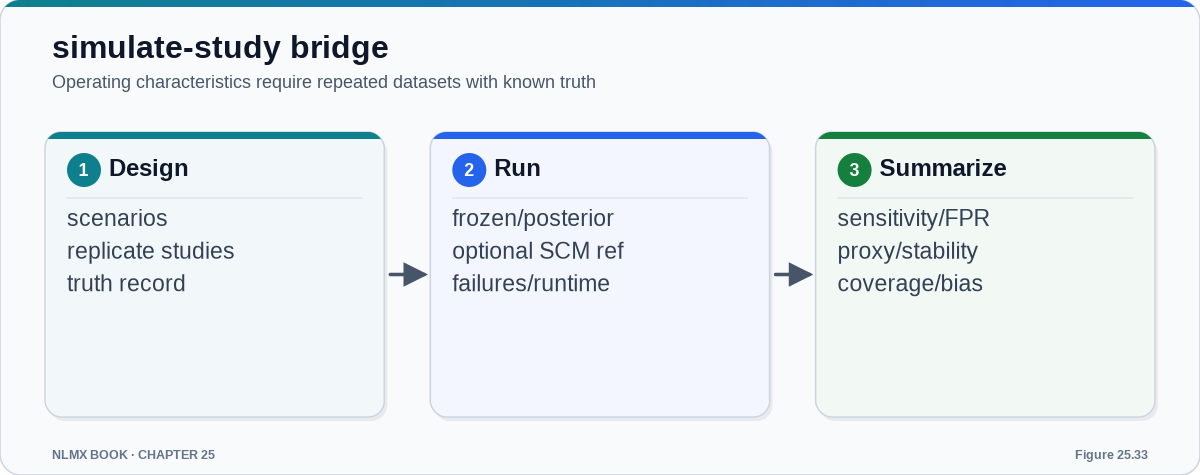
One dataset cannot establish sensitivity, false-positive rate, stability, or comparative accuracy. nlmx simulate-study creates repeated synthetic datasets under known truth and selected scenarios, runs configured methods, and summarizes recovery. --scm-reference can add refit-based SCM as a reference alongside faster engines.
Design scenarios should span effect size, sample size, sampling density, shrinkage, covariate correlation, rare categories, missingness, model misspecification, and computation failures. Store truth records and per-replicate results, not only aggregate percentages. Seeds and failure handling must be explicit.
Chapter 29 provides the full command reference. Here the key principle is qualification: use simulation to define where frozen acceleration and posterior stability preserve decisions, where proxies replace true covariates, and where escalation is mandatory. Avoid generalizing from the Chapter 25 teaching run.
Common mistakes
- Changing the scientific question after seeing the result while presenting it as the original run.
- Reading one engine's summary without checking its prerequisites, failures, normalized settings, and fitted endpoint.
- Treating a generated draft, comparison label, or completed checkpoint as a substitute for model diagnostics and reference-software confirmation.
Page checklist
- The exact command, version, inputs, resolved settings, and output directory are identifiable.
- Engine-specific evidence is interpreted on its own scale before cross-method comparison.
- Recovery state, final refit, diagnostics, and remaining confirmation work are explicit.