18.10 First-order estimation (FO)
FO linearizes every subject at \(\eta^\star=0\) and evaluates residual variance at zero. It therefore avoids conditional modes while evaluating the population OFV. The approximate subject covariance is \(G_0\Omega G_0^{\mathsf T}+R(0)\).
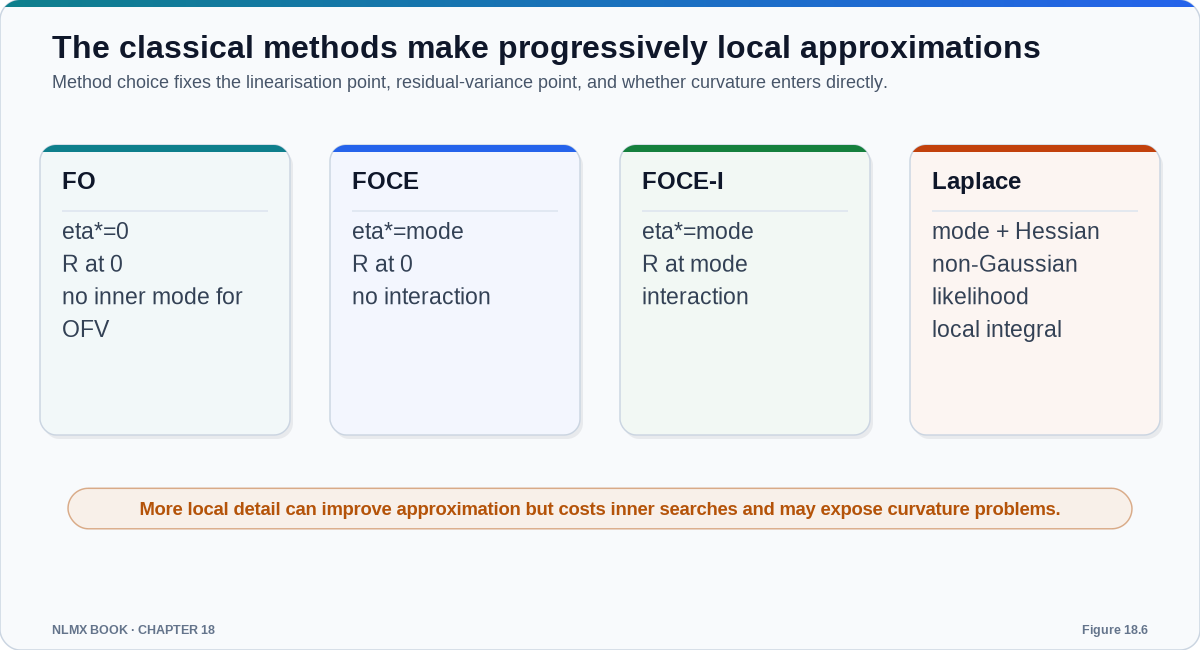
FO is fast and historically important. It can provide useful exploratory estimates when variability is modest and the model is close to linear in ETA. Its weakness is that the same tangent is used for every subject, including those whose plausible ETA lies far from zero. Nonlinearity can bias fixed effects and variances, and rich subject information is not used to choose a local expansion point.
In nlmx, FO can still calculate post hoc conditional modes when individual estimates/precision are requested, but those modes do not define the FO population OFV. This distinction explains why an output may contain EBEs even though the objective was linearized at zero.
FO corresponds to NONMEM METHOD=0. Compare it only with the same method and error interpretation. It is not a cheap preview of a FOCE-I OFV; the objective itself differs.
Practical interpretation
FO is most informative as a defined approximation and reference case. Run it on a simulation with small OMEGA, then increase variability while holding all else fixed. Track bias, OFV behavior and convergence relative to a conditional method. This controlled sequence teaches where the zero-ETA tangent stops representing the population, without confounding method sensitivity with a changed model or dataset.
Common mistakes
Do not interpret FO’s speed as evidence of equal accuracy, or compare its OFV with FOCE-I for LRT/AIC without a declared method change. Avoid assuming EBEs printed after an FO fit were used in population estimation.
Checklist
- Confirm expansion and residual variance are at ETA zero.
- Assess nonlinearity and variability magnitude.
- Label FO results clearly in tables.
- Refit pivotal models with a conditional method.
- Compare fixed-parameter predictions before blaming the estimator.
Further reading
Read conditional modes and FOCE to see what conditional estimation adds.