37.20 Structural-screening settings: complete generated key catalogue
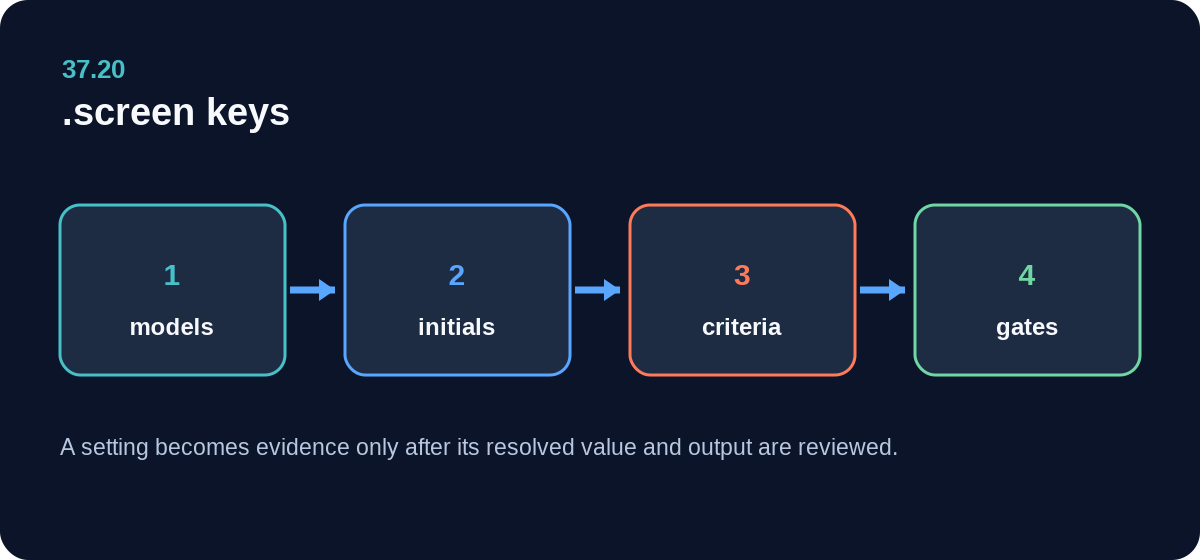
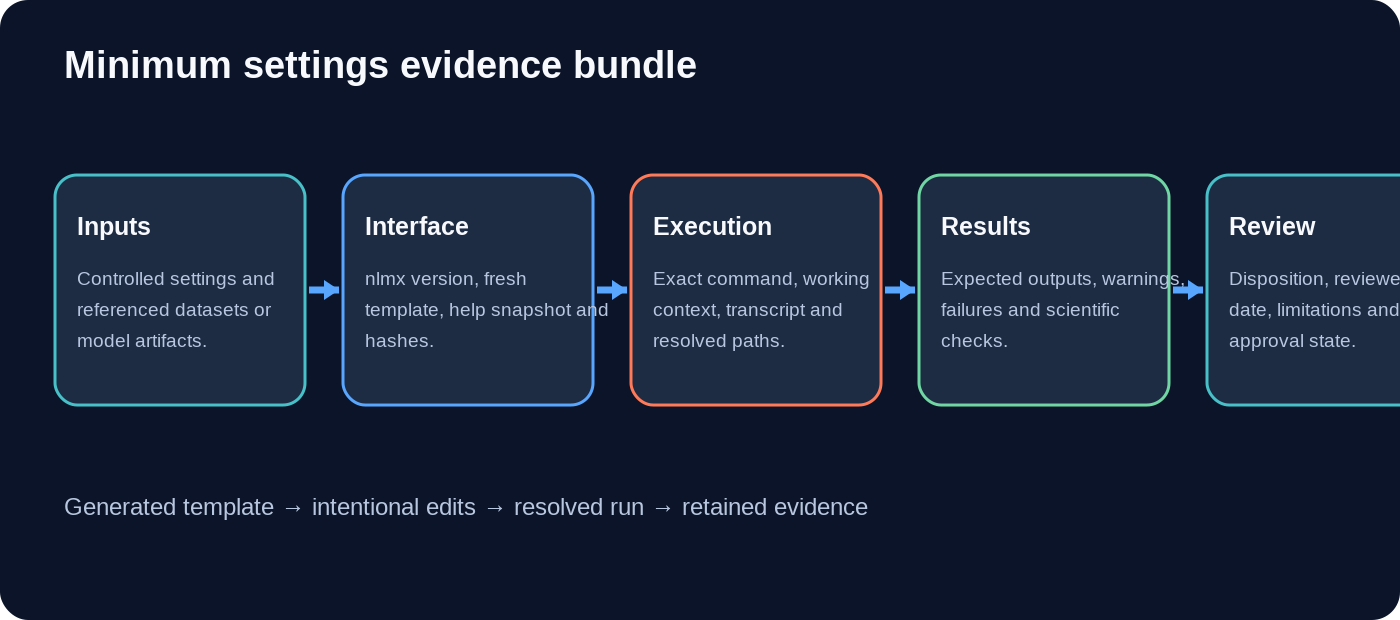
This is the exhaustive generated-template catalogue for nlmx.screen in nlmx 4.16.2. It contains 63 unique dotted key paths. “Active” means the generated example assigns the key; “commented example” means the template exposes it without assigning it. The value column is a template value or example—not automatically the program default. Defaults and constraints are reported only when the nearby template annotation states them.
How to use the table
Search by the full table and key context. Preserve TOML type: do not quote numbers or Booleans, and do not replace an array with a comma-separated string unless the template explicitly uses a string grammar. When two settings interact, use the orientation page and command chapter to review the combination rather than interpreting rows independently.
data
| Key | Type | Template state | Generated value/example | Template annotation and constraints |
|---|---|---|---|---|
file |
string | commented example | "data/pk.csv" |
The dataset: a delimited text file (comma, tab or whitespace) with a header row. Rows starting with # or @ are skipped (as NONMEM IGNORE=#/@). --data or the positional argument |
id |
string | active | "ID" |
Column names (matched in any case). Only ID, TIME, DV and AMT are needed. --id-col |
time |
string | active | "TIME" |
--time-col |
dv |
string | active | "DV" |
--dv-col concentrations |
amt |
string | active | "AMT" |
--amt-col dose amount (> 0 on dose rows) |
evid |
string | active | "EVID" |
--evid-col optional: else AMT > 0 = dose |
mdv |
string | active | "MDV" |
--mdv-col optional: else inferred from EVID |
cmt |
string | active | "CMT" |
--cmt-col optional: tells IV from oral doses |
rate |
string | active | "RATE" |
--rate-col optional: RATE > 0 = infusion |
addl |
string | active | "ADDL" |
--addl-col optional: additional doses |
ii |
string | active | "II" |
--ii-col optional: dosing interval |
ss |
string | active | "SS" |
--ss-col optional: steady-state doses |
route |
string | active | "auto" |
The route found and the evidence are printed and logged. It decides the candidates: absorption models for oral data, none for IV, absorption with F1 for mixed data (see [models] a… |
filter |
string | commented example | 'C != "XYZ"' |
rows that fail it are left out (doses and observations); a subject with no rows left disappears. Text values in quotes compare as text; an empty cell is "" (kept by != "XYZ"). Ope… |
obs_filter |
string | commented example | "BLQ == 0" |
# or 'SITE %in% c("A", "B")' Observation filter: only observation rows are tested; doses are always kept. --obs-filter e.g. 'DVID == 1' |
groups |
array | active | [] |
or route. All subjects are fitted together (each with its own doses); the groups are used to detect the route per group and to summarise the regimens in the listing and report. --… |
lloq |
number | commented example | 0.05 |
--lloq values below are left out (M1) |
blq |
string | commented example | "BLQFL" |
--blq-flag column flagging BLQ observations (non-zero) |
dv_log |
Boolean | active | false |
--dv-log DV is ln(concentration) |
models
| Key | Type | Template state | Generated value/example | Template annotation and constraints |
|---|---|---|---|---|
compartments |
array | active | [1, 2, 3] |
The candidate structural models (names such as 2cmt_abs_lag, 1cmt_noabs_tmdd). --compartments 1,2,3 numbers of compartments |
absorption |
string | active | "auto" |
--absorption |
lag |
string | active | "no" |
(Savic et al. 2007: MTT, NN; $DES) for each number of compartments, e.g. 1cmt_abs_transit; single or widely spaced doses (the input follows the most recent dose) --lag no | yes | … |
eta |
array | active | ["CL", "V", "KA"] |
and without an absorption lag, ALAG1) --eta CL,V,KA parameters with between-subject |
error |
string | active | "combined" |
KA, Q, VP, Q2, VP2, ALAG, KINT, KSS, RTOT, VMAX, KM; an ETA on a parameter a model lacks is ignored; [] (or --eta none) for no random effects --error combined | proportional | add… |
prune_eta |
Boolean | active | true |
(with dv_log: exponential, additive on log scale) --keep-eta turns it off: refit without an ETA |
tmdd |
string | active | "auto" |
whose variance collapses (omega² < 0.001) or cannot be estimated (RSE > 100 %) --tmdd target-mediated drug disposition |
only |
array | commented example | ["1cmt_abs", "2cmt_abs"] |
mm : Michaelis-Menten elimination (VMAX, KM) both : QSS and Michaelis-Menten (recommended: QSS starts from MM) TMDD models have 1 and 2 compartments and are fitted as ODEs ($DES).… |
estimation
| Key | Type | Template state | Generated value/example | Template annotation and constraints |
|---|---|---|---|---|
approximation |
string | active | "foce_i" |
--approximation foce_i | foce | fo | laplace | |
max_iterations |
integer | active | 300 |
saem (SAEM with an importance-sampling OFV) --max-iterations per model |
covariance |
Boolean | active | true |
--no-cov-step / --cov-step covariance step |
gradient_tolerance |
number | commented example | 1e-3 |
(needed for RSE and the condition number) --gradient-tolerance convergence tolerance |
parallel_models |
Boolean | active | true |
--serial-models turns it off: fit independent |
initial
| Key | Type | Template state | Generated value/example | Template annotation and constraints |
|---|---|---|---|---|
source |
string | active | "autoinit" |
Starting values. By default they come from autoinit (NCA, least squares and machine learning on the dataset); larger models start from the final estimates of their parent model. A… |
theta |
inline table | commented example | { CL = 3.5, V = 40, KA = 1.2, Q = 4, VP = 60 } |
theta needs at least CL and V) Overrides (generic names, as in [models] eta; F1 too): --init CL=3.5,V=40 |
omega |
inline table | commented example | { CL = 0.1, V = 0.1, KA = 0.3 } |
--init-omega CL=0.1 |
sigma_prop |
number | commented example | 0.2 |
--sigma-prop proportional error (CV) |
sigma_add |
number | commented example | 0.05 |
--sigma-add additive error (SD, DV units) |
autoinit
| Key | Type | Template state | Generated value/example | Template annotation and constraints |
|---|---|---|---|---|
method |
string | active | "auto" |
Settings of the initial-estimate step (see nlmx autoinit). --init-method auto | nca | nls | ml |
ml_samples |
integer | active | 2000 |
--ml-samples simulations per subject (ML) |
min_r2 |
number | active | 0.8 |
--min-r2 NCA terminal phase, adj. R² |
max_extrap |
integer | active | 30 |
--max-extrap NCA: largest extrapolated AUC % |
omega |
string | active | "robust" |
--omega-method robust (MAD) | variance |
seed |
integer | active | 20240611 |
--seed ML and SAEM random seed |
selection
| Key | Type | Template state | Generated value/example | Template annotation and constraints |
|---|---|---|---|---|
criterion |
string | active | "bic" |
--criterion |
lrt_alpha |
number | active | 0.01 |
aic : lowest AIC lrt : stepwise likelihood-ratio tests of nested models within each absorption family, then BIC between the families --lrt-alpha significance level of the LRT |
bic_penalty |
string | active | "bicc" |
--bic-penalty the sample size in the BIC penalty |
require_covariance |
Boolean | active | false |
obs : ln(observations) for every parameter (NONMEM/PsN convention; the only choice before 2.26.0) subjects : ln(subjects) for every parameter (Monolix's BIC) --require-cov recomme… |
max_rse |
integer | active | 50 |
covariance step succeeded --max-rse a structural THETA with a larger |
max_condition |
integer | active | 1000 |
RSE (%) makes a model "imprecise" --max-condition condition number of the |
max_shrinkage |
integer | commented example | 40 |
structural THETAs; disqualifies only together with imprecise estimates --max-shrinkage ETA shrinkage (%) limit |
output
| Key | Type | Template state | Generated value/example | Template annotation and constraints |
|---|---|---|---|---|
directory |
string | commented example | "pk_screen" |
--output default: |
html |
Boolean | active | true |
report.html |
fit_reports |
Boolean | active | true |
keep each fit's own report.html in models/ |
plots
| Key | Type | Template state | Generated value/example | Template annotation and constraints |
|---|---|---|---|---|
enabled |
Boolean | active | false |
Publication plot of the screen (plots/delta_bic.png or delta_aic.png), in the style of ggplot2's theme_classic(). Any --plot-* option turns it on. --plots |
width |
integer | active | 7 |
--plot-width in units |
height |
integer | active | 5 |
--plot-height |
units |
string | active | "in" |
--plot-units in | cm | mm | px |
dpi |
integer | active | 300 |
--plot-dpi PNG resolution |
base_size |
integer | active | 11 |
--plot-base-size base font size (points) |
format |
string | active | "png" |
--plot-format png | svg | both |
title |
Boolean | active | true |
--plot-no-title turns it off |
legend |
Boolean | active | true |
--plot-no-legend turns it off |
plots.colors
| Key | Type | Template state | Generated value/example | Template annotation and constraints |
|---|---|---|---|---|
outer |
string | commented example | "#2A78D6" |
the bars of the Δ chart (the other vpc colour |
Catalogue review checklist
- The key appears under the intended table and uses the exact spelling.
- Its TOML type matches the generated example.
- Any stated enumeration, range or unit is satisfied.
- Required companion keys and mutually exclusive choices are reconciled.
- Relative paths resolve from the documented base.
- CLI overrides are recorded with the run.
- The effective value and its scientific consequence are reviewed in output evidence.
Source snapshot: nlmx.screen.
Navigation
See the previous page, next page, and complete settings reference.