Multi-covariate scenarios and joint support
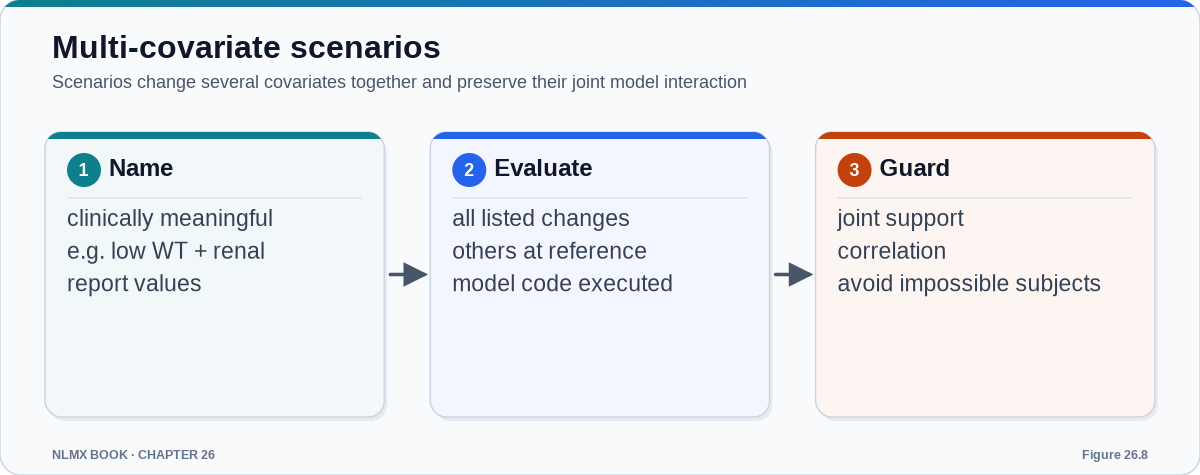
--scenario "Low weight renal impairment:WT=50,EGFR=45" evaluates several covariates together. Settings files use [[scenarios]] with a name and values map. Scenarios are valuable when clinical questions concern realistic combinations rather than isolated one-at-a-time changes.
The model's full code determines the joint effect, including interactions, nonlinearities, and conditional logic. In a multiplicative power model, individual effects compound. The Chapter 26 scenario produces CL ratio about 0.50 and inverse-CL ratio about 1.99, larger than either single change.
Joint support is essential. A combination can lie inside each marginal range but outside the observed multivariate distribution because WT, renal function, age, and disease are correlated. Document subject support or simulation rationale and distinguish extrapolative scenarios visually or in notes.
Common mistakes
- Treating a forest ratio or reference-band class as covariate-selection evidence, causality, or an automatic dosing recommendation.
- Omitting the reference subject, uncertainty source, regimen, subgroup denominator, data support, or fitted-model diagnostics.
- Confusing parameter-uncertainty intervals, BSV ranges, and subject-bootstrap intervals because they share one graphic.
Page checklist
- The numerator, denominator, fitted model, covariate settings, and units are explicit.
- The interval source and clinical meaning are distinguished from BSV and selection uncertainty.
- Tables, resolved settings, commands, diagnostics, limitations, and confirmation evidence are retained.