40.16 Migrating a NONMEM analysis to nlmx
What you will learn
- Inventory records and method before running
- Validate frozen predictions and OFV
- Qualify fitting, covariance, simulation, and outputs separately
Prerequisites: Chapter 39 troubleshooting, Chapter 36 command reference, and Chapter 38 output reference.
This page is scoped to nlmx 4.16.2 and an external-documentation snapshot of 2026-11-10. Product names describe different system boundaries; a blank or “outside role” is not a quality ranking. Treat every migration as a new implementation until model semantics, analysis population, objective definition, numerical behavior, outputs, and decisions have been independently reconciled.
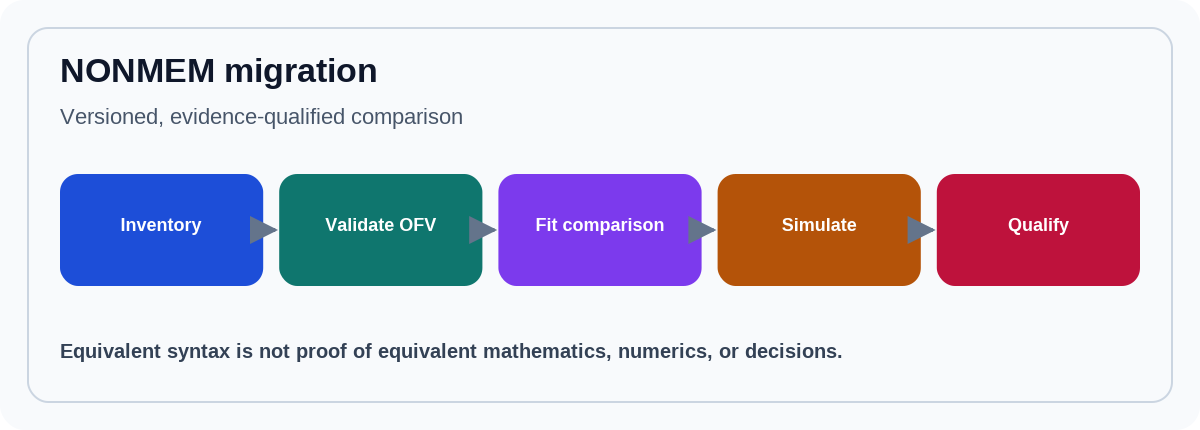
Begin with an immutable NONMEM evidence bundle: .ctl/.mod, exact data, .ext, .cov, .cor, .phi, tables/listing, NONMEM version, command/options, and successful/failed statuses. Run nlmx inspect and validate before fitting. Resolve every refused/ignored record and review ETA-to-parameter/effect mapping.
Reconcile $DATA/$INPUT, IGNORE/ACCEPT, predose policy, event ordering, and model support. Compare ETA=0 and selected individual predictions, then evaluate the NONMEM final parameters in nlmx with the same approximation. The local guide treats an unexplained deterministic OFV gap around 0.1 as evidence that interpretation still differs; use problem-specific tighter/looser criteria justified by scale and numerical precision.
Only after frozen evaluation agrees should you compare optimization. Start from identical estimates and compare final OFV/parameters, gradients, boundary/convergence, covariance matrix on a common scale, individual estimates, residuals, and diagnostics. For SAEM/IMP use MC uncertainty and multiple draws/seeds.
Unsupported records/methods remain in NONMEM. A translated supported model is new and must be named/versioned accordingly. Preserve both systems' outputs; do not overwrite the regulatory/source model.
Recommended comparison sequence
Use one small analytic model first, then the real model. For each: inspect; validate; prediction sentinels; evaluation at NONMEM estimates; fit from the same starts; covariance comparison; simulation moments; and required diagnostics. Add complexity one feature at a time—correlated OMEGA, IOV, infusion, SS, $DES, censoring—so the first failing layer is identifiable. Do not begin with the largest production model and a final-parameter comparison only.
Primary source note: Use the release-matched ICON manuals, beginning with the pdfNONMEM 7 technical guide, rather than relying on syntax remembered from another version.
Review checklist
- Are the exact product versions, task boundaries, inputs, methods, and settings named?
- Were semantics and frozen-parameter results aligned before optimized outputs?
- Is the comparison using a method-appropriate deterministic or stochastic tolerance?
- Are unsupported or analogous features described without implying equivalence?
- Can every claim be reproduced from retained primary evidence?
Navigation
See the previous page, next page, and complete comparison reference.