22.28 Forward, backward, both, and threshold interpretation
Forward and backward stages ask different conditional questions. Forward asks whether adding a candidate improves the current model. Backward asks whether removing an included term degrades the current model enough to retain it.
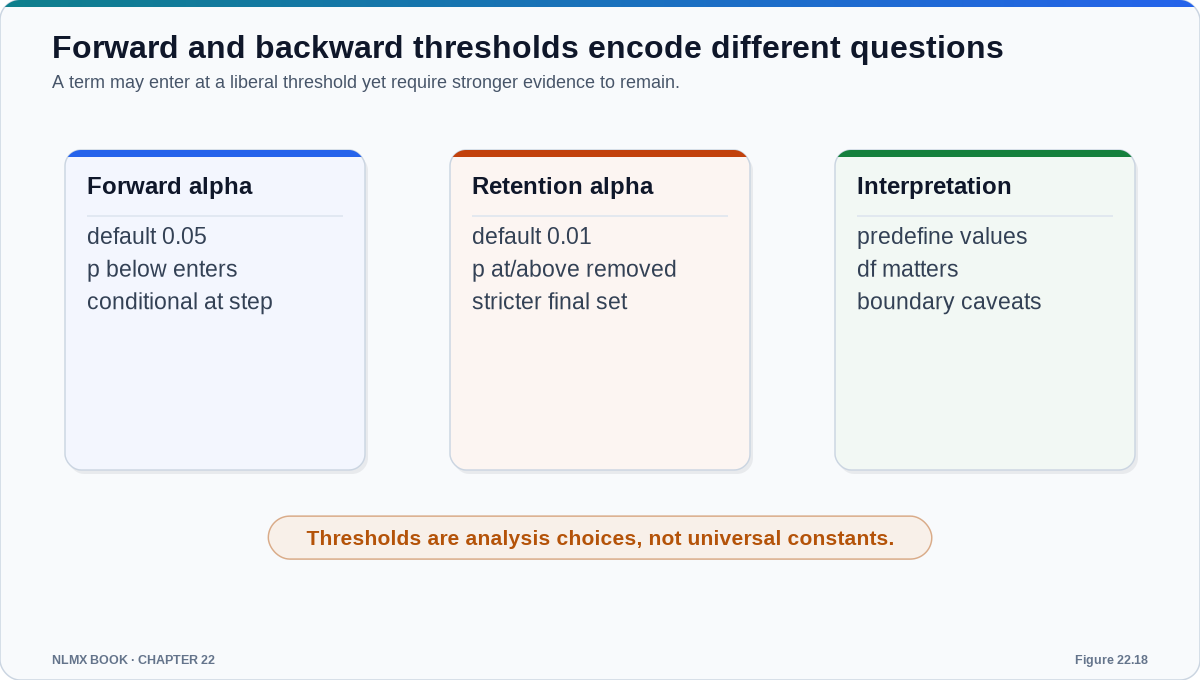
The default forward alpha is 0.05 and retention alpha is 0.01. Because retention is stricter, a term can enter during forward selection but leave during backward elimination after competitors enter. These values are defaults, not universal pharmacometric laws. PsN workflows often use project-specific p-forward/p-backward values.
--scm-direction forward stops after inclusion. backward begins from the full scoped model, which can be difficult or nonconvergent when scope is large. both is the usual forward-then-backward path. The frozen engine’s conditional selection uses analogous thresholds but score evidence rather than stepwise refit LRTs.
Degrees of freedom matter for multilevel categorical or spline effects. Boundary and nonstandard hypotheses may violate simple chi-square assumptions. Prespecify thresholds, df treatment, and confirmation rules.
Selection paths are order-dependent under correlated covariates. Record every step rather than reporting only the final set.
Thresholds as operating characteristics
Forward alpha controls how readily complexity enters; retention alpha controls how strongly an entered term must perform after competition. A common design uses a more permissive forward threshold and a stricter backward threshold, but the values should be justified for the scope size, method, and validation precedent. P-values are conditional on the current path and are not immutable properties of relationships. forward alone can retain terms that become redundant later; backward alone requires a credible estimable full model; both combines the stages but remains path-dependent. Record inequalities precisely—especially whether equality enters or removes—and conduct sensitivity near decision boundaries rather than rounding p-values.
Common mistakes
- Assuming retention alpha is more liberal because it is smaller.
- Starting backward-only from an unstable full model without review.
- Comparing score and refit p-values as identical.
- Ignoring df for multi-parameter relationships.
- Hiding terms that entered and later left.
Checklist
- Choose direction based on purpose and scope.
- Prespecify entry and retention thresholds.
- Review df and nonstandard hypotheses.
- Inspect convergence at each decisive step.
- Report the complete path and order dependence.
Further reading
See SCM, multiplicity, and Chapter 23A.