22.22 Relationship status, mandatory terms, and competition rules
Detailed configuration can mark a relationship as test, always_include, or always_exclude. Use these states to encode the analysis plan rather than forcing every scientific decision through statistical thresholds.
always_include is appropriate for required design adjustments, established mechanistic effects, or prespecified structural scaling. It enters the starting model and is not eliminated like an exploratory term. always_exclude documents a considered but prohibited relationship. test enters the selected method.
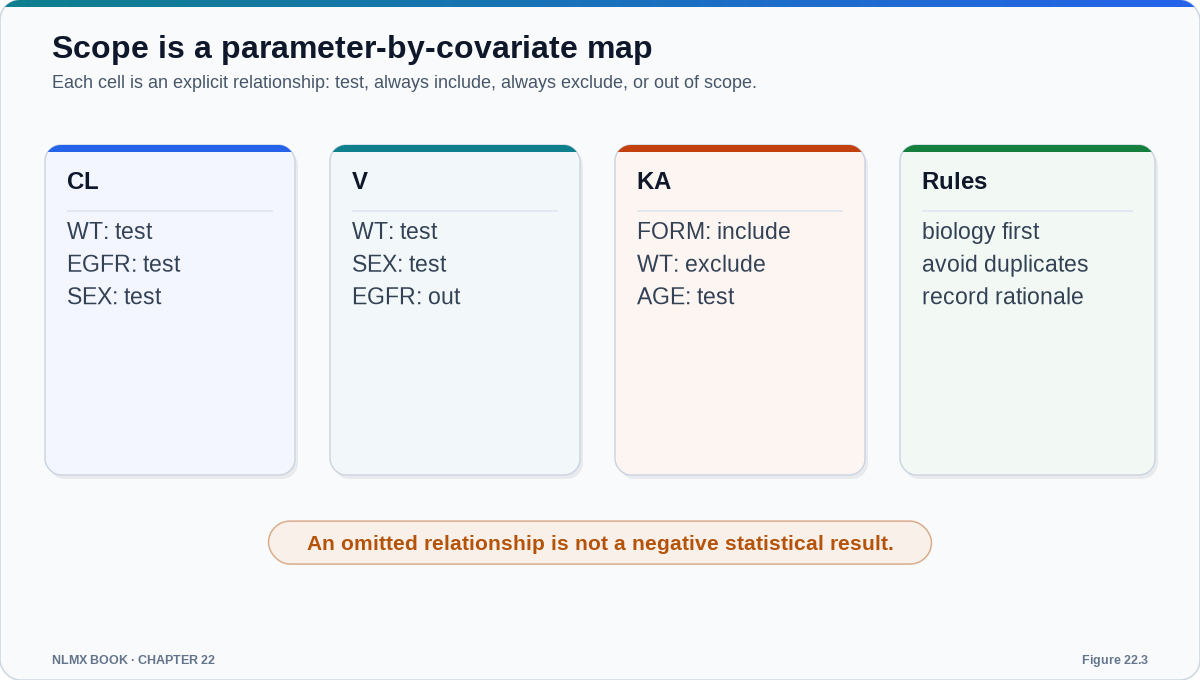
Competition rules address redundant representations or covariates. Although the simple configuration lists candidates, advanced analysis planning should record pairs that should not coexist, alternative equations, or hierarchical relationships. Where configuration lacks a direct competition construct, restrict scope or interpret conditional paths explicitly.
Hierarchy may require a main effect before interaction or a structural term before a modifier. nlmx’s standard equation catalogue does not include general covariate–covariate interactions; custom extensions must be preplanned and confirmed separately.
Mandatory terms affect every likelihood comparison and coefficient interpretation. Report them separately from selected terms. A final model with three retained and two mandatory relationships is not a “three-covariate model.”
Status as an analysis-plan control
Use always_include for relationships that define the intended base parameterization or are required by strong prior evidence, not to guarantee a desirable result. Use always_exclude for impossible, prohibited, duplicated, or deliberately out-of-scope pairs. Leave genuine hypotheses as test. Status affects which model other candidates are tested against, so changing it can change every conditional result. Record who made the decision, when, and why. After the run, verify that mandatory terms appear in the final draft and excluded terms were never evaluated. A sensitivity analysis that changes statuses belongs in a separate output directory with a separately labeled estimand and decision record.
Common mistakes
- Testing mandatory design adjustments for significance.
- Hiding excluded relationships by omitting rationale.
- Allowing mutually redundant terms to coexist unreviewed.
- Ignoring hierarchy when designing scope.
- Reporting mandatory and selected effects as equivalent evidence.
Checklist
- Label every relationship’s status and rationale.
- Identify mandatory, prohibited, and competing effects.
- Enforce hierarchy in scope and interpretation.
- Report mandatory and selected terms separately.
- Preserve the resolved status map in normalized configuration.
Further reading
Continue with method selection, scope declaration, and Chapter 23A SCM.