22.24 Frozen efficient-score selection
The frozen engine screens candidates using derivatives and efficient information at the completed base-model solution. It avoids full estimation for every candidate, which provides the main speed advantage.
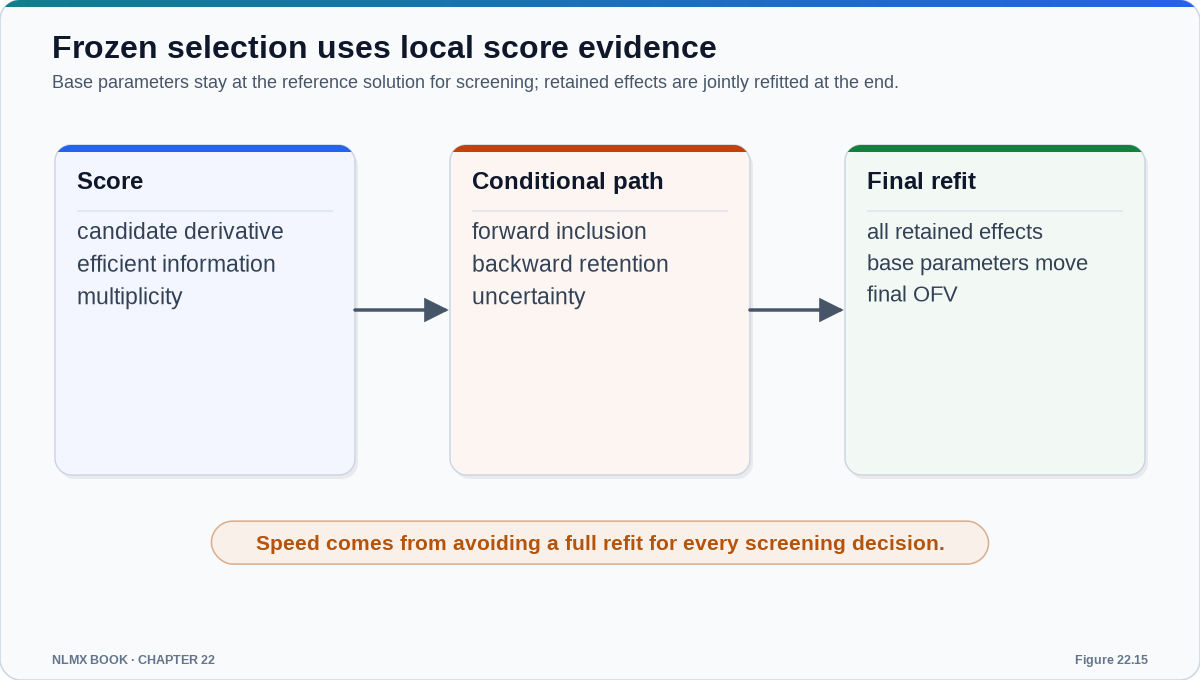
Default hierarchical-conditional selection starts with univariate evidence, adds the best conditional candidate below --alpha (default 0.05), repeats, then removes retained terms whose conditional p-value is at or above --retention-alpha (default 0.01). Other --selection modes include univariate, all-joint, and refit-scm.
--information efficient|candidate-only, --information-estimator opg|observed, and --nuisance-information observed|from-cov control information construction. --fd-rel controls finite-difference scale where applicable. --write-subject-scores and --write-matrices expose detailed evidence for validation.
Multiplicity adjustment uses --adjust. Calibration may use permutation or parametric bootstrap with specified replicates. --refine N can refit the most significant candidates. Base-parameter uncertainty can be propagated using COV draws unless --no-uncertainty is chosen.
The final joint refit is crucial: one-step screening coefficients are local approximations. In the Chapter 22 teaching run, frozen selection retained V–WT but classified true CL–WT and CL–EGFR signals as uncertain under its strict backward threshold; SCM refits retained all three. This is an instructive method difference, not a frozen-engine failure.
When a frozen result needs escalation
A score test evaluates movement away from the frozen base solution without fully optimizing every candidate model. It is most credible for small local perturbations around a well-fitted base and can be less reliable for large effects, strong nonlinearity, boundaries, correlated candidates, or changing random-effect behavior. Review stationarity, information-matrix diagnostics, ridge repairs, refined candidates, and agreement between univariate and conditional stages. Treat uncertain as an instruction for further work, not a negative result. Refit effects near thresholds, effects with important clinical consequences, and effects whose one-step estimate would move the model far from the base. Chapter 23 will define the accuracy envelope quantitatively.
Common mistakes
- Reporting one-step beta as the final coefficient.
- Treating uncertain as rejected.
- Calling conditional score selection full SCM.
- Ignoring stationarity and information diagnostics.
- Disabling uncertainty solely to obtain cleaner classifications.
Checklist
- Review base-solution stationarity and information settings.
- Record selection, adjustment, calibration, and thresholds.
- Distinguish univariate, conditional, and refit evidence.
- Inspect uncertainty pass probabilities.
- Use the joint refit for final estimates.
Further reading
See Chapter 23 for derivations, the worked comparison, and uncertainty.