Parameter uncertainty and SCM classification
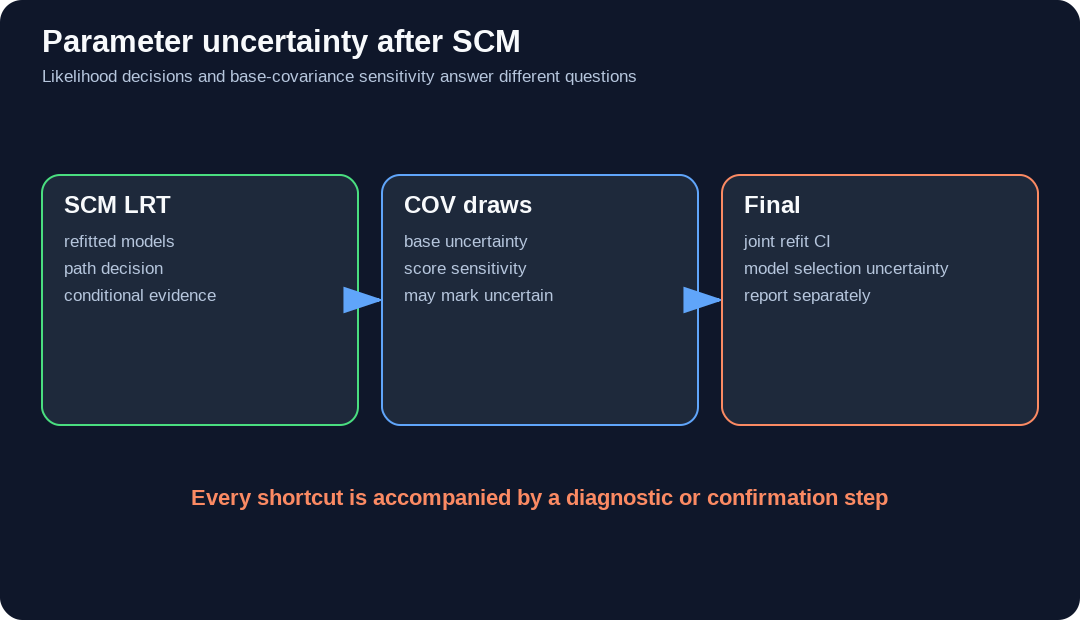
SCM path decisions are based on likelihood refits. Separately, nlmx can propagate base-parameter covariance uncertainty through frozen-score calculations when a usable .cov is available. These procedures answer different questions and should not be merged into a single p-value narrative.
The refit path itself does not create a score-style “uncertain” class. However, the broader covariate workflow may flag sensitivity when covariance draws cause evidence to change. Final joint-model confidence intervals quantify parameter uncertainty conditional on the selected model; they do not include model-selection uncertainty or guarantee repeated-sample path stability.
Report path evidence, base-parameter sensitivity, final coefficient uncertainty, and resampling stability separately. If .cov is unreliable or unavailable, say so. Do not use many uncertainty draws to compensate for a poorly converged base or final model.
Common mistakes
- Treating a stepwise p-value as clinical importance or causal proof.
- Reading a candidate comparison without its active model, convergence state, degrees of freedom, and exact threshold.
- Reporting only the terminal relationship list while discarding failed models, path decisions, configuration, and provenance.
Page checklist
- The scientific question, model identities, and comparison direction are explicit.
- Numerical validity is reviewed before interpreting statistical evidence.
- The result is linked to the complete trace and final joint-model diagnostics.