Likelihood-ratio statistic, degrees of freedom, and p-values
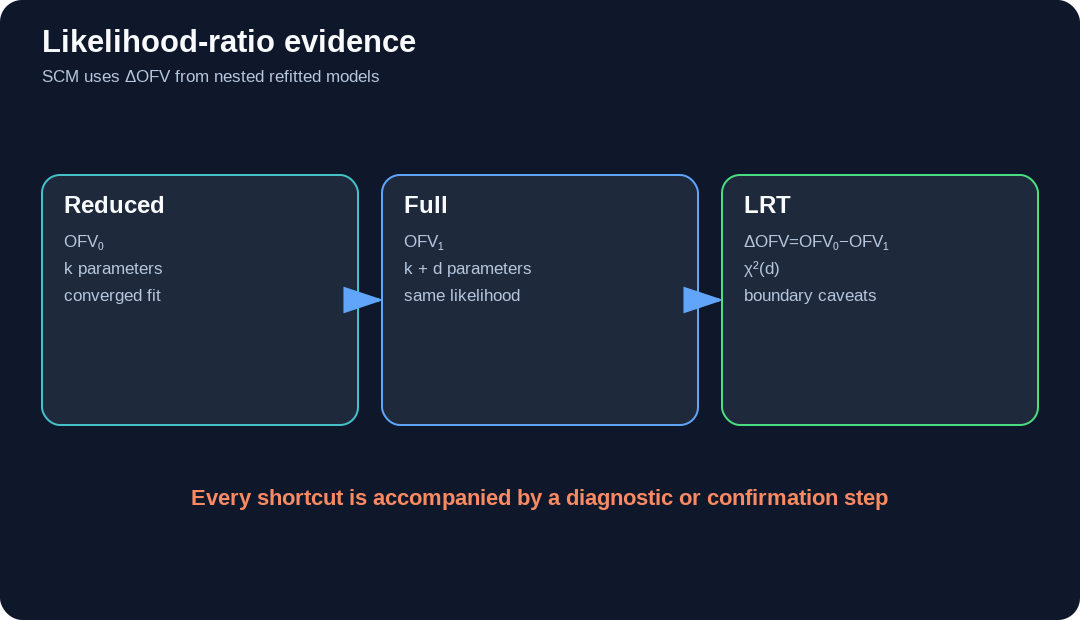
For comparable nested fits, nlmx uses ΔOFV = OFV_reduced − OFV_full. A positive value favors the full model. Under regular asymptotic conditions, ΔOFV is compared with a chi-square distribution whose degrees of freedom equal the number of independently added or removed coefficients. A one-coefficient effect uses one degree of freedom; a categorical block with three non-reference contrasts uses three.
The p-value is a model-comparison quantity, not the probability that the covariate effect is real. It does not measure clinical importance, estimate selection stability, or correct for all searched paths. Sparse categories, boundary parameters, weak identifiability, small samples, and data-driven equation choices can make the nominal chi-square calibration optimistic.
Do not round before applying a threshold. Forward entry is the strict test p < alpha; backward retention is also strict, so p >= retention_alpha is eligible for removal. Report ΔOFV, df, exact stored p-value, convergence status, and the two model identities together.
Common mistakes
- Treating a stepwise p-value as clinical importance or causal proof.
- Reading a candidate comparison without its active model, convergence state, degrees of freedom, and exact threshold.
- Reporting only the terminal relationship list while discarding failed models, path decisions, configuration, and provenance.
Page checklist
- The scientific question, model identities, and comparison direction are explicit.
- Numerical validity is reviewed before interpreting statistical evidence.
- The result is linked to the complete trace and final joint-model diagnostics.