20.12 $THETA: records, bounds, labels, and fixed values
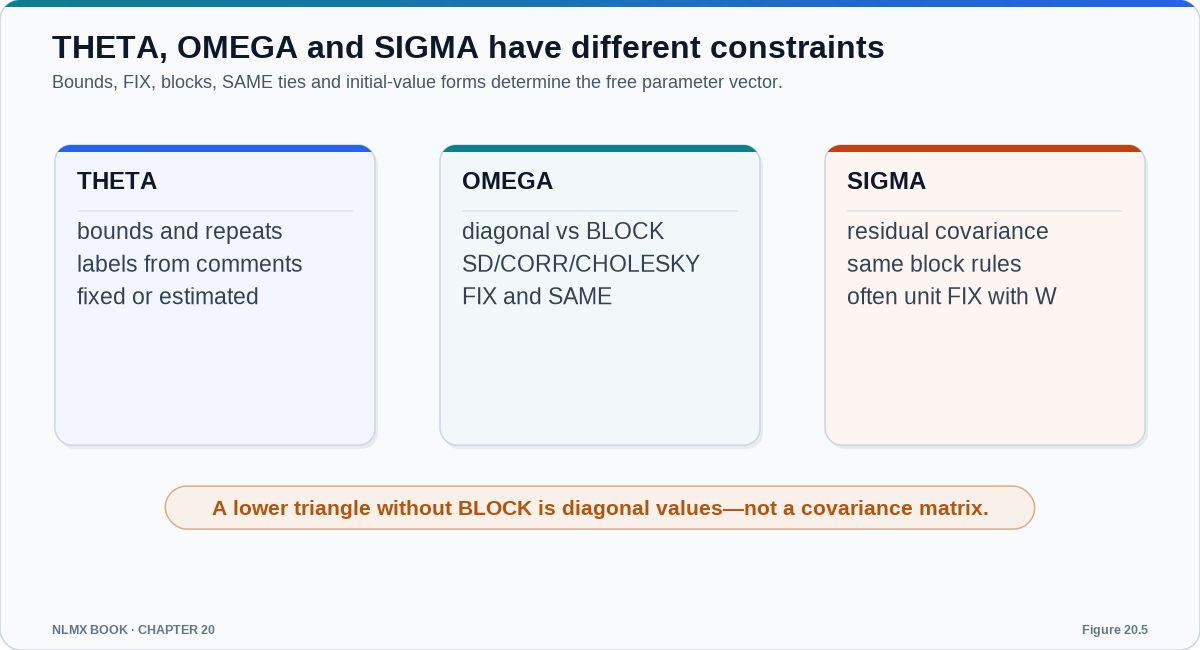
Supported forms include init, (low,init), (low,init,up), infinite bounds, FIX, and repeat syntax (…)xN. A comment on a line containing one THETA becomes its output label; use units and meaning.
Estimated THETAs optimize on transformed coordinates described in Chapter 18. Bounds prevent illegal values but can create boundary estimates. Fixed THETAs remain outside free parameter/covariance vectors.
Review starting value inside bounds and scientific scale. A value near a boundary is flagged relative to its initial distance. Repeated syntax saves text but can obscure labels; expand mentally/in documentation.
Design initials and bounds scientifically
Initial values should be plausible on the declared scale and consistent with units. Derive them from literature, exploratory noncompartmental results or a simpler stable model, and record the source. Use multiple dispersed starts when local optima are possible. A single converged start does not establish robustness.
Bounds express mathematical or scientific restrictions, but overly narrow bounds can manufacture stability. Review estimates close to either bound, gradients on the internal scale and the effect of alternative parameterizations. Positive quantities often behave better on a log scale; proportions may need a logit-type transformation. Keep the reported biological scale distinct from the optimizer scale.
FIX removes a quantity from estimation; it does not make its assumed value certain. Sensitivity analyses may be required when fixed values influence conclusions. Labels should be unique and concise, while a separate dictionary records full meaning, units and transformations.
Common mistakes
Do not use tight bounds to force expected estimates, omit units in labels, or assume FIX values receive SEs. An initial value exactly at bound can make transformations/problem interpretation difficult.
Checklist
- Count expanded THETAs.
- Verify bounds/init/FIX.
- Label meaning and units.
- Check model use and scaling.
- Review boundary warnings.