35.14 Every [policy] and max-values setting
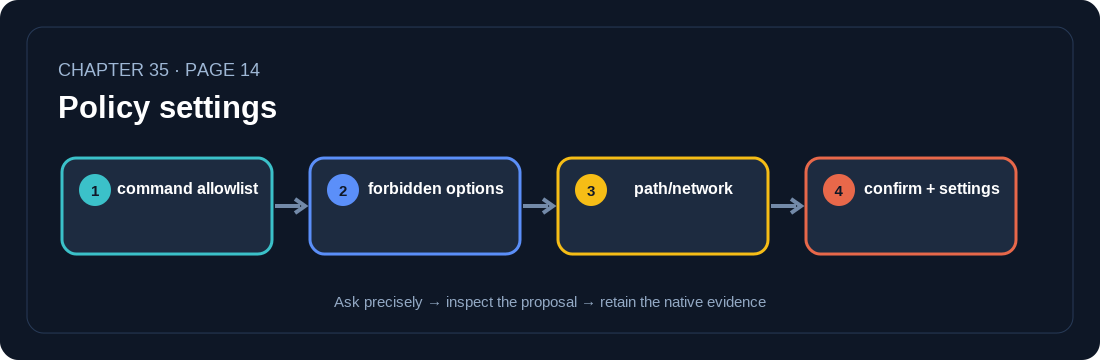
commands is the allowlist; omitting it uses compiled defaults, while the generated template writes an explicit list that currently omits power. forbid_options adds to five non-removable built-ins. read_dirs adds readable roots.
How to use it
confirm is every/long/none; allow_yes=true; allow_remote_server=false; settings_files=true. [policy.max_values] defaults cap subproblems 1000, samples 5000, study-replicates 200 and replicates 1000; add or override option caps.
Practical interpretation
Use least privilege per workflow. Relative read_dirs resolve against the .ask file. Adding a command does not make it scientifically appropriate. Disabling settings files weakens reproducibility. Remote-server permission changes data handling.
Designing policy as a deny-by-default layer
Start from the workflow, not the compiled broad default. List only commands required for that workflow, retain built-in forbidden options, add site-specific forbidden flags, and expose only necessary read roots. Set numeric caps below resource or protocol maxima. Decide whether every command or only long-running commands needs confirmation, and whether unattended --yes is allowed at all.
Test policy with paired cases: one that must pass and one that must fail. Include direct CLI options and equivalent values inside settings files, because effective limits must not be bypassed by moving a value into a file. Test symlinks/canonical paths where relevant, remote URLs, outputs outside the session, and attempts to invoke ask recursively. Review policy after an nlmx upgrade because the compiled command catalog can change; an explicit allowlist remains stable but may omit a newly approved command, while an omitted list inherits new defaults.
A safe novice workflow
- Start with the narrowest backend, policy, files and command set that can answer the request.
- Name exact inputs and decisions; use guide or plan-only before granting execution.
- Inspect the normalized command and complete settings file, not only Maxson’s explanation.
- Read request end state, native command result, warnings, outputs and checksums.
- Preserve the session and record the qualified person’s interpretation and disposition.
Review and pitfalls
Version-control site policy separately from user preferences. Validate with mock scripts that each intended command passes and each forbidden action fails, including values hidden in settings files.
- A session exit code of zero does not prove that every proposal ran or succeeded.
- Model fluency, structured JSON, and policy approval do not establish scientific validity.
- Settings and commands are reproducibility inputs; they still require versioned software and frozen data.
What to retain
Retain .ask, backend/model identity, system prompt, request, raw/normalized replies, transcript, JSONL events, settings versions, commands, child logs/outputs, checksums, exceptions, and reviewer conclusions.
Navigation
See the previous page, next page, and complete ask command and settings index.