13A.10 Point, jitter, and text geoms
point is the default relationship geom: each retained row contributes a mark at x and y. It is appropriate for observed-versus-predicted diagnostics, continuous covariate relationships, and residual plots. Opacity and size help with overplotting, but neither restores records hidden exactly beneath other points.
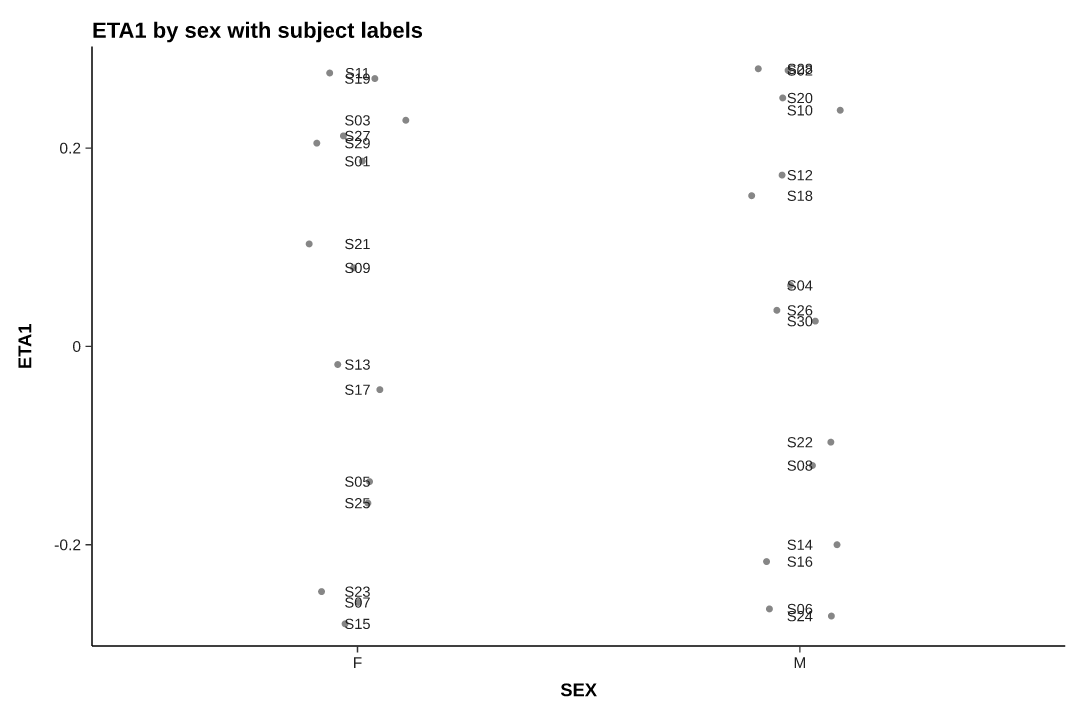
jitter adds deterministic pseudo-random displacement, controlled by --jitter and the style seed. It is most useful when x is categorical and many subjects share the same coordinate. Jitter reveals density but changes displayed coordinates; never read a jittered horizontal position as a measured value.
text draws values from --label at x and y. It is effective for identifying a small set of outliers and unreadable when applied to hundreds of overlapping records. Filter or use head deliberately, and avoid exposing subject identifiers in publication outputs.
Choosing among them
Use point for quantitative position, jitter for repeated categorical positions, and text for annotation. Layering jitter and text, as in the teaching graphic, demonstrates syntax but is intentionally busy; a production figure might label only flagged subjects. Shape, color, size, and alpha can encode additional variables, although more than two or three simultaneous encodings quickly overwhelms novice readers.
For diagnostic scatter plots, identity and equal axes clarify agreement. For residual plots, reference lines at 0 and ±2 create context without converting the display into a hypothesis test.
Common mistakes
- Reading jitter displacement as data.
- Labelling every record in a dense plot.
- Using transparency to claim duplicates are fully visible.
- Publishing source IDs without governance.
Checklist
- Count retained rows and expected marks.
- Decide whether overlap needs jitter, transparency, or aggregation.
- Fix the seed for reproducibility.
- Limit labels to a reviewable subset.
- Use nonidentifying labels when sharing figures.
Further reading
See aesthetics, reference lines, export accessibility, and the diagnostic example.